
Free Safe Operating Procedure (Allergen Segregation) Template
Download our free Safe Operating Procedure for allergen segregation.
Free Safe Operating Procedure (Allergen Segregation) Template
DOCX • 126 KB + PDF
Updated Oct 2026
No signup required
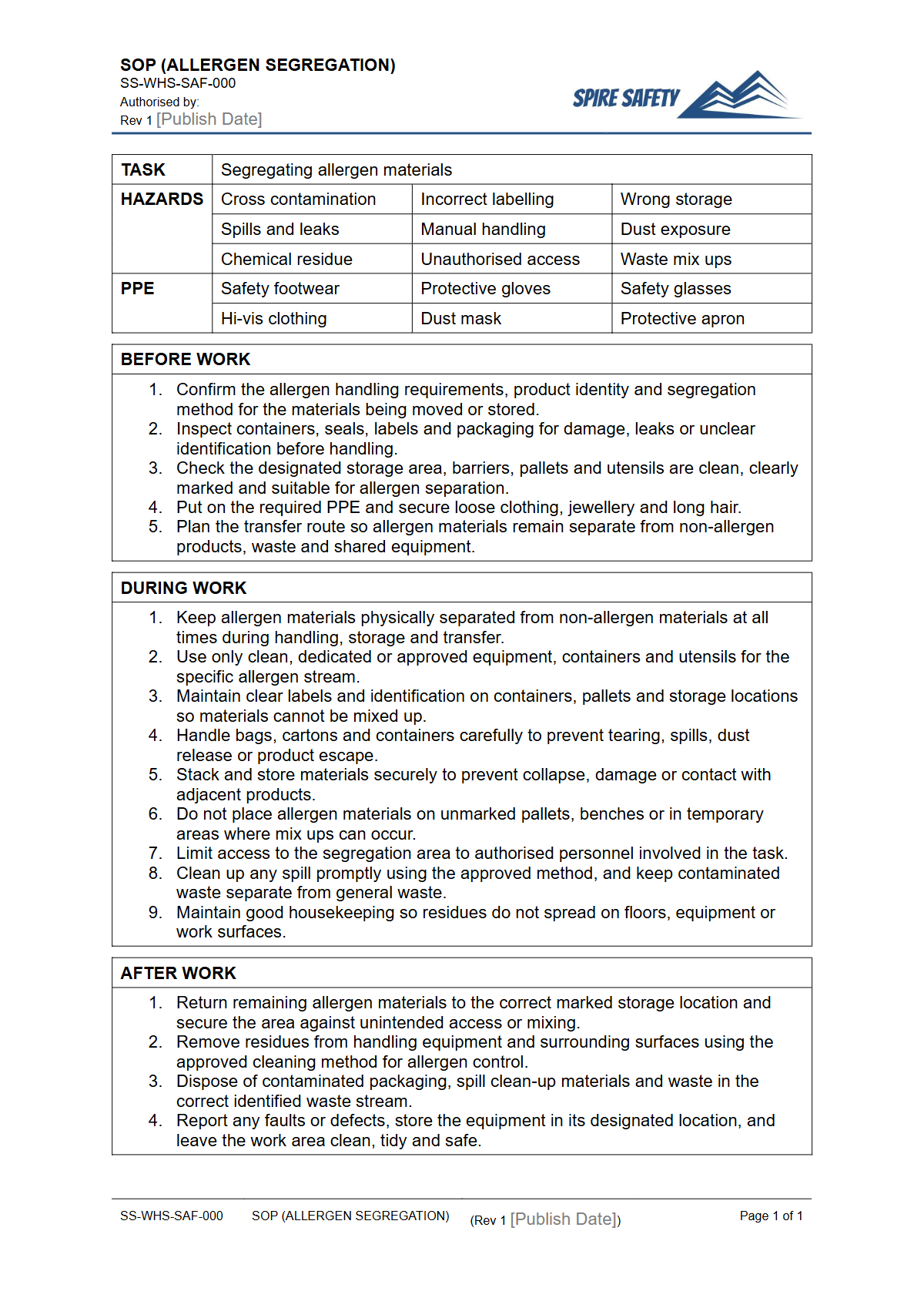
Purpose of the Free Safe Operating Procedure (Allergen Segregation) Template
Managing food allergens is a critical responsibility for any business that prepares, handles, or sells food. Cross-contamination can lead to severe health consequences for customers and significant legal and reputational damage for your organisation.
This Free Safe Operating Procedure (Allergen Segregation) Template provides a structured starting point for documenting the essential controls to prevent the unintended presence of allergens in food. An effective SOP clarifies responsibilities, standardises processes, and serves as a vital training tool for all staff.
By implementing a clear procedure, you demonstrate a commitment to food safety and due diligence, helping to protect your customers, staff, and business. This document is designed to be adapted into a comprehensive workplace procedure, outlining steps for receiving, storing, preparing, and serving food to minimise the risk of allergen cross-contamination.
Video walkthrough
How to use the Free Safe Operating Procedure (Allergen Segregation) Template
This Safe Operating Procedure for allergen segregation is available for download in both DOCX and PDF formats. The DOCX version is fully editable, allowing you to tailor the content to your specific operational needs.
To use the template effectively, you should conduct a thorough review of your own processes. Identify all common allergens handled on-site, map out the flow of ingredients from delivery to service, and assess your current control measures for effectiveness.
This includes evaluating storage areas, preparation surfaces, utensils, and staff training protocols. Integrating this procedure is a key part of developing robust WHS management systems that address all foreseeable hazards in your workplace.
It is crucial to remember that this document is a template. We are not familiar with your specific site, ingredients, or processes.
You must customise this SOP to reflect the actual risks and control measures in your workplace. Involve your team in the customisation process to ensure the procedure is practical and understood by everyone who needs to follow it.
When to use this Safe Operating Procedure
A documented SOP for allergen segregation should be a living document, actively used in daily operations. It is essential during the induction and training of new food handlers, kitchen hands, and service staff to establish clear expectations from day one.
It should also be a reference point for regular refresher training and toolbox talks to reinforce correct practices. The procedure must be reviewed and updated whenever there is a change in menu, ingredients, suppliers, or kitchen layout.
Furthermore, following any incident, near miss, or customer complaint related to an allergic reaction, the SOP should be formally reviewed as part of the investigation process. Regular verification of these procedures through internal checks or formal WHS compliance auditing ensures the controls remain effective over time.
Who should use this document
This Safe Operating Procedure is intended for a wide range of personnel within a food-handling environment. Primary users include chefs, cooks, kitchen hands, and any staff directly involved in food preparation.
Supervisors and managers must use it to train staff and monitor compliance. Additionally, front-of-house staff should be familiar with the key principles to communicate accurately with customers about allergen risks.
Warehouse and receiving staff also play a role, as proper segregation begins the moment ingredients arrive. For businesses needing expert support in implementing such critical controls, engaging external WHS consulting services can provide valuable, site-specific guidance.
Even tasks indirectly related to food prep, like retrieving separately stored ingredients, require procedural safety, similar to how one might use a step ladder SOP to ensure safe access to high shelving. WHS managers and business owners are ultimately responsible for ensuring such procedures are developed, implemented, and maintained.
By standardising your approach to this critical risk, you create a safer environment for everyone. This template is one of many documents available in our free WHS resources library, designed to help Australian businesses improve their safety practices.
Common mistakes
Common mistakes to avoid
- Using the same utensils, cutting boards, or fryer oil for allergen-free and regular meals.
- Relying on memory instead of documented recipes and procedures, especially with new or relief staff.
- Poor communication between front-of-house staff taking orders and kitchen staff preparing them.
- Inadequate labelling of stored ingredients and prepared food, leading to mix-ups.
Legal references
Legal considerations
The following legal requirements may be relevant to this type of work.
- Work Health and Safety Act (Harmonised) — Provides the primary duties for protecting workers and other people from work health and safety risks.
- Work Health and Safety Regulations (Harmonised) — Sets out requirements supporting the management of workplace hazards and risks.
The following codes may be relevant to this type of work.
- Managing WHS Risks Code of Practice — Provides practical guidance on identifying hazards, assessing risks and applying effective controls.
- Work Health and Safety Consultation, Cooperation and Coordination Code of Practice — Provides practical guidance on consulting workers and coordinating with other duty holders.
- Managing the Work Environment and Facilities Code of Practice — Provides practical guidance on safe work environments, workplace facilities and related controls.
Did you know
Allergy Statistics
According to the National Allergy Strategy, Australia has one of the highest rates of documented food allergies in the world, with around 1 in 10 infants and 1 in 50 adults having a diagnosed food allergy.
Hidden Allergens
Allergens can be 'hidden' in unexpected ingredients like sauces, marinades, garnishes, and even cooking oils. This is why reading ingredient labels for every delivery is a critical step in any allergen management plan.
FAQ
Frequently asked questions
01What are the 'Big 9' major food allergens in Australia?
02Is an Allergen Segregation SOP a legal requirement in Australia?
03What is the difference between an allergen-free claim and an allergen statement?
04How often should we train staff on our Allergen Segregation SOP?
Share this resource
Free Safe Operating Procedure (Allergen Segregation) Template
Browse Categories
How To Use It
- 1Download and open in Word or PDF.
- 2Replace the placeholders with your business details.
- 3Get it reviewed by a WHS specialist before rollout.
Need it customised?
Our WHS consultants can adapt this template to your site, run a gap analysis, or audit what you already have in place.
Book a Free Consultation WHS consulting servicesor call 1300 156 382
Related templates
- Free Safe Operating Procedure (Anchor Winch) Template
- Free Safe Operating Procedure (Anemometer) Template
- Free Safe Operating Procedure (Angle Drill) Template
- Free Safe Operating Procedure (Animal Crush) Template
- Free Safe Operating Procedure (Animal Watering) Template
- Free Safe Operating Procedure (Annular Cutter) Template