
Free Safe Operating Procedure (Anchor Winch) Template
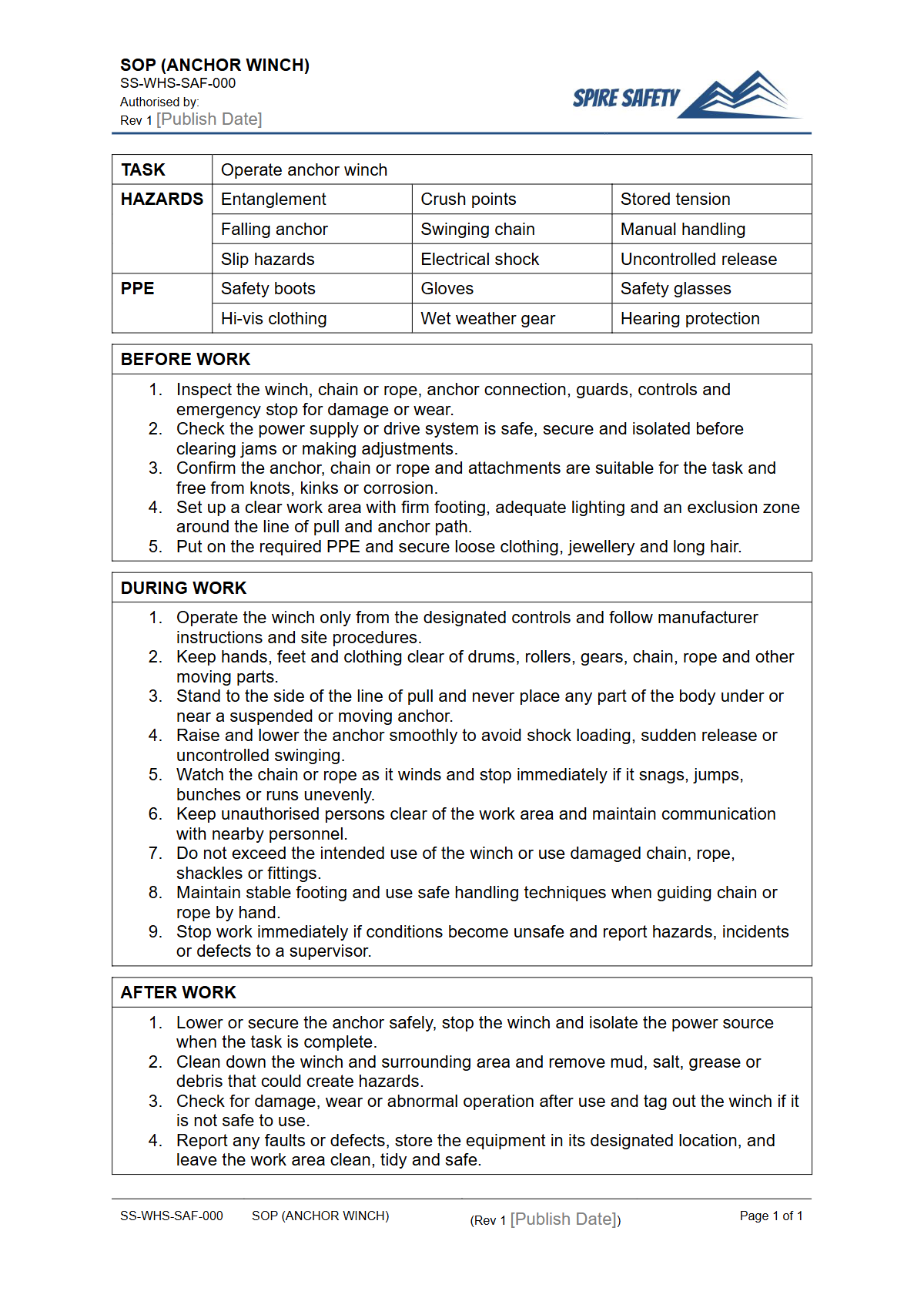
Download our free Safe Operating Procedure (Anchor Winch) template for Australian workplaces.
Free Safe Operating Procedure (Anchor Winch) Template
DOCX • 126 KB + PDF
Updated Oct 2026
No signup required
Purpose of the Free Safe Operating Procedure (Anchor Winch) Template
Operating an anchor winch, whether on a vehicle, vessel, or fixed installation, introduces significant workplace hazards. This free Safe Operating Procedure (Anchor Winch) Template provides a structured starting point for documenting the required steps to operate this equipment safely.
A well-drafted SOP is a critical tool for managing risks like entanglement, crushing, and injuries from equipment failure. It forms an essential part of your risk management strategy, standardises operator conduct, and serves as a key document for training and competency assessments.
By outlining every step from pre-start checks to shutdown, this Safe Operating Procedure helps ensure all personnel follow a consistent, safety-focused process. This systematic approach is fundamental to preventing incidents and is a core component of Australian WHS practice.
For another example of a document that formalises equipment use, you can review our free Telehandler SOP template, which applies similar principles to different machinery.
Video walkthrough
How to use the Free Safe Operating Procedure (Anchor Winch) Template
This document is a template, not a finished procedure. To be effective, you must customise it to reflect the specific anchor winch models, tasks, and environmental conditions at your workplace.
Download the DOCX file and adapt it by incorporating details from your own site-specific risk assessments. We strongly recommend consulting with the winch operators and maintenance staff during this process—their hands-on experience is invaluable for creating a practical and effective procedure.
When customising, ensure you include:
- Equipment specifics: Brand, model, capacity, and unique features of your winch(es).
- Task specifics: Detailed steps for the typical winching tasks performed at your site.
- PPE requirements: List all personal protective equipment required, such as gloves, safety glasses, and high-visibility clothing.
- Emergency actions: Clear instructions for dealing with cable jams, power failure, or other potential emergencies.
When to use this Safe Operating Procedure
An SOP for an anchor winch should be a living document, actively used in daily operations. It is not meant to be filed away and forgotten.
Use it during the induction and training of new operators to establish a baseline for safe performance. It should also be a reference for refresher training and for supervisors conducting competency verifications.
Furthermore, the SOP is a vital reference tool before commencing non-routine or higher-risk winching operations and can be invaluable during an incident investigation to understand deviations from established procedures. Integrating SOPs like this one into comprehensive WHS management systems ensures safety is systematically embedded in your organisation's culture.
Who should use it
This Safe Operating Procedure is intended for a range of personnel. Primarily, it is for the direct users—the anchor winch operators who need clear, unambiguous instructions to perform their work safely.
Supervisors and team leaders must also be intimately familiar with the SOP to oversee work, enforce safe practices, and correct unsafe behaviours. Beyond the front line, WHS managers, safety officers, and trainers will use this document to develop training programs, conduct audits, and ensure organisational processes align with WHS obligations.
The principles of documenting safe use are transferable across heavy machinery, as seen in our free Dozer SOP, which serves a similar purpose for different personnel.
Ultimately, anyone involved in the procurement, operation, maintenance, or supervision of anchor winches has a responsibility to understand and apply the contents of the relevant SOP. If you're looking for more templates to build out your safety documentation, you can browse our entire our free WHS resources library for a wide range of documents covering various plant and equipment.
Common mistakes
Common mistakes to avoid
- Neglecting pre-use inspections of the winch cable, hook, and safety latch.
- Exceeding the winch's rated line pull or operating at unsafe angles.
- Failing to establish and maintain clear exclusion zones during winching operations.
- Using the winch for lifting loads vertically unless it is specifically designed and rated for that purpose.
Legal references
Legal considerations
The following legal requirements may be relevant to this type of work.
- Work Health and Safety Act (Harmonised) — Provides the primary duties for protecting workers and other people from work health and safety risks.
- Work Health and Safety Regulations (Harmonised) — Sets out requirements supporting the management of workplace hazards and risks.
The following codes may be relevant to this type of work.
- Managing WHS Risks Code of Practice — Provides practical guidance on identifying hazards, assessing risks and applying effective controls.
- Work Health and Safety Consultation, Cooperation and Coordination Code of Practice — Provides practical guidance on consulting workers and coordinating with other duty holders.
- Managing the Work Environment and Facilities Code of Practice — Provides practical guidance on safe work environments, workplace facilities and related controls.
Did you know
Winch Cable 'Snap-Back'
A common cause of serious injury is cable snap-back. When a loaded wire rope breaks, it can whip back with enormous force, creating a dangerous zone far wider than the length of the cable itself.
Spooling Matters
Incorrectly spooling the winch cable can cause damage to the rope and the winch drum. Proper, even layering under slight tension is crucial for equipment longevity and safe operation.
FAQ
Frequently asked questions
01What's the difference between a SWMS and an SOP for an anchor winch?
02How often should an anchor winch SOP be reviewed?
03Is this anchor winch SOP template suitable for marine and offshore use?
04Do I still need to provide operator training if we have an SOP?
Share this resource
Free Safe Operating Procedure (Anchor Winch) Template
Browse Categories
How To Use It
- 1Download and open in Word or PDF.
- 2Replace the placeholders with your business details.
- 3Get it reviewed by a WHS specialist before rollout.
Need it customised?
Our WHS consultants can adapt this template to your site, run a gap analysis, or audit what you already have in place.
Book a Free Consultation WHS consulting servicesor call 1300 156 382
Related templates
- Free Safe Operating Procedure (Anemometer) Template
- Free Safe Operating Procedure (Angle Drill) Template
- Free Safe Operating Procedure (Animal Crush) Template
- Free Safe Operating Procedure (Animal Watering) Template
- Free Safe Operating Procedure (Annular Cutter) Template
- Free Safe Operating Procedure (Anodising) Template