
Free Safe Operating Procedure (Airside Waste Collection) Template
Download our free Safe Operating Procedure (Airside Waste Collection) Template.
Free Safe Operating Procedure (Airside Waste Collection) Template
DOCX • 126 KB + PDF
Updated Oct 2026
No signup required
Purpose of the Free Safe Operating Procedure (Airside Waste Collection) Template
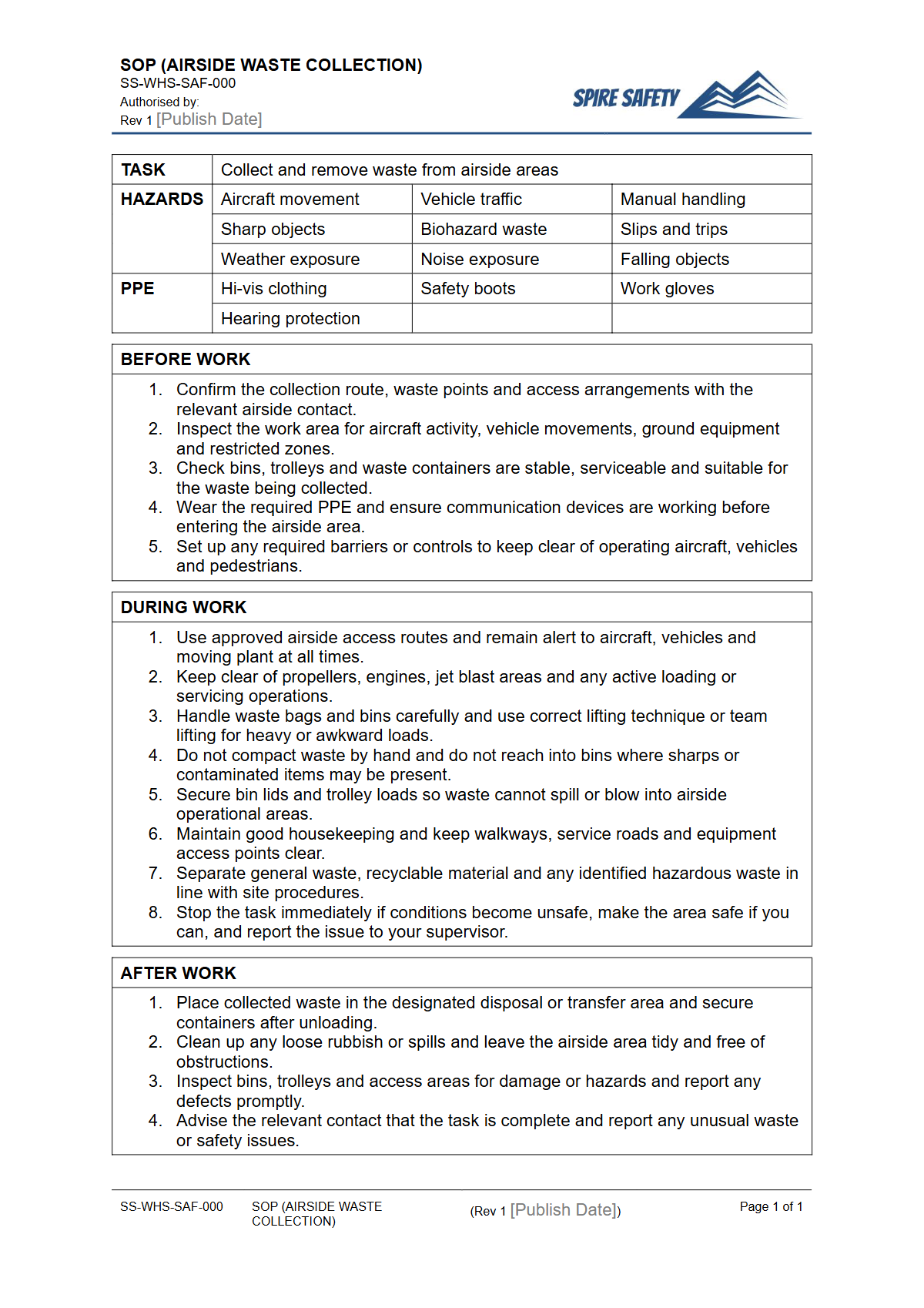
Operating vehicles and collecting waste airside presents a unique and high-risk set of challenges. This Free Safe Operating Procedure (Airside Waste Collection) Template provides a structured starting point for documenting the step-by-step process required to perform this task safely.
Using this Safe Operating Procedure (SOP) helps your organisation manage risks associated with vehicle movements, interaction with aircraft, foreign object debris (FOD), security protocols, and communication in a controlled aviation environment.
A documented procedure is a key tool in any safety management system, ensuring tasks are performed consistently and safely by all personnel. It formalises training requirements, sets clear expectations for safe work, and provides a benchmark for supervision and performance review.
Similar to procedures for the safe operation of body trucks, this SOP focuses on a specific high-consequence task.
Video walkthrough
How to use the Free Safe Operating Procedure (Airside Waste Collection) Template
To use this document, download the file in your preferred format (DOCX or PDF) and integrate the content into your existing safety management system. It is critical to adapt this template to the specific circumstances of your workplace, including the types of vehicles used, the layout of the aerodrome, and the specific client requirements for waste handling.
Please note: This template is a starting point. We have designed it to be customised to reflect the specific hazards, equipment, and controls in your workplace. You must conduct a site-specific risk assessment and consult with your workers to ensure the final document is practical and effective. This process is a fundamental part of developing robust WHS management systems that genuinely protect your team.
Key sections to customise
- Required PPE: Specify all personal protective equipment, such as high-visibility clothing, hearing protection, and safety footwear required for airside work.
- Pre-Start Checks: Detail the specific vehicle and equipment checks that must be performed before entering the airside area, including checks for fluid leaks, tyre condition, and operational lights.
- Step-by-Step Procedure: Outline the exact sequence of tasks, from obtaining airside clearance to positioning the vehicle, collecting waste, securing the load, and exiting the operational area.
- Airside-Specific Rules: Incorporate local aerodrome rules, such as speed limits, right-of-way protocols around aircraft, designated vehicle corridors, and mandatory radio communication procedures.
- Emergency Procedures: Clearly define actions to be taken in case of a vehicle breakdown, fuel spill, fire, or security incident.
When to use it
A Safe Operating Procedure for airside waste collection should be used consistently as a core operational document. It is essential during the induction and training of new employees to ensure they understand the hazards and required controls from day one.
It also serves as a critical reference for refresher training for experienced workers, helping to prevent complacency. Furthermore, this document should be reviewed as part of any incident investigation or when procedures are audited. Regular reviews are easily integrated into programs supported by our WHS compliance auditing services.
Who should use it
This SOP is intended for use by multiple groups within an organisation. Persons Conducting a Business or Undertaking (PCBUs) and their management teams use it to meet their duty of care.
Supervisors and team leaders use it to train, monitor, and instruct workers. Most importantly, the operators and workers performing the waste collection task must use the SOP to guide their work and understand the established safe methods. Involving these end-users in the development and review of the SOP is critical to its success, a principle that applies to all high-risk tasks, including those covered by documents like the SOP for telehandlers.
Developing comprehensive, site-specific SOPs for complex environments like airports can be challenging. If you require assistance with risk assessments or procedure development, our team offers expert WHS consulting to help you create effective safety documentation.
You can also explore our comprehensive library of free WHS resources for other useful templates and guides.
Common mistakes
Common mistakes to avoid
- Using a generic template without customising it for the specific airport and vehicle.
- Failing to consult with workers who actually perform the task when drafting the procedure.
- Not including specific airside protocols like radio communication standards and vehicle corridors.
- Neglecting to schedule regular reviews, leading to the SOP becoming outdated.
Legal references
Legal considerations
The following legal requirements may be relevant to this type of work.
- Work Health and Safety Act (Harmonised) — Provides the primary duties for protecting workers and other people from work health and safety risks.
- Work Health and Safety Regulations (Harmonised) — Sets out requirements supporting the management of workplace hazards and risks.
The following codes may be relevant to this type of work.
- Managing WHS Risks Code of Practice — Provides practical guidance on identifying hazards, assessing risks and applying effective controls.
- Work Health and Safety Consultation, Cooperation and Coordination Code of Practice — Provides practical guidance on consulting workers and coordinating with other duty holders.
- Managing the Work Environment and Facilities Code of Practice — Provides practical guidance on safe work environments, workplace facilities and related controls.
Did you know
FOD Cost
Foreign Object Debris (FOD) costs the global aviation industry an estimated US$13 billion per year in direct and indirect costs, highlighting the critical importance of clean airside environments.
FAQ
Frequently asked questions
01What is the difference between an SOP and a SWMS for airside work?
02How often should an SOP for airside waste collection be reviewed?
03Who is responsible for ensuring the airside waste collection SOP is followed?
04What key information must be included in an airside vehicle pre-start check?
Share this resource
Free Safe Operating Procedure (Airside Waste Collection) Template
Browse Categories
How To Use It
- 1Download and open in Word or PDF.
- 2Replace the placeholders with your business details.
- 3Get it reviewed by a WHS specialist before rollout.
Need it customised?
Our WHS consultants can adapt this template to your site, run a gap analysis, or audit what you already have in place.
Book a Free Consultation WHS consulting servicesor call 1300 156 382
Related templates
- Free Safe Operating Procedure (Alarm Panel Check) Template
- Free Safe Operating Procedure (Alarm Response Check) Template
- Free Safe Operating Procedure (Allergen Ingredient Setup) Template
- Free Safe Operating Procedure (Allergen Segregation) Template
- Free Safe Operating Procedure (Anchor Winch) Template
- Free Safe Operating Procedure (Anemometer) Template