
Free Safe Operating Procedure (Airside Vehicle Driving) Template
Download our free Safe Operating Procedure (Airside Vehicle Driving) template. This DOCX & PDF resource helps document safety controls for airport operations.
Free Safe Operating Procedure (Airside Vehicle Driving) Template
DOCX • 126 KB + PDF
Updated Oct 2026
No signup required
Purpose of the Free Safe Operating Procedure (Airside Vehicle Driving) Template
Operating vehicles in an airside environment presents unique and significant risks. This free Safe Operating Procedure (Airside Vehicle Driving) template provides a structured starting point for organisations to document the required steps for operating vehicles safely within aerodromes, near aircraft, and on taxiways and aprons.
Its primary purpose is to establish a clear, documented process that minimises the risk of incidents, such as collisions with aircraft, ground support equipment, or personnel. By outlining specific controls, communication protocols, and emergency responses, this SOP helps ensure all vehicle operations are conducted in a predictable and safe manner.
This document is designed to assist your Person Conducting a Business or Undertaking (PCBU) in meeting their primary duty of care under WHS legislation. It helps formalise procedures for pre-operational checks, situational awareness, adherence to airport-specific rules, and communication with Air Traffic Control (ATC) or ground control.
A well-developed SOP is a critical administrative control that forms part of a broader safety framework. Similar to how our free Body Truck SOP template outlines controls for road-based heavy vehicles, this document focuses on the specialised airside context.
Video walkthrough
How to use the Free Safe Operating Procedure (Airside Vehicle Driving) Template
This document is a foundational template that must be customised to your specific operational environment. After downloading the DOCX or PDF file, you should conduct a detailed risk assessment of your airside vehicle activities.
Use the findings to populate and adapt each section of the template. This includes detailing the types of vehicles used, the specific layout of the aerodrome, local speed limits, right-of-way rules, and required communication frequencies or call signs.
All personnel who operate vehicles airside must be trained on the final, approved procedure.
It's crucial to remember that this document is a template. We've designed it to be a starting point, but you must customise it to reflect the specific vehicles, aerodrome layouts, local procedures, and risks present in your workplace.
Integrate it into your comprehensive WHS management system to ensure it aligns with your overall safety policies and objectives. The effectiveness of any SOP relies on its site-specific accuracy and diligent implementation.
What is included in this Safe Operating Procedure?
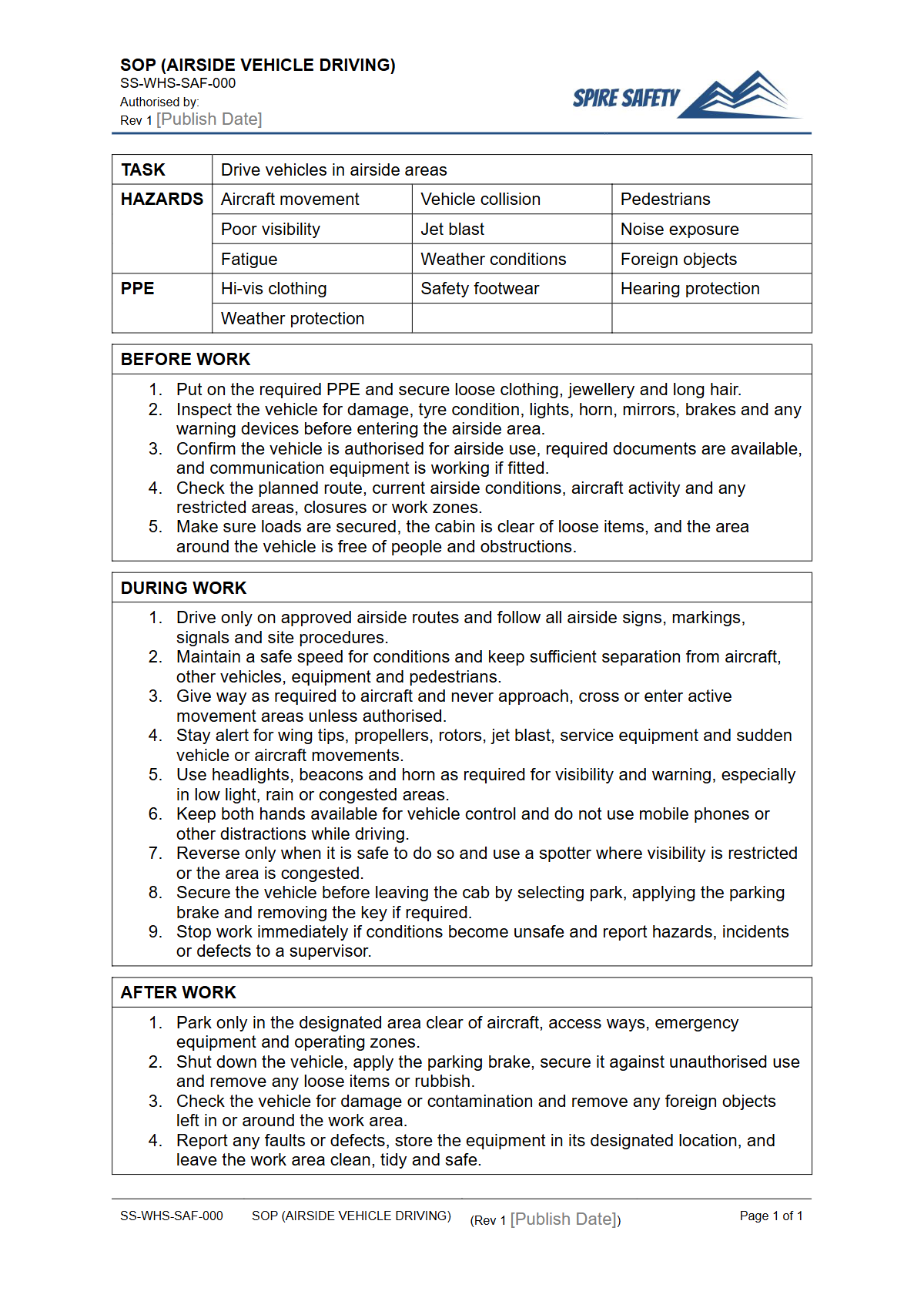
This SOP template provides a comprehensive structure covering key aspects of airside vehicle safety. It includes sections for:
- Documenting required Personal Protective Equipment (PPE) such as high-visibility clothing.
- Outlining pre-operational checks specific to airside vehicles, including lights, beacons, and communication equipment.
- A step-by-step guide for performing the driving task safely, covering procedures for entering and operating in controlled movement areas.
- Emergency procedures, including actions to take in case of vehicle breakdown, communication failure, or incident.
- A section for listing required training and competencies, such as an Airside Driving Authority (ADA).
When to use a Safe Operating Procedure for Airside Driving
An SOP for airside vehicle driving should be used whenever a worker is required to operate any form of vehicle within the boundaries of an aerodrome's airside area. This includes service roads, aprons, taxiways, and any area where interaction with aircraft is possible.
It is a critical document for daily operations, induction of new drivers, and refresher training. It also serves as an essential reference during safety briefings and a benchmark for performance monitoring.
For other types of mobile plant, you may require a separate Telehandler SOP or procedure for different equipment.
This procedure should be readily accessible to all relevant personnel, including drivers, supervisors, and safety managers. It becomes a key reference document during incident investigations and safety audits.
Implementing and enforcing this SOP is a proactive measure to manage the high-consequence risks associated with the complex and dynamic airside environment. Regular reviews and updates are necessary, especially after any changes to airport layout, procedures, or vehicle fleet.
Who should use this Safe Operating Procedure
This template is intended for use by anyone responsible for safety and operations in an aviation context. This includes Airport Operators, Ground Handling Agents, Freight and Logistics companies, Maintenance, Repair, and Overhaul (MRO) organisations, and any other business operating vehicles airside. Key personnel who will use and benefit from this document include:
- WHS Managers and Safety Officers: To develop and implement formal safety procedures as part of their risk management duties.
- Operations Managers and Supervisors: To ensure their teams have clear instructions and to enforce safe work practices on a daily basis.
- Vehicle Operators: As a primary reference for understanding the correct, safe method for performing their duties and responding to non-standard situations.
- Training Coordinators: To develop training materials and competency assessments based on a standardised, approved procedure.
Ultimately, this SOP is a tool for the PCBU to demonstrate how it is managing risks. The final document serves as evidence of a systematic approach to safety, which can be verified through processes like regular WHS compliance auditing. For more guides and templates on other workplace hazards, explore our free WHS resources library.
Common mistakes
Common mistakes to avoid
- Failing to incorporate airport-specific rules, markings, and light signals.
- Neglecting to detail clear communication protocols with ground or air traffic control.
- Using a generic vehicle pre-start checklist instead of one tailored for airside hazards.
- Providing inadequate detail on emergency procedures, such as vehicle breakdown on a taxiway.
Legal references
Legal considerations
The following legal requirements may be relevant to this type of work.
- Work Health and Safety Act (Harmonised) — Provides the primary duties for protecting workers and other people from work health and safety risks.
- Work Health and Safety Regulations (Harmonised) — Sets out requirements supporting the management of workplace hazards and risks.
The following codes may be relevant to this type of work.
- Managing WHS Risks Code of Practice — Provides practical guidance on identifying hazards, assessing risks and applying effective controls.
- Work Health and Safety Consultation, Cooperation and Coordination Code of Practice — Provides practical guidance on consulting workers and coordinating with other duty holders.
- Managing the Work Environment and Facilities Code of Practice — Provides practical guidance on safe work environments, workplace facilities and related controls.
Did you know
Runway Incursions
A runway incursion is any occurrence at an aerodrome involving the incorrect presence of an aircraft, vehicle, or person on the protected area of a surface designated for aircraft landing and take-off.
Foreign Object Debris (FOD)
Foreign Object Debris (FOD) is a major hazard in aviation. Strict procedures for vehicle cleanliness and checks to ensure nothing falls from a vehicle are critical components of airside safety.
FAQ
Frequently asked questions
01What is a Safe Operating Procedure for airside vehicle driving?
02Who needs to be trained on this SOP?
03How often should an Airside Driving SOP be reviewed?
04Does this SOP replace the need for an Airside Driving Authority (ADA)?
Share this resource
Free Safe Operating Procedure (Airside Vehicle Driving) Template
Browse Categories
How To Use It
- 1Download and open in Word or PDF.
- 2Replace the placeholders with your business details.
- 3Get it reviewed by a WHS specialist before rollout.
Need it customised?
Our WHS consultants can adapt this template to your site, run a gap analysis, or audit what you already have in place.
Book a Free Consultation WHS consulting servicesor call 1300 156 382
Related templates
- Free Safe Operating Procedure (Airside Waste Collection) Template
- Free Safe Operating Procedure (Alarm Panel Check) Template
- Free Safe Operating Procedure (Alarm Response Check) Template
- Free Safe Operating Procedure (Allergen Ingredient Setup) Template
- Free Safe Operating Procedure (Allergen Segregation) Template
- Free Safe Operating Procedure (Anchor Winch) Template