
Free Safe Operating Procedure (Airside FOD Inspection) Template
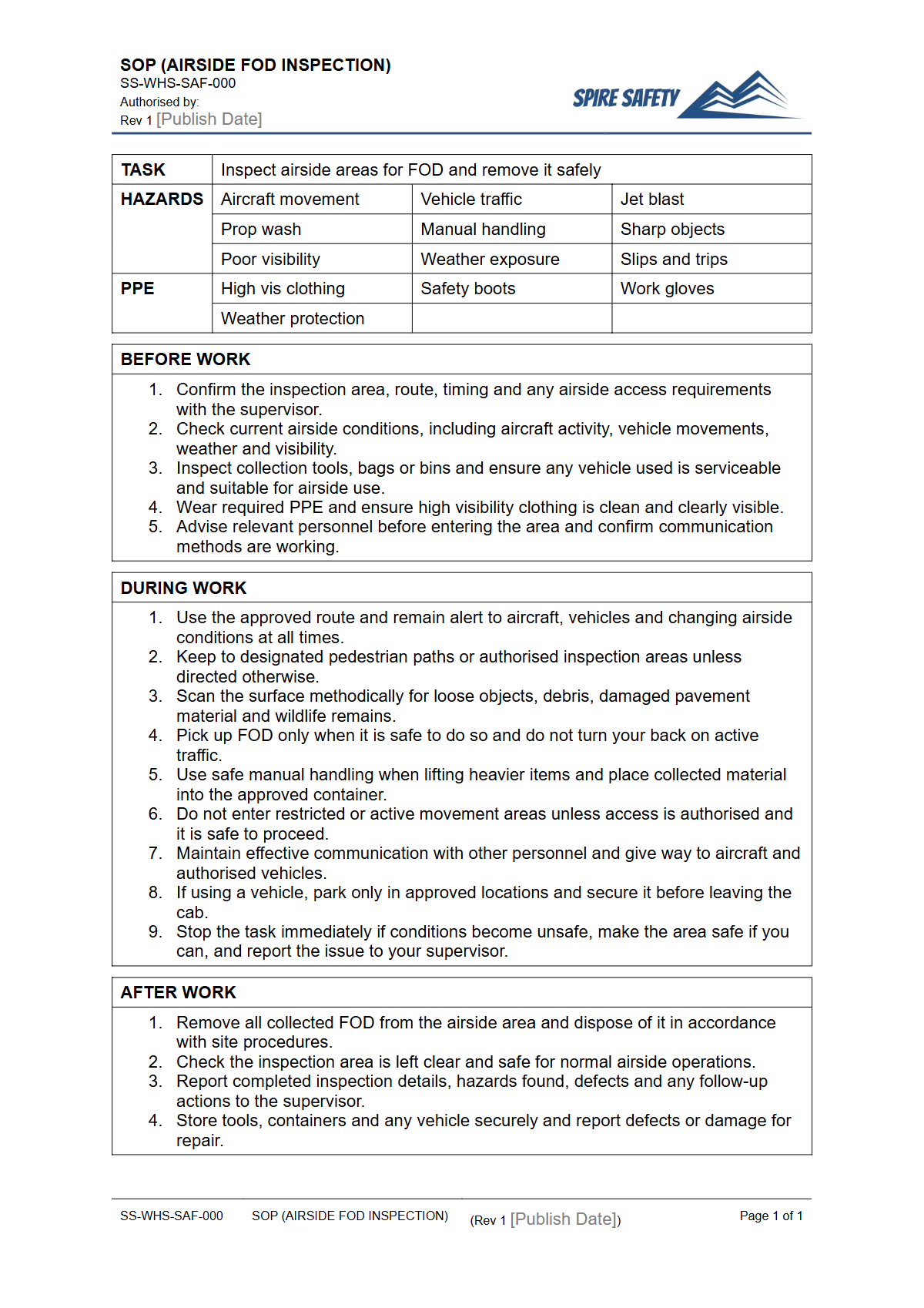
Minimise catastrophic aviation risks with our Free Safe Operating Procedure (Airside FOD Inspection) Template. Download our DOCX to formalise your FOD checks.
Free Safe Operating Procedure (Airside FOD Inspection) Template
DOCX • 126 KB + PDF
Updated Oct 2026
No signup required
Purpose of the Free Safe Operating Procedure (Airside FOD Inspection) Template
Foreign Object Debris (FOD) on runways, taxiways, and aprons presents one of the most significant threats in aviation. A single loose item can cause catastrophic damage to aircraft engines, tyres, and structures, endangering lives and leading to costly repairs and operational downtime.
This Free Safe Operating Procedure (Airside FOD Inspection) Template provides a structured framework for conducting thorough and consistent inspections to detect and remove hazardous debris from airside environments.
Implementing a formal SOP for FOD inspections is a critical component of an effective safety management system. It establishes a clear, repeatable process that reduces the risk of human error and ensures all personnel understand their responsibilities.
By standardising inspection methods, reporting protocols, and documentation, this template helps your organisation demonstrate its commitment to safety and operational excellence. A well-defined procedure is a cornerstone of robust WHS management systems in high-risk industries like aviation.
Video walkthrough
How to use the Free Safe Operating Procedure (Airside FOD Inspection) Template
This resource is provided as a fully editable DOCX file, allowing for complete customisation to your specific operational context. After downloading, you will need to review and adapt the content to align with your airport's layout, local procedures, specific aircraft movements, and regulatory requirements.
The goal is to create a practical document that your team can use consistently in the field.
Important: This document is a template and must be customised to suit the specific requirements of your organisation, the aerodrome you operate in, and your local regulatory obligations. We have drafted it as a starting point, but its effectiveness depends on your thorough adaptation.
We cannot guarantee its suitability for your specific circumstances without a formal consultation.
Key Customisation Steps
- Site-Specific Details: Add the name of your aerodrome, specific runway/taxiway designations, and zone maps for inspection areas.
- Personnel and Responsibilities: Clearly define the roles responsible for conducting, supervising, and documenting FOD inspections.
- Equipment and PPE: List the required Personal Protective Equipment (e.g., high-visibility clothing, safety footwear) and inspection equipment (e.g., FOD collection bags, magnetic sweepers).
- Frequencies and Triggers: Define the schedule for routine inspections (e.g., daily before first movement) and the triggers for non-routine checks (e.g., after maintenance, storm events).
- Reporting Protocol: Customise the procedure for reporting and documenting found FOD, including immediate actions for hazardous items.
Regularly reviewing the effectiveness of your procedures is a key safety activity. This process can be supported by independent WHS compliance auditing to identify any gaps or opportunities for improvement in your safety systems.
When to use this Safe Operating Procedure
This SOP should be used as the primary guidance document for all planned and reactive airside FOD inspections. Its application is crucial in various scenarios, including:
- Scheduled Inspections: Daily or pre-operational sweeps of all aircraft movement areas.
- Pre-Flight Checks: Inspections of specific aircraft stands or bays immediately prior to an aircraft's arrival or departure.
- Post-Maintenance Activity: Thorough checks of an area where aircraft or ground support equipment maintenance has occurred to ensure no tools or parts were left behind.
- Following Severe Weather: Inspections after high winds, heavy rain, or storms that may have deposited debris onto airside surfaces.
- In Response to Reports: When a pilot, air traffic controller, or ground crew member reports potential FOD.
While this SOP covers the inspection task itself, personnel may use vehicles to traverse the airside environment. The safe use of such vehicles requires its own documented procedure, such as a Safe Operating Procedure for body trucks or other relevant plant.
Who should use this Safe Operating Procedure
This procedure is designed for all personnel authorised and trained to conduct airside FOD inspections. This typically includes:
- Airport Operations Officers: Staff responsible for the day-to-day safety and maintenance of the airfield.
- Ground Handling Crew: Personnel involved in baggage handling, aircraft marshalling, and servicing who often work in close proximity to aircraft.
- Aircraft Maintenance Engineers: Technicians who must ensure their work areas are clear of debris after completing tasks.
- Safety Personnel: WHS or Safety Managers responsible for overseeing and auditing the FOD management program.
All users must be deemed competent, having received specific training on airport-specific FOD procedures, airside driving rules, and radio communication protocols. If your organisation requires broader safety support, consider engaging expert WHS consulting services. For more templates and safety guides, you can browse our complete free WHS resources library.
Common mistakes
Common mistakes to avoid
- Failing to physically inspect an area and assuming it is clear.
- Incomplete documentation of inspection findings, including 'nil' reports.
- Using improper tools for debris collection which can create further FOD.
- Poor communication protocols for reporting hazardous FOD immediately.
Legal references
Legal considerations
The following legal requirements may be relevant to this type of work.
- Work Health and Safety Act (Harmonised) — Provides the primary duties for protecting workers and other people from work health and safety risks.
- Work Health and Safety Regulations (Harmonised) — Sets out requirements supporting the management of workplace hazards and risks.
The following codes may be relevant to this type of work.
- Managing WHS Risks Code of Practice — Provides practical guidance on identifying hazards, assessing risks and applying effective controls.
- Work Health and Safety Consultation, Cooperation and Coordination Code of Practice — Provides practical guidance on consulting workers and coordinating with other duty holders.
- Managing the Work Environment and Facilities Code of Practice — Provides practical guidance on safe work environments, workplace facilities and related controls.
Did you know
The Global Cost of FOD
Globally, Foreign Object Debris (FOD) is estimated to cost the aviation industry over A$20 billion each year in direct and indirect costs, including aircraft damage, flight delays, and subsequent maintenance.
FAQ
Frequently asked questions
01What is Foreign Object Debris (FOD)?
02How often should airside FOD inspections be performed?
03Is an SOP legally required for FOD inspections in Australia?
04What is the difference between an SOP and a SWMS?
Share this resource
Free Safe Operating Procedure (Airside FOD Inspection) Template
Browse Categories
How To Use It
- 1Download and open in Word or PDF.
- 2Replace the placeholders with your business details.
- 3Get it reviewed by a WHS specialist before rollout.
Need it customised?
Our WHS consultants can adapt this template to your site, run a gap analysis, or audit what you already have in place.
Book a Free Consultation WHS consulting servicesor call 1300 156 382
Related templates
- Free Safe Operating Procedure (Airside GSE Parking) Template
- Free Safe Operating Procedure (Airside Vehicle Driving) Template
- Free Safe Operating Procedure (Airside Waste Collection) Template
- Free Safe Operating Procedure (Alarm Panel Check) Template
- Free Safe Operating Procedure (Alarm Response Check) Template
- Free Safe Operating Procedure (Allergen Ingredient Setup) Template