
Free Safe Operating Procedure (Airside Cabin Supplies) Template
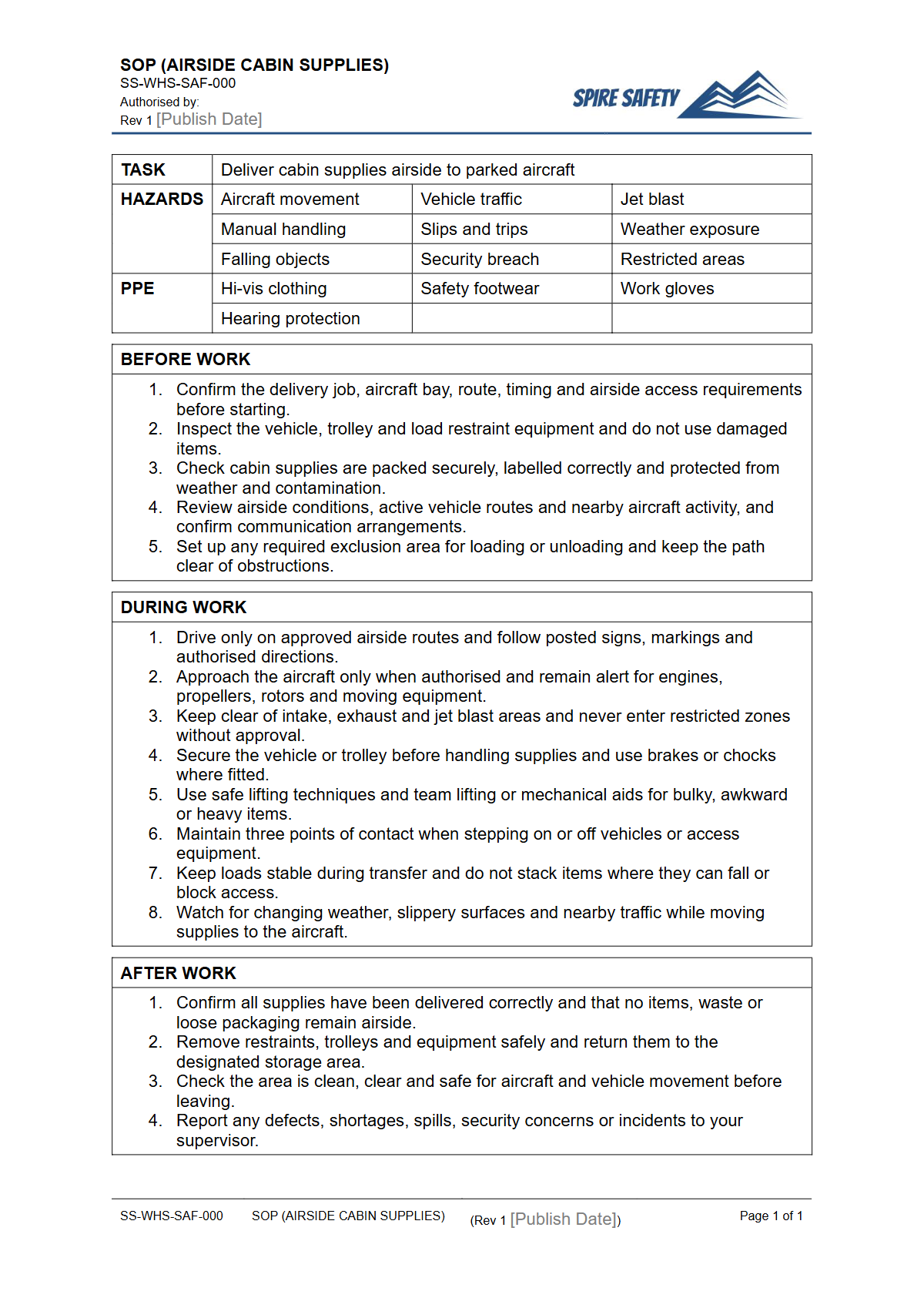
Download our Free Safe Operating Procedure for Airside Cabin Supplies Template (DOCX & PDF). A structured starting point for managing WHS risks.
Free Safe Operating Procedure (Airside Cabin Supplies) Template
DOCX • 126 KB + PDF
Updated Oct 2026
No signup required
Purpose of the Free Safe Operating Procedure (Airside Cabin Supplies) Template
Operating in an airside environment presents a unique combination of logistical, manual handling, and high-consequence risks. This Safe Operating Procedure (SOP) for Airside Cabin Supplies provides a structured framework to help your organisation document the step-by-step process for safely restocking aircraft cabins.
Using this free template helps formalise safe work practices, reduce the likelihood of incidents, and provide a clear, consistent training tool for all personnel involved in ground handling and supply logistics.
A well-defined SOP is a critical control measure for managing hazards specific to cabin resupply tasks. These include musculoskeletal injuries from manual tasks, falls from height when accessing storage or aircraft, and collisions with ground service equipment.
By documenting the approved process, you establish a baseline for safe behaviour and performance. This procedure is designed to integrate with other operational documents, such as a specific safe operating procedure for a body truck, ensuring safety is considered at every stage of the supply chain.
Video walkthrough
How to use the Free Safe Operating Procedure (Airside Cabin Supplies) Template
This resource is provided in both DOCX and PDF formats. The DOCX file is fully editable, allowing you to tailor the content to the specific requirements of your airport, airline, and workforce.
The PDF version serves as a ready-to-print reference. It is crucial to adapt this template to reflect your unique operational context, including the types of aircraft serviced, the ground support equipment used, and your site-specific risk profile.
Important: This is a template and must be customised for your workplace. We recommend a person conducting a business or undertaking (PCBU) consults with workers, supervisors, and health and safety representatives (HSRs) to ensure the final document is practical, comprehensive, and reflects the reality of the tasks performed.
A SOP is most effective when it is part of one of your comprehensive WHS management systems, linking risk assessments to daily operational controls.
When to use this Safe Operating Procedure
An SOP for airside cabin supplies should be a core component of your daily operations and safety management. It should be used during the induction and training of all new ground crew and supply staff to establish clear safety expectations from day one.
It also serves as the basis for periodic refresher training and competency assessments to ensure standards are maintained.
Supervisors should reference the SOP during pre-shift briefings to highlight key risks and controls relevant to the day's operations. The document is also an invaluable tool during incident investigations, helping to identify any deviations from the established safe process.
For specific sub-tasks, it may be used alongside other procedures, such as your step ladder SOP when accessing items at height within the supply vehicle.
Who should use this document
This Safe Operating Procedure is intended for all personnel directly involved in the process of transporting, loading, and distributing cabin supplies airside. This includes catering staff, supply truck drivers, ground handlers, and logistics coordinators.
Team leaders and supervisors have a critical role in implementing the SOP, ensuring their teams understand and follow the procedures, and correcting any unsafe work practices they observe.
Furthermore, WHS managers and safety officers will use this document as a key piece of evidence during safety reviews and audits. It forms a benchmark against which actual work practices can be measured.
Regular WHS compliance auditing can help verify that the documented procedures are being effectively implemented on the tarmac. You can find more templates like this one in our complete free WHS resources library to support your safety management framework.
Common mistakes
Common mistakes to avoid
- Failing to customise the template with site-specific details like vehicle types and routes.
- Neglecting to consult with the ground crew who perform the tasks daily.
- Not providing adequate training on the finalised SOP.
- Storing the document where it is inaccessible to workers during their shifts.
Legal references
Legal considerations
The following legal requirements may be relevant to this type of work.
- Work Health and Safety Act (Harmonised) — Provides the primary duties for protecting workers and other people from work health and safety risks.
- Work Health and Safety Regulations (Harmonised) — Sets out requirements supporting the management of workplace hazards and risks.
The following codes may be relevant to this type of work.
- Managing WHS Risks Code of Practice — Provides practical guidance on identifying hazards, assessing risks and applying effective controls.
- Work Health and Safety Consultation, Cooperation and Coordination Code of Practice — Provides practical guidance on consulting workers and coordinating with other duty holders.
- Managing the Work Environment and Facilities Code of Practice — Provides practical guidance on safe work environments, workplace facilities and related controls.
Did you know
Manual Task Risks
According to Safe Work Australia, manual handling injuries are a leading cause of serious workers' compensation claims. Procedures for tasks like lifting and moving supply containers are critical for injury prevention.
Airside Incidents
A significant percentage of aircraft damage incidents occur on the ground, often involving ground support equipment. Standardised procedures for all airside vehicle movements are a key defence against these costly events.
FAQ
Frequently asked questions
01What is a Safe Operating Procedure (SOP) in aviation ground handling?
02Why is an SOP for airside cabin supplies important?
03Does this template meet Australian WHS compliance requirements?
04How often should a Safe Operating Procedure be reviewed?
Share this resource
Free Safe Operating Procedure (Airside Cabin Supplies) Template
Browse Categories
How To Use It
- 1Download and open in Word or PDF.
- 2Replace the placeholders with your business details.
- 3Get it reviewed by a WHS specialist before rollout.
Need it customised?
Our WHS consultants can adapt this template to your site, run a gap analysis, or audit what you already have in place.
Book a Free Consultation WHS consulting servicesor call 1300 156 382
Related templates
- Free Safe Operating Procedure (Airside Catering Delivery) Template
- Free Safe Operating Procedure (Airside Equipment Clean) Template
- Free Safe Operating Procedure (Airside FOD Inspection) Template
- Free Safe Operating Procedure (Airside GSE Parking) Template
- Free Safe Operating Procedure (Airside Vehicle Driving) Template
- Free Safe Operating Procedure (Airside Waste Collection) Template