
Free Safe Operating Procedure (Airside Equipment Clean) Template
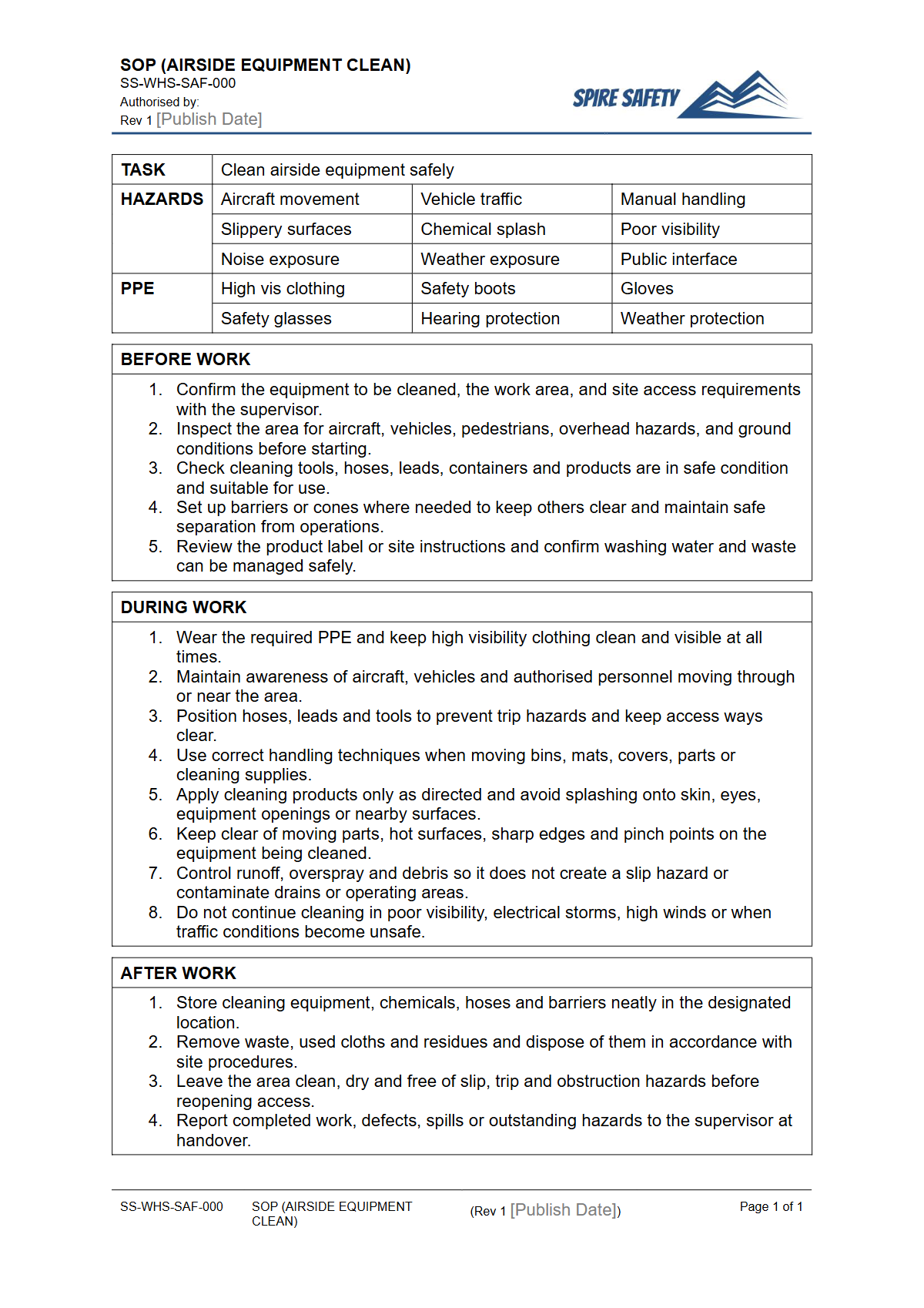
Download our free Safe Operating Procedure (Airside Equipment Clean) template. This Word and PDF resource helps you outline safe work methods.
Free Safe Operating Procedure (Airside Equipment Clean) Template
DOCX • 126 KB + PDF
Updated Oct 2026
No signup required
Purpose of the Free Safe Operating Procedure (Airside Equipment Clean) Template
This Free Safe Operating Procedure (Airside Equipment Clean) Template provides a structured framework for documenting the safe methods required to clean ground support equipment (GSE) and other machinery within an airport's airside operational area. Its primary purpose is to help your organisation manage risks and provide clear, consistent instructions to workers.
A documented procedure is a critical tool for standardising tasks, training personnel, and demonstrating due diligence under Work Health and Safety (WHS) obligations.
Cleaning equipment in an airside environment introduces specific hazards beyond the task itself. These include interaction with aircraft and other vehicles, exposure to jet blast, and the critical need to prevent Foreign Object Debris (FOD).
This SOP template prompts you to consider hazards such as chemical exposure from cleaning agents, ergonomic risks from manual handling, and slips, trips, and falls. By formalising the process, you create a safer system of work similar to how you would for other high-risk plant, such as by using a detailed Body Truck SOP for vehicle operations.
Video walkthrough
How to use the Free Safe Operating Procedure (Airside Equipment Clean) Template
Begin by downloading the template in your preferred format (DOCX for easy editing or PDF for reference). The document is designed as a comprehensive starting point, aligned with Australian WHS principles.
It guides you through the essential components of a robust SOP for airside equipment cleaning.
Important: This template provides a solid foundation, but it is not a complete, out-of-the-box solution. We have developed it as a starting point.
You must customise it to reflect the specific equipment, chemicals, personnel, and unique site conditions of your workplace to ensure it is effective.
Customisation is Essential
To adapt this template effectively, you should:
- Conduct a thorough, site-specific risk assessment for the cleaning task.
- Incorporate the make, model, and specific characteristics of the equipment being cleaned.
- Reference the Safety Data Sheets (SDS) for all cleaning chemicals used, detailing handling, storage, and disposal requirements.
- Specify the exact Personal Protective Equipment (PPE) required for each step.
- Consult with your workers and any Health and Safety Representatives (HSRs). Their hands-on experience is invaluable for creating a practical and effective procedure.
Integrating customised SOPs into a broader safety framework is a key part of maintaining a safe workplace. This structured approach is fundamental to well-organised WHS management systems that protect your workers and your business.
When to use it
A Safe Operating Procedure for airside equipment cleaning should be used consistently as a control measure. It serves as a primary reference document before, during, and after the task. Key times to use the SOP include:
- As a planning tool: Before any cleaning work begins, to ensure all controls, equipment, and PPE are in place.
- For worker training: To induct new employees or provide refresher training for existing staff on the correct, safe procedure.
- During the task: As a checklist or reference for supervisors and workers to ensure no steps are missed.
- For incident investigation: To review whether the established procedure was followed and if it remains adequate.
- As part of safety reviews: The SOP should be regularly reviewed and updated, especially when new equipment or chemicals are introduced.
Regularly reviewing your procedures is a core part of safety governance. This often forms a key component of formal WHS compliance auditing activities to verify that safety systems are working as intended.
Who should use it
This SOP is intended for a range of personnel involved in airport operations. This includes:
- Ground crew and maintenance staff: The primary users who perform the cleaning tasks.
- Supervisors and team leaders: To oversee the work, provide instruction, and ensure procedures are followed correctly.
- WHS Managers and Advisors: To develop, implement, and review safety procedures as part of the overall safety management system.
- PCBUs (Persons Conducting a Business or Undertaking): To help meet their primary duty of care under WHS law by providing a safe system of work.
Workers may also need to follow procedures for associated tasks. For example, if cleaning larger equipment requires working from a height, a separate procedure like a step ladder SOP would be essential to manage fall risks.
Similarly, if high-pressure washing equipment is used, procedures should align with safe use of associated machinery, such as that outlined in an air compressor SOP. Integrating these documents ensures comprehensive risk management across all activities.
Building a holistic safety system that connects procedures for different tasks is a sign of a mature safety culture. This integrated approach is a central tenet of standards like AS/NZS ISO 45001, and expert ISO 45001 consulting can help organisations achieve this level of integration.
Common mistakes
Common mistakes to avoid
- Forgetting to account for Foreign Object Debris (FOD) creation and cleanup.
- Using generic cleaning chemicals not approved for aviation use, risking damage to equipment.
- Failing to de-energise and isolate equipment before washing, creating electrical hazards.
- Neglecting to consult the Safety Data Sheet (SDS) for required PPE and handling procedures.
Legal references
Legal considerations
The following legal requirements may be relevant to this type of work.
- Work Health and Safety Act (Harmonised) — Provides the primary duties for protecting workers and other people from work health and safety risks.
- Work Health and Safety Regulations (Harmonised) — Sets out requirements supporting the management of workplace hazards and risks.
The following codes may be relevant to this type of work.
- Managing WHS Risks Code of Practice — Provides practical guidance on identifying hazards, assessing risks and applying effective controls.
- Work Health and Safety Consultation, Cooperation and Coordination Code of Practice — Provides practical guidance on consulting workers and coordinating with other duty holders.
- Managing the Work Environment and Facilities Code of Practice — Provides practical guidance on safe work environments, workplace facilities and related controls.
Did you know
FOD Risk
Foreign Object Debris (FOD) is a major hazard in aviation. A simple loose part from a cleaning machine can cause catastrophic engine damage if ingested by an aircraft.
Chemical Safety
Some aircraft cleaning fluids are highly specialised and can be corrosive to certain metals or harmful to the environment. Always check the Safety Data Sheet (SDS) and aircraft manufacturer's guidelines.
FAQ
Frequently asked questions
01What is a Safe Operating Procedure for airside equipment cleaning?
02Why is a specific SOP needed for airside cleaning?
03Is this Safe Operating Procedure template ready to use immediately?
04Who is responsible for creating and implementing an SOP?
Share this resource
Free Safe Operating Procedure (Airside Equipment Clean) Template
Browse Categories
How To Use It
- 1Download and open in Word or PDF.
- 2Replace the placeholders with your business details.
- 3Get it reviewed by a WHS specialist before rollout.
Need it customised?
Our WHS consultants can adapt this template to your site, run a gap analysis, or audit what you already have in place.
Book a Free Consultation WHS consulting servicesor call 1300 156 382
Related templates
- Free Safe Operating Procedure (Airside FOD Inspection) Template
- Free Safe Operating Procedure (Airside GSE Parking) Template
- Free Safe Operating Procedure (Airside Vehicle Driving) Template
- Free Safe Operating Procedure (Airside Waste Collection) Template
- Free Safe Operating Procedure (Alarm Panel Check) Template
- Free Safe Operating Procedure (Alarm Response Check) Template