
Free Safe Operating Procedure (Airside Catering Delivery) Template
Download our free Safe Operating Procedure (Airside Catering Delivery) template.
Free Safe Operating Procedure (Airside Catering Delivery) Template
DOCX • 126 KB + PDF
Updated Oct 2026
No signup required
Purpose of the Free Safe Operating Procedure (Airside Catering Delivery) Template
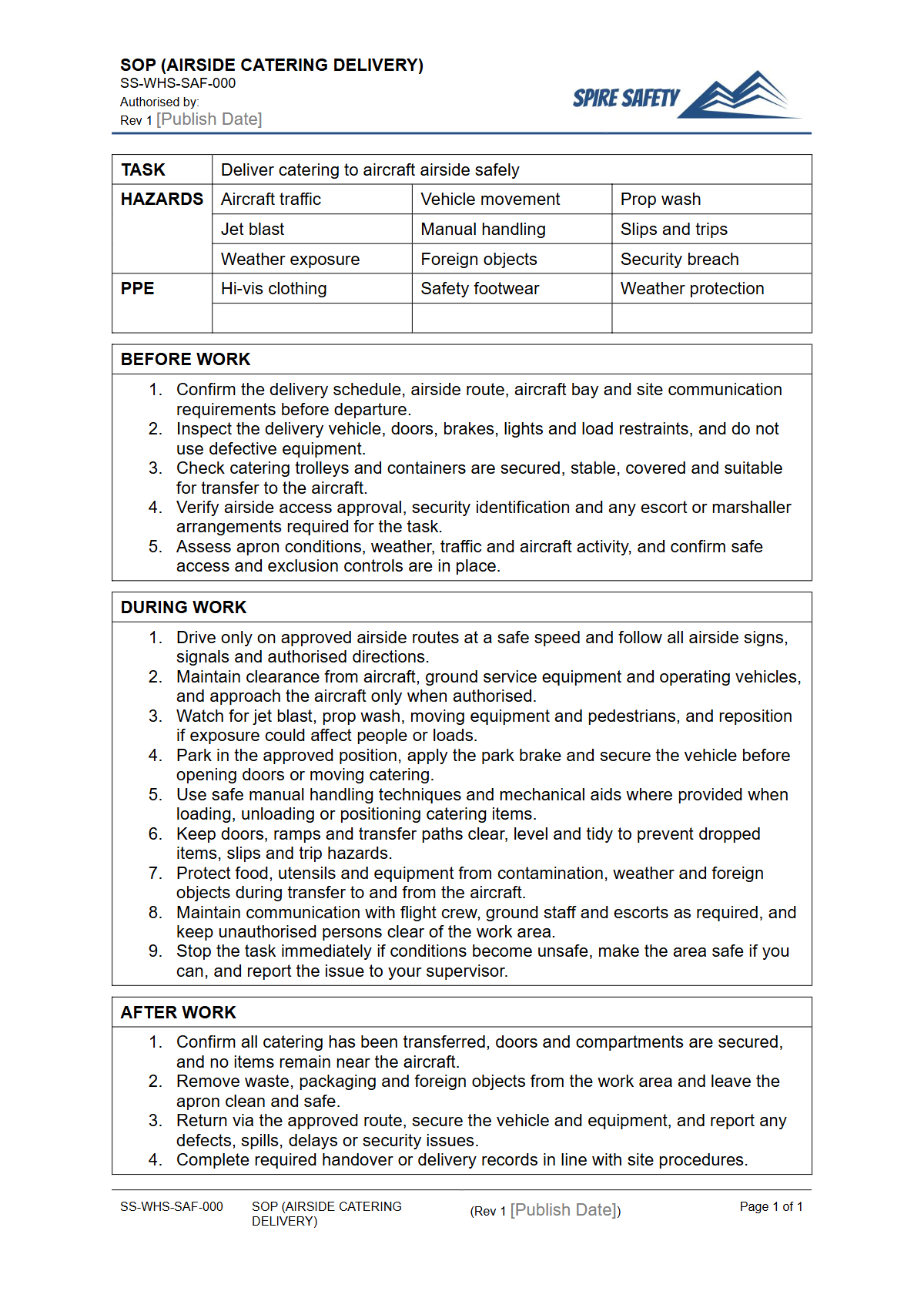
Operating in an airside environment presents unique and significant risks. This Safe Operating Procedure (SOP) for airside catering delivery provides a framework for documenting the step-by-step process required to perform this task safely.
The primary goal is to control hazards associated with vehicle movements near aircraft, manual handling, and interaction with other ground service equipment. By standardising procedures, you can minimise the risk of personal injury, equipment damage, and serious aviation incidents.
Our free template is designed as a foundational document to help your organisation establish and communicate these critical safety protocols to all relevant personnel.
A well-defined SOP is a key component of a safe system of work. It serves as a vital training tool for new employees and a reference for experienced operators, ensuring consistency and adherence to safety standards.
The document outlines essential pre-operational checks, specific steps for the delivery task, and post-operational procedures. It prompts you to consider risks such as collisions with aircraft or other ground support equipment (GSE), falls from height from catering trucks, and ergonomic injuries from handling heavy food trolleys.
For vehicles used in this process, you may also find our Safe Operating Procedure for body trucks a helpful supplementary resource.
Video walkthrough
How to use the Free Safe Operating Procedure (Airside Catering Delivery) Template
This document is a template and must be adapted to your specific operational context. To use it effectively, begin by conducting a thorough risk assessment of your airside catering delivery tasks.
This involves identifying all potential hazards, assessing their risk level, and determining appropriate control measures. Involve your workers, supervisors, and health and safety representatives in this process; their firsthand experience is invaluable for creating a practical and effective SOP.
The template is structured to guide you through this, with sections for required Personal Protective Equipment (PPE), qualifications, and a logical sequence of work.
Populate each section with details relevant to your equipment, airport layout, and company policies. For example, specify the exact model of catering truck used, the designated driving routes on the apron, and communication protocols with ground control or marshallers.
It is crucial that the final document reflects the reality of the work being performed. We have designed this template as a starting point; you must customise it to reflect the specific hazards, equipment, and environment of your workplace.
Integrating this SOP into your broader safety framework is a key step towards building comprehensive WHS management systems that protect your people and your operations.
When to use it
An SOP for airside catering delivery should be used in several key situations. It is essential for the induction and training of new catering drivers and ground staff, providing them with clear, unambiguous instructions.
It should also be used for refresher training to reinforce safe behaviours and introduce any procedural updates. The SOP serves as a benchmark for supervisors conducting workplace observations and performance reviews.
Following a near miss or incident, the SOP should be reviewed as part of the investigation to identify any gaps or weaknesses in the procedure. Regular reviews, typically annually or when changes occur, ensure the document remains current and effective.
Who should use it
This procedure is intended for all personnel involved in the airside catering delivery process. This includes catering truck drivers, loaders, and ground assistants who physically perform the tasks.
Supervisors and team leaders must use the SOP to train their staff, monitor compliance, and enforce safe work practices on the apron. WHS managers and safety officers will use the SOP as part of the site's overall risk management program and for auditing purposes.
Even personnel in adjacent roles, such as aircraft marshallers or baggage handlers, should be aware of the procedures to ensure seamless and safe coordination between different ground handling functions.
The effectiveness of any procedure hinges on its practical application. If your team requires support in embedding these practices or assessing their effectiveness, our WHS compliance auditing services can provide an independent review of your systems against established benchmarks.
In situations involving work at height, such as accessing storage on the truck, it is crucial to have documented procedures, which can be supported by a specific step ladder SOP where applicable.
This template joins a wide range of other documents, such as our popular telehandler Safe Operating Procedure, available in our library of free WHS resources. For tailored advice on complex operational hazards, our team can provide specialist WHS consulting to help you meet your safety obligations.
Common mistakes
Common mistakes to avoid
- Failing to account for specific airport traffic rules and right-of-way protocols.
- Inadequate operator training and competency verification for hi-lift catering trucks.
- Overlooking manual handling risks when loading, unloading, and pushing heavy trolleys.
- Not integrating the SOP with the airport's overall emergency and FOD prevention plans.
Legal references
Legal considerations
The following legal requirements may be relevant to this type of work.
- Work Health and Safety Act (Harmonised) — Provides the primary duties for protecting workers and other people from work health and safety risks.
- Work Health and Safety Regulations (Harmonised) — Sets out requirements supporting the management of workplace hazards and risks.
The following codes may be relevant to this type of work.
- Managing WHS Risks Code of Practice — Provides practical guidance on identifying hazards, assessing risks and applying effective controls.
- Work Health and Safety Consultation, Cooperation and Coordination Code of Practice — Provides practical guidance on consulting workers and coordinating with other duty holders.
- Managing the Work Environment and Facilities Code of Practice — Provides practical guidance on safe work environments, workplace facilities and related controls.
Did you know
Airside Environment
The 'airside' area of an airport is the restricted zone accessible only to authorised personnel and vehicles, including aprons, taxiways, and runways, where aircraft are parked and serviced.
FOD Risk
Foreign Object Debris (FOD) is a major aviation hazard. Even a dropped catering utensil or piece of plastic wrap on the apron can pose a serious risk to aircraft engines during taxi or takeoff.
FAQ
Frequently asked questions
01What are the main hazards in airside catering delivery?
02Does this SOP template cover airport security requirements?
03Who is responsible for implementing this Safe Operating Procedure?
04How often should an SOP for airside catering be reviewed?
Share this resource
Free Safe Operating Procedure (Airside Catering Delivery) Template
Browse Categories
How To Use It
- 1Download and open in Word or PDF.
- 2Replace the placeholders with your business details.
- 3Get it reviewed by a WHS specialist before rollout.
Need it customised?
Our WHS consultants can adapt this template to your site, run a gap analysis, or audit what you already have in place.
Book a Free Consultation WHS consulting servicesor call 1300 156 382
Related templates
- Free Safe Operating Procedure (Airside Equipment Clean) Template
- Free Safe Operating Procedure (Airside FOD Inspection) Template
- Free Safe Operating Procedure (Airside GSE Parking) Template
- Free Safe Operating Procedure (Airside Vehicle Driving) Template
- Free Safe Operating Procedure (Airside Waste Collection) Template
- Free Safe Operating Procedure (Alarm Panel Check) Template