
Free Safe Operating Procedure (Airside Baggage Transfer) Template
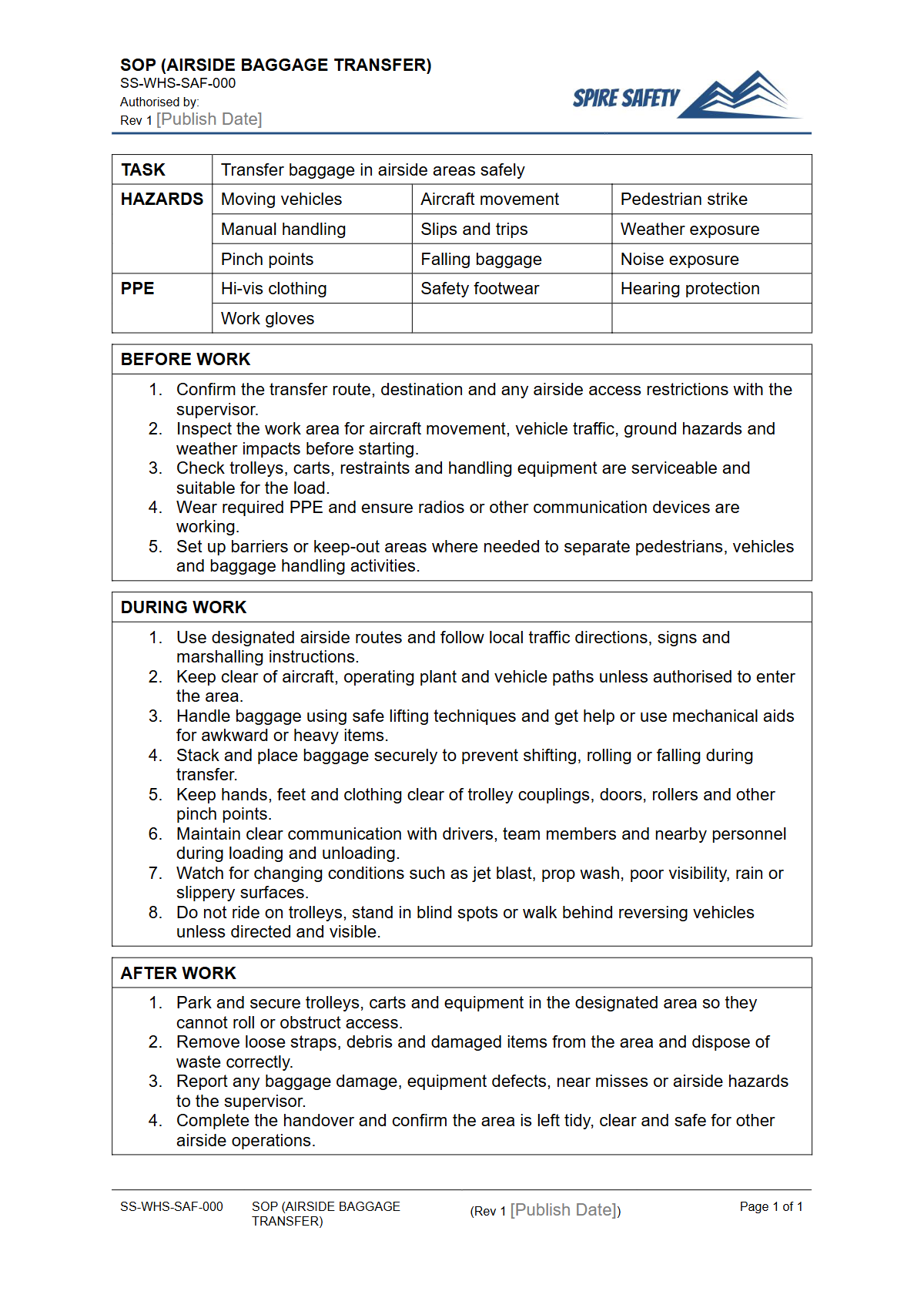
Download our free Safe Operating Procedure (Airside Baggage Transfer) template. This structured DOCX/PDF helps you define safe work practices for ground crews.
Free Safe Operating Procedure (Airside Baggage Transfer) Template
DOCX • 126 KB + PDF
Updated Oct 2026
No signup required
Purpose of the Free Safe Operating Procedure (Airside Baggage Transfer) Template
Airside baggage transfer is a high-risk activity involving manual handling, vehicle operation, and close proximity to aircraft in a dynamic environment. Spire Safety provides this Free Safe Operating Procedure (Airside Baggage Transfer) Template to help aviation and ground handling organisations establish and document a safe system of work for this critical task.
Using a structured SOP helps to standardise processes, reduce the risk of injury and incidents, and provide a clear framework for training and supervision. This template is designed as a comprehensive starting point, aligned with Australian WHS principles, to guide your team through the key steps and precautions required for safe baggage handling on the apron.
The primary goal is to manage significant hazards inherent in airside operations. These include musculoskeletal disorders from lifting, carrying, and twisting; collisions between baggage carts, belt loaders, and other ground service equipment; noise exposure from aircraft engines; and environmental risks like adverse weather and low light conditions.
By clearly outlining controls for these hazards, the SOP serves as a vital tool in your overall safety management system.
Video walkthrough
How to use the Free Safe Operating Procedure (Airside Baggage Transfer) Template
This template is provided in both DOCX and PDF formats for your convenience. The DOCX file is fully editable, allowing you to tailor the content to the specific requirements of your operation.
It includes sections for outlining equipment, pre-start checks, step-by-step procedures, required personal protective equipment (PPE), and emergency protocols.
Important: This document is a template and must be customised to your workplace. Every airport and ground handling operation is unique.
You are responsible for ensuring the final SOP reflects your specific aircraft types, ground service equipment (GSE), apron layout, traffic management plan, and company policies. We accept no liability for incidents arising from the use of this template without proper, site-specific customisation and risk assessment.
After customisation, the SOP should be used as a practical tool for daily operations. It forms the basis for worker training, competency assessments, and pre-start briefings. For more templates covering a range of workplace tasks, you can browse our complete free WHS resources library.
Key Hazards in Airside Baggage Transfer
A thorough risk assessment is the foundation of any effective SOP. The airside environment presents a unique combination of hazards that must be addressed. Key risks include:
- Musculoskeletal Disorders (MSDs): Resulting from repetitive lifting, awkward postures, and forceful exertion when moving baggage between carts, belt loaders, and aircraft holds.
- Vehicle and Equipment Collisions: The apron is a congested area with moving aircraft, passenger buses, catering trucks, and other GSE. Clear traffic rules and operator vigilance are essential. Similar principles apply to other mobile plant, as detailed in resources like our FREE Body Truck SOP Template.
- Noise-Induced Hearing Loss: Constant exposure to high-decibel noise from jet engines and auxiliary power units (APUs) poses a significant long-term health risk.
- Slips, Trips, and Falls: Spills (fuel, hydraulic fluid), loose debris, and uneven ground surfaces on the apron can lead to serious fall injuries.
- Environmental Factors: Workers are exposed to weather extremes, including heat, cold, rain, and high winds. Operations in low light or darkness also increase risk if not properly managed.
When to use this Safe Operating Procedure
The completed Airside Baggage Transfer SOP is not a document to be filed away; it is a live safety tool for daily use. It should be consulted during:
- Worker Induction and Training: As the primary training document for new baggage handlers.
- Pre-Task Briefings: To review procedures and highlight specific risks before a shift or a complex loading task begins.
- Incident Investigations: As a benchmark to determine if established procedures were followed during a near-miss or incident.
- Performance and Competency Reviews: To assess a worker’s understanding and application of safe work practices.
- Regular Safety Audits: As a key piece of evidence during internal or external safety audits. These procedures are often a focus during a formal WHS compliance auditing process.
Who should use this SOP Template
This template is designed for use by various personnel within an aviation or ground services organisation:
- WHS/HSE Managers: To develop and standardise safety documentation across the operation.
- Ground Operations Managers and Supervisors: To implement, enforce, and review the procedures with their teams.
- Team Leaders: To conduct daily briefings and ensure their crews adhere to the SOP.
- Workers: As a reference guide for performing their tasks safely and correctly.
The principles of creating and following an SOP are universal across different types of high-risk equipment. For instance, teams that also operate specialised lifting equipment on the airside might benefit from reviewing our FREE Telehandler SOP Template to ensure consistency in their documentation approach.
Integrating the SOP into Your WHS System
A Safe Operating Procedure is most effective when it is part of a holistic safety framework. This document should directly link to other key components of your safety processes.
For example, the hazards identified in the SOP should correspond with your organisation's risk register. The training requirements outlined in the SOP should be recorded in your training matrix.
Any incidents related to baggage transfer should trigger a review of the SOP to identify potential improvements.
By embedding this SOP within your operational framework, it becomes more than just a procedure—it becomes a cornerstone of your safety culture. This integration is a key element of effective WHS management systems, ensuring that documented procedures translate into safe workplace behaviour.
Common mistakes
Common mistakes to avoid
- Failing to customise the template for specific airport layouts and ground service equipment (GSE).
- Neglecting to provide practical, hands-on training to supplement the written procedure.
- Not reviewing or updating the SOP after an incident, near-miss, or change in process occurs.
- Treating the SOP as a 'tick-and-flick' compliance document instead of a live safety tool used daily.
Legal references
Legal considerations
The following legal requirements may be relevant to this type of work.
- Work Health and Safety Act (Harmonised) — Provides the primary duties for protecting workers and other people from work health and safety risks.
- Work Health and Safety Regulations (Harmonised) — Sets out requirements supporting the management of workplace hazards and risks.
The following codes may be relevant to this type of work.
- Managing WHS Risks Code of Practice — Provides practical guidance on identifying hazards, assessing risks and applying effective controls.
- Work Health and Safety Consultation, Cooperation and Coordination Code of Practice — Provides practical guidance on consulting workers and coordinating with other duty holders.
- Managing the Work Environment and Facilities Code of Practice — Provides practical guidance on safe work environments, workplace facilities and related controls.
Did you know
Aviation Injury Statistics
The International Air Transport Association (IATA) identifies musculoskeletal disorders (MSDs), often from manual handling, as one of the top three injury types for ground handling staff globally.
Tarmac Speed Limits
Most airports enforce strict speed limits on the apron (the area where aircraft are parked, loaded, and refuelled), often as low as 15-20 km/h, to minimise the risk of collisions.
FAQ
Frequently asked questions
01What should be included in an airside baggage transfer SOP?
02How often should a Safe Operating Procedure for baggage handling be reviewed?
03Is this template suitable for all types of baggage handling equipment?
04Who is responsible for enforcing the SOP on the tarmac?
Share this resource
Free Safe Operating Procedure (Airside Baggage Transfer) Template
Browse Categories
How To Use It
- 1Download and open in Word or PDF.
- 2Replace the placeholders with your business details.
- 3Get it reviewed by a WHS specialist before rollout.
Need it customised?
Our WHS consultants can adapt this template to your site, run a gap analysis, or audit what you already have in place.
Book a Free Consultation WHS consulting servicesor call 1300 156 382
Related templates
- Free Safe Operating Procedure (Airside Cabin Supplies) Template
- Free Safe Operating Procedure (Airside Catering Delivery) Template
- Free Safe Operating Procedure (Airside Equipment Clean) Template
- Free Safe Operating Procedure (Airside FOD Inspection) Template
- Free Safe Operating Procedure (Airside GSE Parking) Template
- Free Safe Operating Procedure (Airside Vehicle Driving) Template