
Free Safe Operating Procedure (Aircraft Tug) Template
Download our free Safe Operating Procedure (Aircraft Tug) template. This structured DOCX and PDF document helps outline safety steps for aircraft tug use.
Free Safe Operating Procedure (Aircraft Tug) Template
DOCX • 126 KB + PDF
Updated Oct 2026
No signup required
Purpose of the Free Safe Operating Procedure (Aircraft Tug) Template
Operating an aircraft tug involves significant risks, from potential collisions with aircraft and other ground service equipment to personnel injuries. A documented Safe Operating Procedure (SOP) is a critical risk control measure that provides clear, step-by-step instructions for performing this task safely.
This Free Safe Operating Procedure (Aircraft Tug) Template provides a structured starting point for your organisation to formalise its processes, helping to ensure all operators work to a consistent and safe standard.
An effective SOP demonstrates a commitment to workplace health and safety, forming a key part of a broader WHS management system. It helps meet legislative duties to provide safe systems of work, minimises operational errors, and provides a valuable resource for worker training, induction, and competency verification. By clearly defining pre-start checks, operational steps, and shutdown procedures, you create a safer environment on the apron for everyone.
Video walkthrough
How to use the Free Safe Operating Procedure (Aircraft Tug) Template
This template is available for immediate download in both DOCX and PDF formats. The DOCX version is fully editable, allowing you to adapt the content to the specific models of aircraft tugs used at your site, your unique aerodrome layout, and your organisation's existing safety protocols.
It is crucial to replace the placeholder text with information relevant to your operations.
Important: This is a template only. We cannot know the specific hazards and risks of your workplace.
You must customise this document by undertaking a risk assessment for aircraft tug operations at your site. For guidance on adapting this document to ensure it aligns with your operational needs and WHS duties, consider seeking professional WHS consulting services.
What’s included in this Safe Operating Procedure?
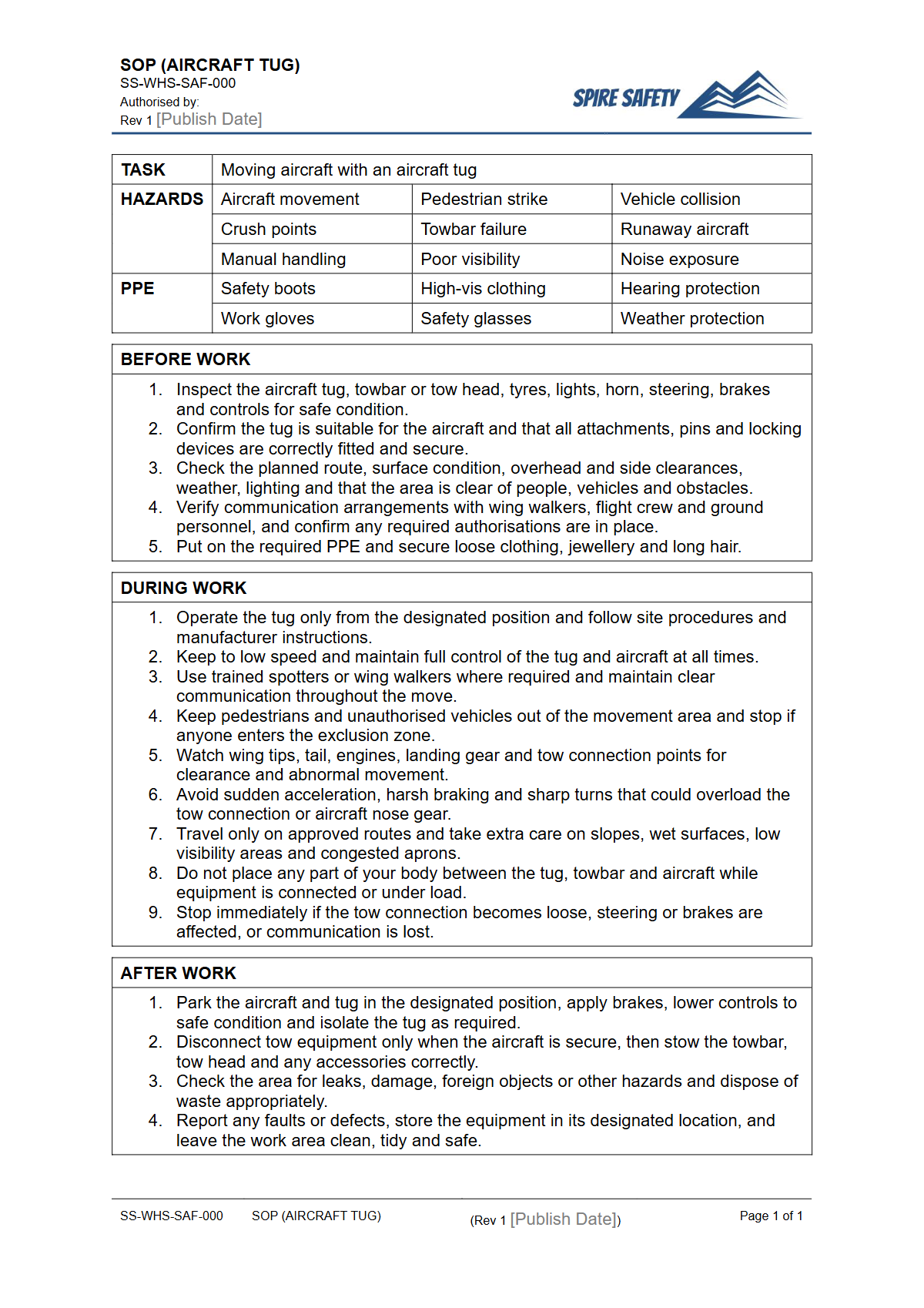
Our template is structured based on Australian WHS principles and provides a comprehensive framework for you to build upon. Key sections within the SOP include:
- Required Personal Protective Equipment (PPE): Specifies necessary PPE such as high-visibility clothing, hearing protection, and safety-toed boots.
- Pre-Operational Safety Checks: A detailed checklist covering fluid levels, tyre condition, braking systems, lights, horns, and the integrity of the tow hitch and shear pins. This formalises the critical walk-around inspection.
- Step-by-Step Operating Sequence: A logical flow of actions from starting the tug to connecting to the aircraft, communicating with the flight deck, completing the pushback or tow, and disconnecting.
- Post-Operational Procedures: Outlines the correct sequence for shutting down, parking, and securing the aircraft tug, including refuelling and reporting defects.
- Identified Risks and Control Measures: A section for you to list specific hazards identified in your risk assessment (e.g., jet blast, FOD, congested ramp areas) and the controls to mitigate them.
The principles of methodical checks and clear operational steps are universal for mobile plant. Similar principles apply to other heavy vehicles, as seen in our FREE Body Truck SOP Template.
Key Safety Considerations for Aircraft Tug Operation
When customising your SOP, pay special attention to the high-risk aspects of aircraft ground handling. The procedure must clearly define communication protocols, including standard hand signals and radio phraseology used between the tug operator, marshaller, and flight crew.
It should also specify the tug's towing limitations and ensure operators know how to match the correct tug to the aircraft type and weight.
Environmental factors like adverse weather (rain, high winds), low visibility, and night operations require specific procedural adjustments that must be included. A robust SOP prepares operators for these non-standard situations.
For another example of a heavy vehicle procedure, see our FREE Telehandler SOP Template, which also addresses variable operational conditions.
When to use this Safe Operating Procedure
A finalised SOP for aircraft tugs should be a central document in your ground operations. Its primary uses include:
- Training and Inducting New Operators: As a foundational training document to ensure all new staff learn the correct, safe method from day one.
- Competency Assessments: Used by supervisors as a checklist to verify an operator’s ongoing competency and adherence to procedure.
- Pre-Start Briefings: As a reference point during daily toolboxes or pre-shift safety meetings to reinforce key safety messages.
- Incident Investigations: To determine if procedural deviations contributed to an incident or near-miss, helping to identify root causes.
The SOP is a living document and should be reviewed regularly and updated after any incident, when new equipment is introduced, or when processes change. Regular checks ensure the SOP remains effective, a process often validated through WHS compliance auditing.
Who should use this Aircraft Tug SOP
This template is designed for use by a range of personnel within the Australian aviation and aerospace industries. Key users include:
- WHS Managers and Safety Officers: To develop and implement formalised safety procedures as part of the overall safety management system.
- Operations and Ground Handling Managers: To standardise procedures across teams and shifts for improved efficiency and safety.
- Supervisors and Team Leaders: For training their teams and monitoring day-to-day compliance with safe work practices.
- Aircraft Tug Operators: As a clear and accessible reference for performing their duties safely.
For more procedural documents covering various equipment, browse our comprehensive free WHS resources library.
Common mistakes
Common mistakes to avoid
- Failing to conduct a thorough 360-degree walk-around inspection before moving the tug.
- Exceeding the tug's rated towing capacity or using the incorrect towbar for the aircraft type.
- Poor communication or misunderstanding of signals between the tug driver, marshaller, and flight crew.
- Operating the tug at excessive speeds for the conditions on the apron.
Legal references
Legal considerations
The following legal requirements may be relevant to this type of work.
- Work Health and Safety Act (Harmonised) — Provides the primary duties for protecting workers and other people from work health and safety risks.
- Work Health and Safety Regulations (Harmonised) — Sets out requirements supporting the management of workplace hazards and risks.
The following codes may be relevant to this type of work.
- Managing WHS Risks Code of Practice — Provides practical guidance on identifying hazards, assessing risks and applying effective controls.
- Work Health and Safety Consultation, Cooperation and Coordination Code of Practice — Provides practical guidance on consulting workers and coordinating with other duty holders.
- Managing the Work Environment and Facilities Code of Practice — Provides practical guidance on safe work environments, workplace facilities and related controls.
Did you know
Towing Power
The largest towbarless aircraft tugs can lift the nose gear of and move an Airbus A380, which has a maximum takeoff weight of over 575 tonnes.
Electric Revolution
Many modern aircraft tugs are fully electric to reduce carbon emissions, lower fuel costs, and create a quieter working environment on the airport apron.
FAQ
Frequently asked questions
01What is a Safe Operating Procedure for an aircraft tug?
02Is specific training required to operate an aircraft tug in Australia?
03How often should an aircraft tug SOP be reviewed?
04Does this template cover all types of aircraft tugs?
Share this resource
Free Safe Operating Procedure (Aircraft Tug) Template
Browse Categories
How To Use It
- 1Download and open in Word or PDF.
- 2Replace the placeholders with your business details.
- 3Get it reviewed by a WHS specialist before rollout.
Need it customised?
Our WHS consultants can adapt this template to your site, run a gap analysis, or audit what you already have in place.
Book a Free Consultation WHS consulting servicesor call 1300 156 382
Related templates
- Free Safe Operating Procedure (Aircraft Tyre Change) Template
- Free Safe Operating Procedure (Aircraft Washing) Template
- Free Safe Operating Procedure (Aircraft Water Service) Template
- Free Safe Operating Procedure (Airfield Lighting Work) Template
- Free Safe Operating Procedure (Airless Paint Sprayer) Template
- Free Safe Operating Procedure (Airport Bus) Template