
Free Safe Operating Procedure (Aircraft Water Service) Template
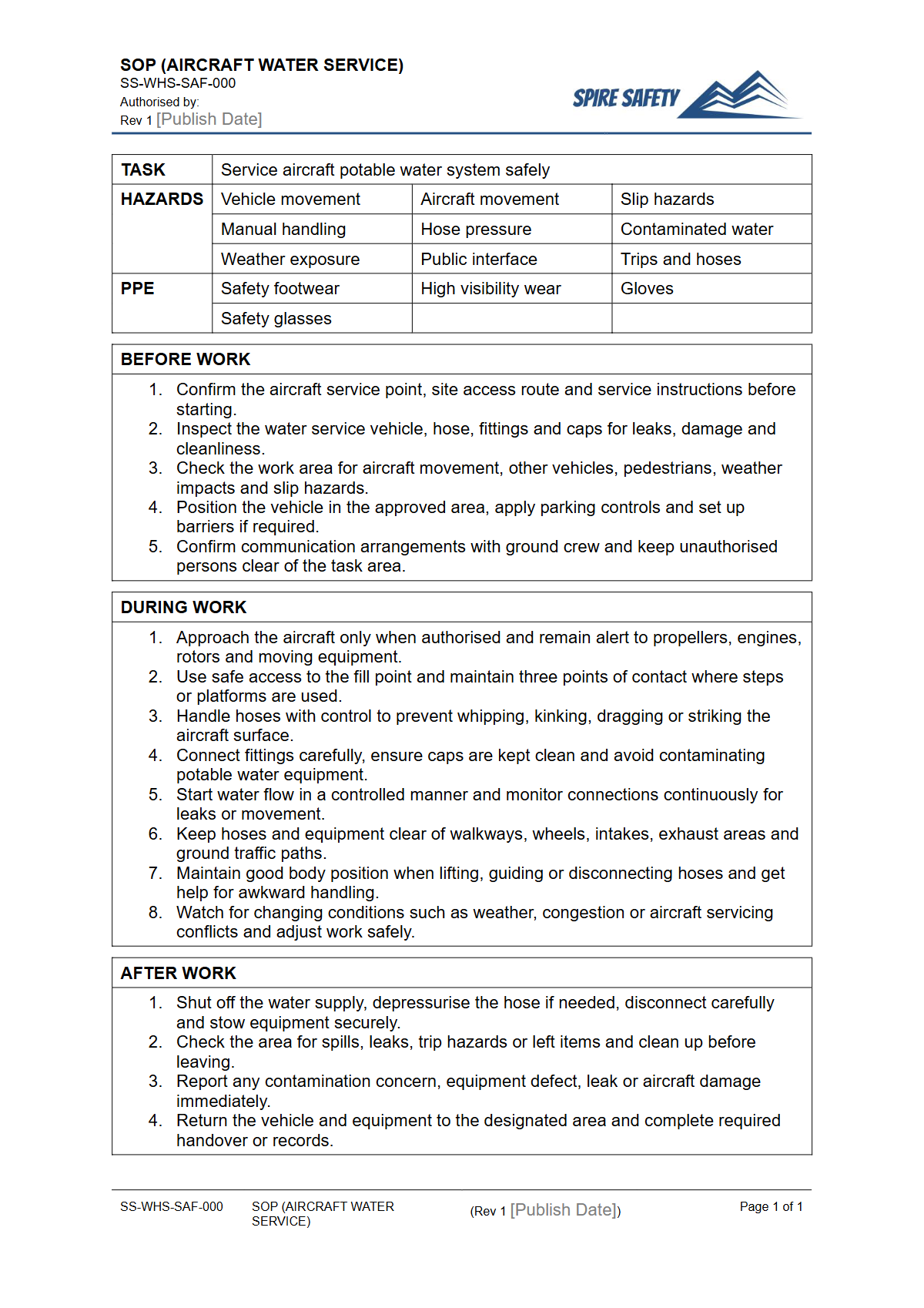
Download our free Safe Operating Procedure (Aircraft Water Service) Template. This editable DOCX and PDF helps define safe work steps for aviation ground crews.
Free Safe Operating Procedure (Aircraft Water Service) Template
DOCX • 126 KB + PDF
Updated Oct 2026
No signup required
Purpose of the Free Safe Operating Procedure (Aircraft Water Service) Template
This Safe Operating Procedure (SOP) template provides a structured framework for documenting the required steps to safely service an aircraft's potable (drinking) water and non-potable (toilet or 'blue') water systems. An effective SOP is a critical administrative control that standardises processes, reduces the risk of error, and ensures tasks are performed consistently and safely by all personnel.
Using our free Safe Operating Procedure (Aircraft Water Service) Template helps your organisation clearly define hazards, outline risk controls, and establish a clear sequence of work. It serves as a vital tool for worker training, competency assessments, and demonstrating due diligence in managing workplace health and safety.
A well-defined SOP is a cornerstone of any effective safety framework. Integrating this procedure into your broader safety program ensures that specific task-level risks are managed in alignment with your overall organisational goals. Proper implementation supports the development and maintenance of comprehensive WHS management systems.
Video walkthrough
How to use the Free Safe Operating Procedure (Aircraft Water Service) Template
This template is available as an editable Microsoft Word (DOCX) document, allowing for full customisation. A PDF version is also provided for easy printing and distribution.
To use the template, download the file and systematically work through each section, replacing the placeholder text with information specific to your operational context. This includes detailing the exact models of water service carts, types of aircraft serviced, specific personal protective equipment (PPE) requirements, and emergency response actions relevant to your aerodrome.
Important: This document is a starting point. We have provided a structured template aligned with Australian WHS principles, but you must adapt it to reflect the unique equipment, processes, and risks present in your workplace.
A generic procedure is not sufficient for compliance; it must be made site-specific. Procedures for ground support equipment can vary significantly, so what works for one task might need adjustment for another, similar to the differences between this procedure and a free Water Truck SOP template.
Key elements of an effective SOP
As you customise the template, ensure it thoroughly covers these core areas:
- Pre-operational Checks: Detail the visual inspections required for the water service cart, hoses, couplings, and any associated vehicles before use. This includes checking for leaks, contamination, and general serviceability.
- Step-by-Step Task Sequence: Clearly and logically list every action the operator must take, from positioning the equipment to connecting, servicing, and disconnecting from the aircraft. Use simple, direct language. Include separate procedures for potable and non-potable water to prevent cross-contamination.
- Hazard Identification and Controls: List all foreseeable hazards associated with the task, such as manual handling, slip and trip hazards from spills, exposure to cleaning or disinfection chemicals, and potential for cross-contamination. For each hazard, specify the required control measures.
- Emergency Procedures: Outline the immediate actions to be taken in case of an emergency, such as a major spill, chemical exposure, or equipment failure.
When to use it
A Safe Operating Procedure for aircraft water servicing should be used as a primary reference document in several key situations. It is essential for the induction and training of new ground crew members, ensuring they learn the correct, safe method from the outset.
It also serves as an excellent tool for conducting periodic refresher training and competency verification for experienced staff. Furthermore, the SOP should be readily accessible in the work area for pre-task reference.
In the unfortunate event of an incident or near-miss, the SOP becomes a critical document for the investigation process, helping to identify any procedural gaps or non-conformance.
This document complements other vehicle-specific procedures, such as a Body Truck SOP template, to build a comprehensive library of safe work instructions for your ground support operations. Having a full suite of SOPs ensures consistency across all ground handling tasks.
Who should use it
This template is designed for use by a range of personnel within the Australian aviation and aerospace sectors. Primary users include:
- Ground Crew and Ramp Agents: The operators who perform the task daily and rely on the SOP for clear, safe instruction.
- Supervisors and Team Leaders: Responsible for training their teams, overseeing work, and ensuring procedures are followed correctly.
- WHS/HSE Managers and Advisors: Professionals who develop, implement, and review safety documentation as part of the organisation's overall WHS system.
- Aircraft Maintenance Engineers (AMEs): May be involved in or oversee water servicing tasks, particularly after maintenance or system disinfection.
Regularly reviewing and updating SOPs is a key activity to ensure ongoing safety performance. This process can be supported by periodic independent reviews to identify gaps and opportunities for improvement, often conducted as part of WHS compliance auditing activities.
By thoroughly customising this SOP, your organisation can establish a robust procedure that protects workers and ensures the hygienic integrity of aircraft water systems. For additional procedural documents and safety tools, feel free to browse our complete free WHS resources library.
Common mistakes
Common mistakes to avoid
- Using the same equipment (hoses, carts) for both potable and non-potable water systems.
- Failing to wear appropriate personal protective equipment (PPE), especially gloves and eye protection.
- Neglecting pre-use checks on hoses and couplings, leading to leaks or connection failures.
- Not properly securing the water service cart's brakes before starting the task.
Legal references
Legal considerations
The following legal requirements may be relevant to this type of work.
- Work Health and Safety Act (Harmonised) — Provides the primary duties for protecting workers and other people from work health and safety risks.
- Work Health and Safety Regulations (Harmonised) — Sets out requirements supporting the management of workplace hazards and risks.
The following codes may be relevant to this type of work.
- Managing WHS Risks Code of Practice — Provides practical guidance on identifying hazards, assessing risks and applying effective controls.
- Work Health and Safety Consultation, Cooperation and Coordination Code of Practice — Provides practical guidance on consulting workers and coordinating with other duty holders.
- Managing the Work Environment and Facilities Code of Practice — Provides practical guidance on safe work environments, workplace facilities and related controls.
Did you know
Water System Hygiene
Aircraft potable water systems require regular, scheduled disinfection to prevent the growth of bacteria like Legionella. These procedures are strictly regulated by aviation authorities and public health organisations worldwide to protect passenger and crew health.
Colour Coding
To prevent catastrophic errors, ground support equipment couplings are often physically different and colour-coded. Potable water connections are distinct from those used for toilet waste ('lavatory') servicing, making it difficult to connect the wrong hose.
FAQ
Frequently asked questions
01What is the difference between potable and non-potable aircraft water service?
02Why is a specific SOP needed for aircraft water servicing?
03What PPE is typically required for aircraft water service?
04How often should an aircraft water service SOP be reviewed?
Share this resource
Free Safe Operating Procedure (Aircraft Water Service) Template
Browse Categories
How To Use It
- 1Download and open in Word or PDF.
- 2Replace the placeholders with your business details.
- 3Get it reviewed by a WHS specialist before rollout.
Need it customised?
Our WHS consultants can adapt this template to your site, run a gap analysis, or audit what you already have in place.
Book a Free Consultation WHS consulting servicesor call 1300 156 382
Related templates
- Free Safe Operating Procedure (Airfield Lighting Work) Template
- Free Safe Operating Procedure (Airless Paint Sprayer) Template
- Free Safe Operating Procedure (Airport Bus) Template
- Free Safe Operating Procedure (Airside Baggage Transfer) Template
- Free Safe Operating Procedure (Airside Cabin Supplies) Template
- Free Safe Operating Procedure (Airside Catering Delivery) Template