
Free Safe Operating Procedure (Aircraft Tyre Change) Template
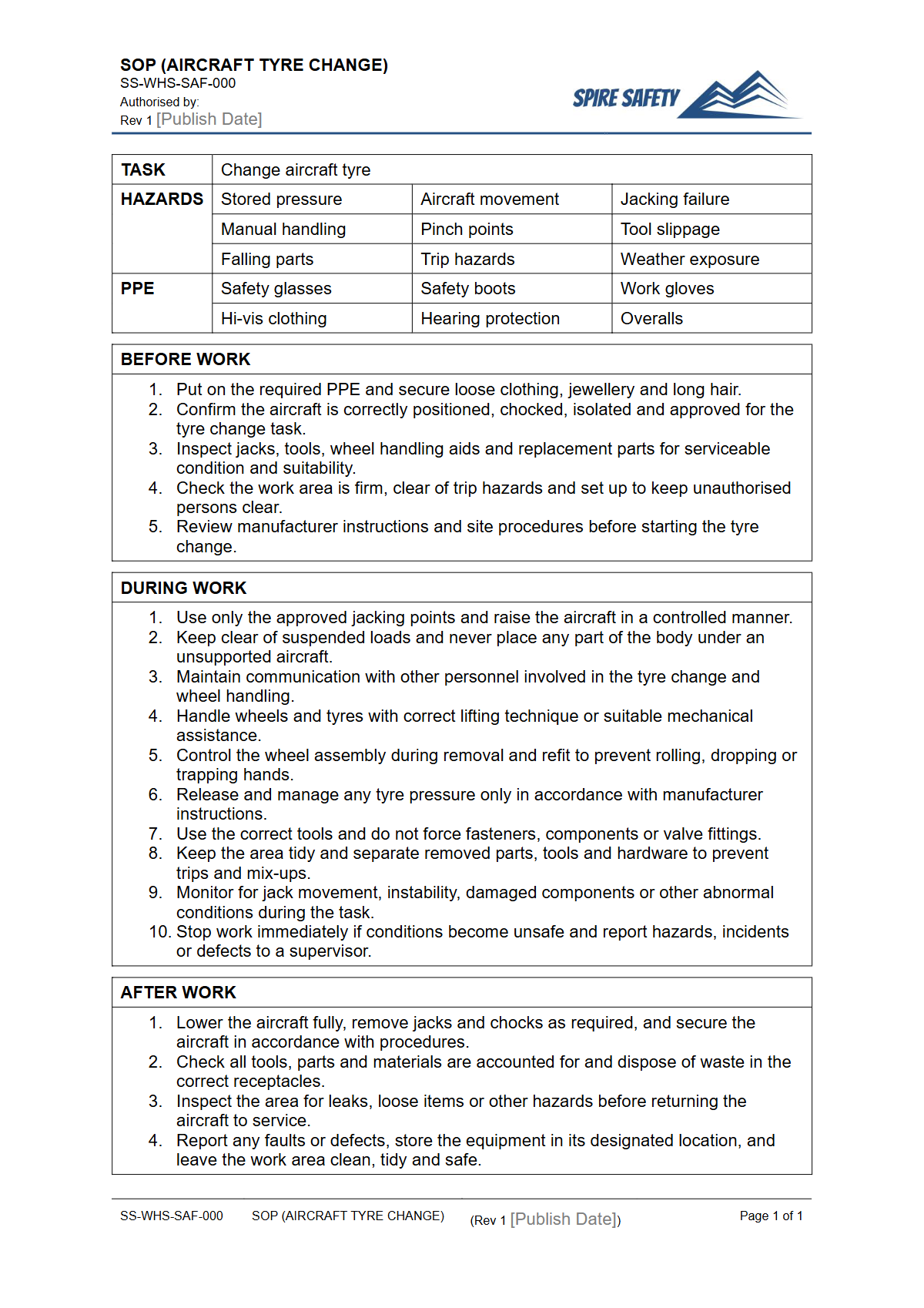
Download our free Safe Operating Procedure (Aircraft Tyre Change) template. This structured DOCX and PDF helps manage high-risk aviation maintenance tasks.
Free Safe Operating Procedure (Aircraft Tyre Change) Template
DOCX • 126 KB + PDF
Updated Oct 2026
No signup required
Purpose of the Free Safe Operating Procedure (Aircraft Tyre Change) Template
Changing an aircraft tyre is a high-risk maintenance task that involves significant hazards, including stored energy in pressurised tyres, manual handling of heavy components, and the use of specialised tooling. A structured Safe Operating Procedure (SOP) is essential for ensuring this task is performed safely and consistently.
This free Safe Operating Procedure (Aircraft Tyre Change) template provides a documented framework for maintenance organisations to outline the required steps, identify potential hazards, and implement effective risk controls.
By formalising the process, you create a reliable reference for technicians, standardise work methods, and demonstrate a commitment to workplace health and safety. A well-developed SOP helps prevent catastrophic failures, personal injury, and damage to the aircraft.
The procedure should be integrated into your broader safety framework, forming a key part of a comprehensive WHS management system that protects both your people and assets.
Video walkthrough
How to use the Free Safe Operating Procedure (Aircraft Tyre Change) Template
This template is a starting point designed to be adapted to your specific operational context. It is not a complete, ready-to-use document.
To use it effectively, download the DOCX file and customise it with details relevant to your organisation, including the specific aircraft types you service, the ground support equipment available, and your unique site conditions. It is critical to consult the relevant Aircraft Maintenance Manual (AMM) for the specific model, as it contains the authoritative procedures, torque values, and specifications.
Important: This is a generic template that we have created as a starting point. You must customise this document to reflect the specific hazards, equipment, and processes in your workplace.
The end user is solely responsible for ensuring the final document is fit for purpose and provides a safe system of work. Procedures for other ground support equipment, such as a FREE Telehandler SOP Template, should also be customised for your site.
Key Sections to Customise:
- PPE Requirements: Specify the exact Personal Protective Equipment needed, such as safety glasses, steel-capped boots, and gloves.
- Tools and Equipment: List all required tools, including calibrated torque wrenches, tyre deflation tools, wheel dollies, and jacks.
- Step-by-Step Procedure: Detail every action from aircraft preparation and deflating the tyre to wheel removal, installation, and inflation. Ensure steps align with the AMM.
- Hazard Identification and Risk Control: Review and expand upon the listed hazards, adding controls specific to your environment. This might include procedures for high-pressure systems like those outlined in a Free Air Compressor SOP.
- Emergency Procedures: Outline the steps to take in case of an emergency, such as a tyre explosion, hydraulic leak, or personal injury.
When to use it
This SOP should be the primary reference document whenever a scheduled or unscheduled aircraft tyre change is required. It serves as a critical tool during the initial and recurrent training of aircraft maintenance technicians, ensuring they understand the approved methodology.
It should also be used as a checklist during the task itself to prevent steps from being missed. Furthermore, the SOP is a vital document during safety meetings and for activities related to WHS compliance auditing to review and improve maintenance procedures.
Who should use it
This Safe Operating Procedure is intended for use by qualified and authorised personnel within an aviation maintenance organisation. This includes Licensed Aircraft Maintenance Engineers (LAMEs), Aircraft Maintenance Technicians, and apprentices under direct supervision.
WHS managers and Maintenance Supervisors should also use this document to oversee operations, conduct training, and ensure that safety standards are consistently met. Documenting procedures for all workshop tasks is crucial, extending even to seemingly simple tasks involving basic access equipment like step ladders.
Spire Safety provides a wide range of templates and documents to assist in building a robust safety system. You can explore our complete free WHS resources library for more templates to support your operations.
Common mistakes
Common mistakes to avoid
- Failing to fully deflate the tyre before attempting to remove the wheel assembly.
- Using an uncalibrated torque wrench or applying incorrect torque values during installation.
- Neglecting to inspect the wheel, brake assembly, and hardware for damage or wear.
- Forgetting to install locking devices, such as cotter pins or lock rings, after assembly.
Legal references
Legal considerations
The following legal requirements may be relevant to this type of work.
- Work Health and Safety Act (Harmonised) — Provides the primary duties for protecting workers and other people from work health and safety risks.
- Work Health and Safety Regulations (Harmonised) — Sets out requirements supporting the management of workplace hazards and risks.
The following codes may be relevant to this type of work.
- Managing WHS Risks Code of Practice — Provides practical guidance on identifying hazards, assessing risks and applying effective controls.
- Work Health and Safety Consultation, Cooperation and Coordination Code of Practice — Provides practical guidance on consulting workers and coordinating with other duty holders.
- Managing the Work Environment and Facilities Code of Practice — Provides practical guidance on safe work environments, workplace facilities and related controls.
Did you know
Extreme Pressure
A main landing gear tyre on a large commercial aircraft like an Airbus A380 can be inflated to over 220 psi, which is more than six times the pressure of a typical car tyre.
Nitrogen Inflation
Aircraft tyres are inflated with nitrogen, not air. Nitrogen is an inert gas that is less likely to support a fire and is less reactive to the temperature and pressure changes experienced during flight.
FAQ
Frequently asked questions
01Why is an SOP for an aircraft tyre change so important?
02Can I use this template for any type of aircraft?
03What training is required to perform an aircraft tyre change?
04How often should our Aircraft Tyre Change SOP be reviewed?
Share this resource
Free Safe Operating Procedure (Aircraft Tyre Change) Template
Browse Categories
How To Use It
- 1Download and open in Word or PDF.
- 2Replace the placeholders with your business details.
- 3Get it reviewed by a WHS specialist before rollout.
Need it customised?
Our WHS consultants can adapt this template to your site, run a gap analysis, or audit what you already have in place.
Book a Free Consultation WHS consulting servicesor call 1300 156 382
Related templates
- Free Safe Operating Procedure (Aircraft Washing) Template
- Free Safe Operating Procedure (Aircraft Water Service) Template
- Free Safe Operating Procedure (Airfield Lighting Work) Template
- Free Safe Operating Procedure (Airless Paint Sprayer) Template
- Free Safe Operating Procedure (Airport Bus) Template
- Free Safe Operating Procedure (Airside Baggage Transfer) Template