
Free Safe Operating Procedure (Aircraft Towbar) Template
Download our Free Safe Operating Procedure (Aircraft Towbar) Template.
Free Safe Operating Procedure (Aircraft Towbar) Template
DOCX • 126 KB + PDF
Updated Oct 2026
No signup required
Purpose of the Free Safe Operating Procedure (Aircraft Towbar) Template
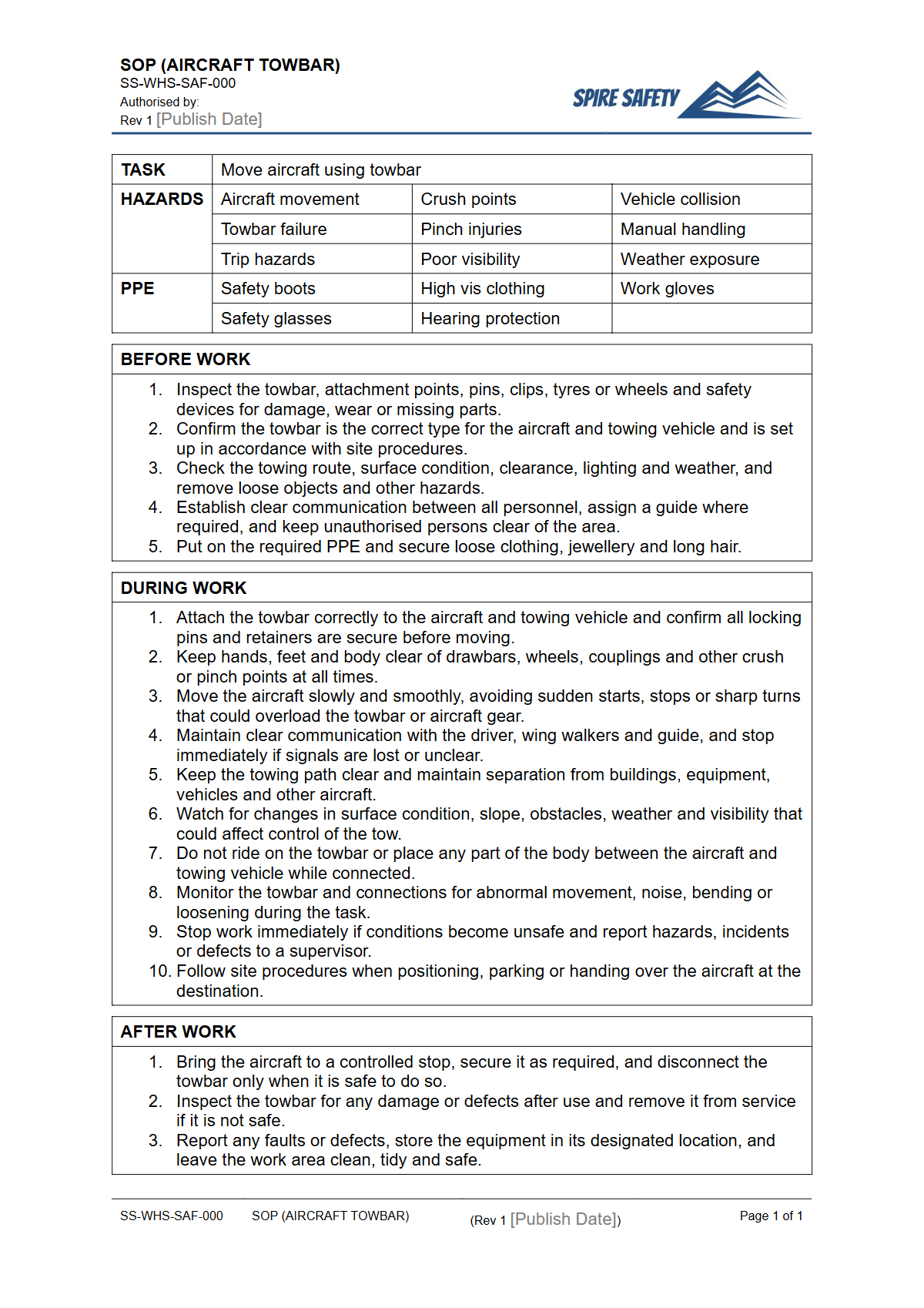
Operating ground support equipment in an aviation environment demands precision and a strict adherence to safety protocols. This Free Safe Operating Procedure (Aircraft Towbar) Template provides a structured starting point for documenting the safe use of aircraft towbars in your workplace.
It is designed to help you outline the required steps for pre-operational checks, connection, towing, disconnection, and post-operational procedures. Using a standardised SOP helps minimise risks such as aircraft damage, equipment failure, and serious injury to ground personnel.
It serves as a critical tool for training, competency assessment, and demonstrating due diligence in managing workplace health and safety risks.
Video walkthrough
How to use the Free Safe Operating Procedure (Aircraft Towbar) Template
This document is a template, not a finished procedure. To implement it effectively, you must customise it to reflect the specific equipment, aircraft, and conditions at your site.
Download the DOCX file and work through each section, replacing the placeholder text with your operational details. This includes specifying the exact models of towbars and tractors in use, the types of aircraft they service, your airfield's unique layout, and established communication protocols.
It is vital to consult with the operators who perform the task, their supervisors, and health and safety representatives during this process. We've provided a comprehensive framework, but it is your organisation's responsibility to ensure the final document is accurate, relevant, and fully integrated into your existing safety management system. For comparison, you can see how safety procedures for different types of heavy equipment are structured in our Body Truck SOP template.
When to use an Aircraft Towbar SOP
A Safe Operating Procedure for aircraft towbars should be a living document within your organisation. It is used in several key situations.
Primarily, it forms the basis of training for all new ground crew tasked with aircraft movement. It should also be used for conducting regular refresher training to prevent procedural drift and reinforce safe habits.
The SOP serves as the benchmark against which operator competency is verified. Furthermore, the procedure must be reviewed and updated whenever there is a change in equipment, processes, or following any incident or near-miss involving aircraft towing operations. This continuous review is a core component of a healthy WHS management system.
Who should use this Safe Operating Procedure
This SOP template is designed for a range of personnel within an aviation or MRO setting. WHS Managers and Safety Officers will use it to formalise risk controls and ensure a consistent, documented approach to a high-risk task.
Supervisors and Team Leaders will use the finalised procedure to train staff, induct new team members, and monitor day-to-day compliance on the apron. The operators themselves—the ground crew and aircraft maintenance engineers—are the primary end-users, relying on the SOP for clear, step-by-step instructions that guide their work safely and efficiently. While an aircraft towbar has unique risks, the principles of documenting pre-start checks are similar to those in other mobile plant procedures, such as our free Telehandler SOP template.
Key Risk Factors in Aircraft Towing
Using an aircraft towbar introduces several significant risks that your SOP must address. These include mechanical failure of the towbar or shear pins, incorrect connection to the aircraft nose gear, and poor communication between the tow tractor driver and the flight deck or wing walkers.
The potential for collisions with other vehicles, infrastructure, or personnel is always present on a busy airfield. Your procedure needs detailed controls for these hazards, such as mandatory pre-use inspections, clear hand signals or radio communication standards, and defined speed limits. If you need expert assistance in developing comprehensive risk assessments for complex aviation tasks, consider our specialised WHS consulting services.
Auditing and Continuous Improvement
Once implemented, your aircraft towbar SOP is not a 'set and forget' document. Its effectiveness relies on being followed correctly every time.
Regular workplace inspections and observations are necessary to confirm that the documented procedure matches the reality on the ground. These checks can identify gaps or discover 'workarounds' that may have introduced new, uncontrolled hazards.
The findings from these observations should feed back into a review of the SOP. Formal WHS compliance auditing can provide an independent assessment of how well your procedures are implemented and help drive continuous improvement. For more templates and safety documents, browse our complete free WHS resources library.
Common mistakes
Common mistakes to avoid
- Using a towbar not rated for the specific aircraft type and weight.
- Failing to conduct a thorough pre-use inspection of the towbar, including the shear pin and attachment points.
- Poor or unclear communication between the tow vehicle operator, wing walkers, and the flight deck.
- Exceeding towing speed limits or making excessively sharp turns, putting stress on the nose gear and towbar.
Legal references
Legal considerations
The following legal requirements may be relevant to this type of work.
- Work Health and Safety Act (Harmonised) — Provides the primary duties for protecting workers and other people from work health and safety risks.
- Work Health and Safety Regulations (Harmonised) — Sets out requirements supporting the management of workplace hazards and risks.
The following codes may be relevant to this type of work.
- Managing WHS Risks Code of Practice — Provides practical guidance on identifying hazards, assessing risks and applying effective controls.
- Work Health and Safety Consultation, Cooperation and Coordination Code of Practice — Provides practical guidance on consulting workers and coordinating with other duty holders.
- Managing the Work Environment and Facilities Code of Practice — Provides practical guidance on safe work environments, workplace facilities and related controls.
Did you know
Shear Pin Savvy
The shear pin or shear bolt on an aircraft towbar is a critical safety feature. It is designed to be the weakest link, failing under excessive stress to prevent expensive and dangerous damage to the aircraft's nose landing gear.
Cost of Error
Ground handling incidents, including towing errors, are estimated to cost the global aviation industry billions of dollars each year in aircraft repairs, operational delays, and associated damages.
FAQ
Frequently asked questions
01What key risks does an aircraft towbar SOP address?
02Is an SOP legally required for using an aircraft towbar in Australia?
03How often should we review our aircraft towbar SOP?
04Can I use this template for both conventional towbars and towbarless tractors?
Share this resource
Free Safe Operating Procedure (Aircraft Towbar) Template
Browse Categories
How To Use It
- 1Download and open in Word or PDF.
- 2Replace the placeholders with your business details.
- 3Get it reviewed by a WHS specialist before rollout.
Need it customised?
Our WHS consultants can adapt this template to your site, run a gap analysis, or audit what you already have in place.
Book a Free Consultation WHS consulting servicesor call 1300 156 382
Related templates
- Free Safe Operating Procedure (Aircraft Tug) Template
- Free Safe Operating Procedure (Aircraft Tyre Change) Template
- Free Safe Operating Procedure (Aircraft Washing) Template
- Free Safe Operating Procedure (Aircraft Water Service) Template
- Free Safe Operating Procedure (Airfield Lighting Work) Template
- Free Safe Operating Procedure (Airless Paint Sprayer) Template