
Free Safe Operating Procedure (Aircraft Lavatory Clean) Template
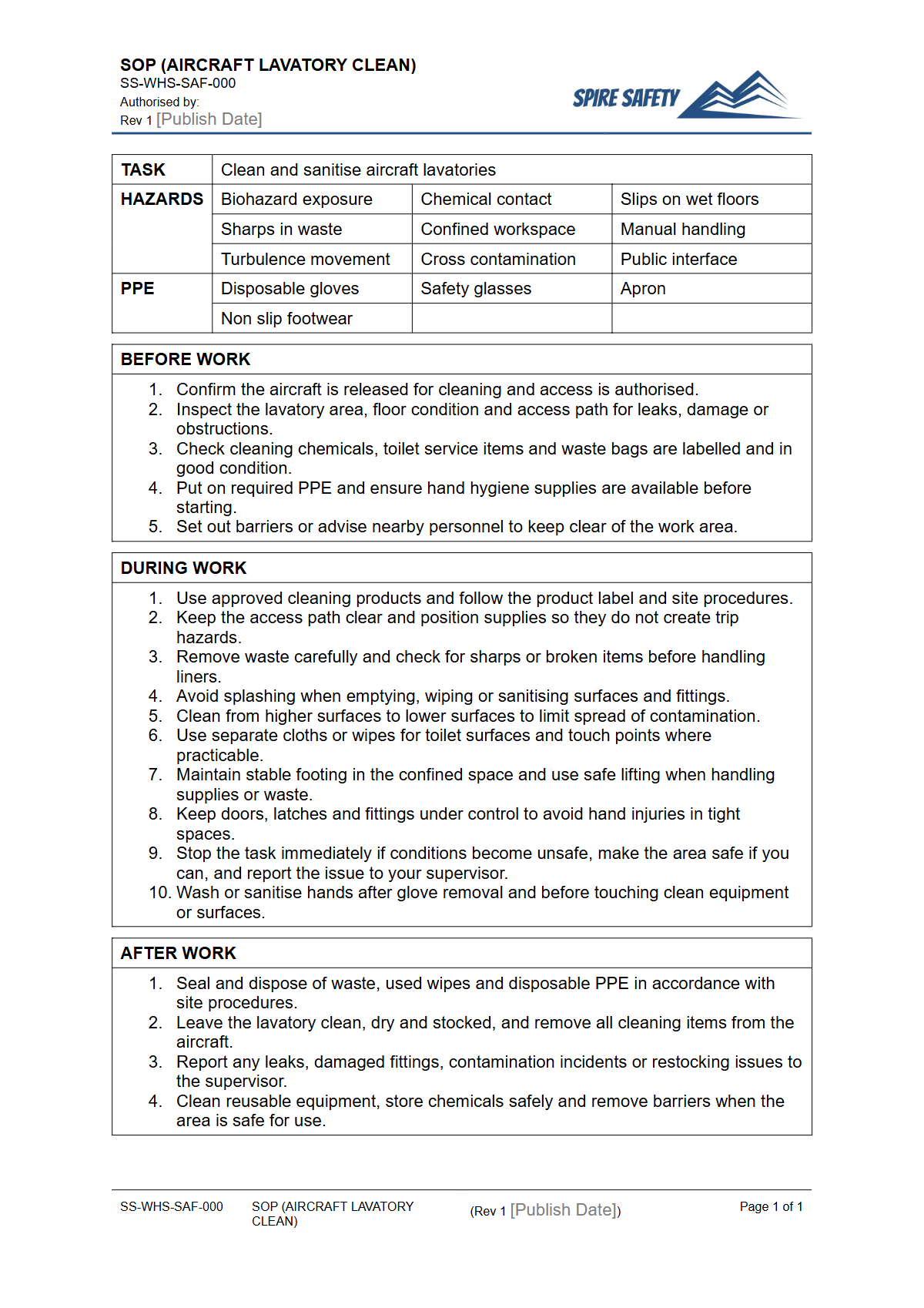
Download our free Safe Operating Procedure (SOP) template for aircraft lavatory cleaning. This DOCX and PDF resource provides a structured starting point.
Free Safe Operating Procedure (Aircraft Lavatory Clean) Template
DOCX • 126 KB + PDF
Updated Oct 2026
No signup required
Purpose of the Free Safe Operating Procedure (Aircraft Lavatory Clean) Template
Cleaning aircraft lavatories is a critical task in the aviation industry, essential for passenger hygiene and comfort. However, it exposes workers to a range of health and safety risks, including biological hazards, chemical exposure, musculoskeletal injuries from manual tasks, and the challenges of working in confined spaces.
This Free Safe Operating Procedure (Aircraft Lavatory Clean) Template provides a structured framework for documenting a safe system of work to manage these risks effectively. It helps organisations standardise their cleaning processes, ensuring every step is performed consistently and safely.
A documented SOP is a fundamental control measure that outlines the required PPE, safe handling of cleaning agents, correct waste disposal, and ergonomic best practices. It forms a key part of your safety management system, demonstrating a commitment to worker health and safety.
Using a clear SOP ensures that all team members, regardless of experience, understand the identified hazards and the required controls. This is vital for maintaining a safe working environment during fast-paced aircraft turnarounds. Formalising procedures for all tasks, including those that might seem simple, is crucial; for example, using ladders to access certain areas requires its own set of controls, as detailed in our free Step Ladder SOP.
Video walkthrough
How to use the Free Safe Operating Procedure (Aircraft Lavatory Clean) Template
This downloadable document is a starting point, not a finished product. To use the Free Safe Operating Procedure (Aircraft Lavatory Clean) Template effectively, you must adapt it to the specific context of your operation, including the types of aircraft you service and the approved chemicals you use.
Start by downloading the template in your preferred format (DOCX for easy editing or PDF). Next, conduct a specific risk assessment for the task in your workplace, involving the workers who perform the cleaning.
Use the findings from your risk assessment to customise the SOP. Add details such as specific aircraft models, names of approved cleaning chemicals and their Safety Data Sheets (SDS), locations of first aid and emergency eyewash stations, and your organisation's emergency contact numbers.
This customisation is a critical step; we have written this document to align with Australian WHS principles, but only a site-specific version can be considered a valid control measure for your workplace. If you require expert assistance in this process, consider engaging professional WHS consulting services.
When to use it
A Safe Operating Procedure for aircraft lavatory cleaning should be used consistently as a primary reference tool. It is not a document to be filed away and forgotten.
It should be readily accessible to all relevant personnel and integrated into daily operations. Use it during the induction and training of new ground crew or cleaning staff to establish a baseline for safe work practices from day one.
It should also be a central document for regular refresher training to prevent complacency and reinforce correct procedures.
The SOP should be reviewed before commencing work, especially if the task is infrequent for a particular worker. It is also a critical reference point during incident investigations to determine if procedures were followed.
Furthermore, the document should be a key part of your safety review cycle. The SOP should be reviewed during regular safety walkthroughs and formal WHS compliance auditing to ensure its continued relevance and effectiveness.
Who should use it
This SOP is intended for a range of personnel within an aviation or ground handling organisation. The primary users are the aircraft cleaning staff and ground crew who perform the task.
They will use it to understand and follow the approved safe work method. Supervisors and team leaders should use the SOP to oversee work, deliver toolbox talks, and ensure their teams are adhering to the established safety standards.
They are responsible for enforcing its application on the tarmac or in the hangar.
WHS managers and safety officers will use this template as a foundation for developing a key part of their safety framework. Incorporating this SOP into your broader WHS management system ensures it is part of a holistic approach to workplace safety and compliance documentation.
Training coordinators can also use the finalised SOP as a cornerstone for developing competency-based training programs. For additional templates to support your safety framework, you can browse our complete free WHS resources library.
Common mistakes
Common mistakes to avoid
- Using a generic template without customising it for specific aircraft types and approved chemicals.
- Failing to provide or use the correct Personal Protective Equipment (PPE) for the specific chemicals and biohazards involved.
- Not providing adequate ventilation, leading to hazardous concentrations of chemical vapours in a confined space.
- Storing cleaning chemicals improperly, such as in unlabelled containers or within the lavatory itself between uses.
Legal references
Legal considerations
The following legal requirements may be relevant to this type of work.
- Work Health and Safety Act (Harmonised) — Provides the primary duties for protecting workers and other people from work health and safety risks.
- Work Health and Safety Regulations (Harmonised) — Sets out requirements supporting the management of workplace hazards and risks.
The following codes may be relevant to this type of work.
- Managing WHS Risks Code of Practice — Provides practical guidance on identifying hazards, assessing risks and applying effective controls.
- Work Health and Safety Consultation, Cooperation and Coordination Code of Practice — Provides practical guidance on consulting workers and coordinating with other duty holders.
- Managing the Work Environment and Facilities Code of Practice — Provides practical guidance on safe work environments, workplace facilities and related controls.
Did you know
Chemical Cocktails
Mixing certain cleaning chemicals, such as bleach and ammonia-based products, can create toxic chloramine gas. An SOP ensures only approved, non-reactive chemical combinations are used.
Turnaround Times
A narrow-body aircraft can have a turnaround time of as little as 25 minutes. Standardised and efficient procedures like SOPs are crucial for performing tasks like lavatory cleaning safely under tight time pressure.
FAQ
Frequently asked questions
01What are the main hazards when cleaning an aircraft lavatory?
02Is an SOP the same as a Safe Work Method Statement (SWMS)?
03How often should an SOP for aircraft lavatory cleaning be reviewed?
04What PPE is required for cleaning an aircraft lavatory?
Share this resource
Free Safe Operating Procedure (Aircraft Lavatory Clean) Template
Browse Categories
How To Use It
- 1Download and open in Word or PDF.
- 2Replace the placeholders with your business details.
- 3Get it reviewed by a WHS specialist before rollout.
Need it customised?
Our WHS consultants can adapt this template to your site, run a gap analysis, or audit what you already have in place.
Book a Free Consultation WHS consulting servicesor call 1300 156 382
Related templates
- Free Safe Operating Procedure (Aircraft Marshalling) Template
- Free Safe Operating Procedure (Aircraft Refuelling) Template
- Free Safe Operating Procedure (Aircraft Seat Cleaning) Template
- Free Safe Operating Procedure (Aircraft Towbar) Template
- Free Safe Operating Procedure (Aircraft Tug) Template
- Free Safe Operating Procedure (Aircraft Tyre Change) Template