
Free Safe Operating Procedure (Aircraft Marshalling) Template
Download our free Safe Operating Procedure (Aircraft Marshalling) Template. This Word and PDF resource helps you outline safe aircraft ground handling.
Free Safe Operating Procedure (Aircraft Marshalling) Template
DOCX • 126 KB + PDF
Updated Oct 2026
No signup required
Purpose of the Free Safe Operating Procedure (Aircraft Marshalling) Template
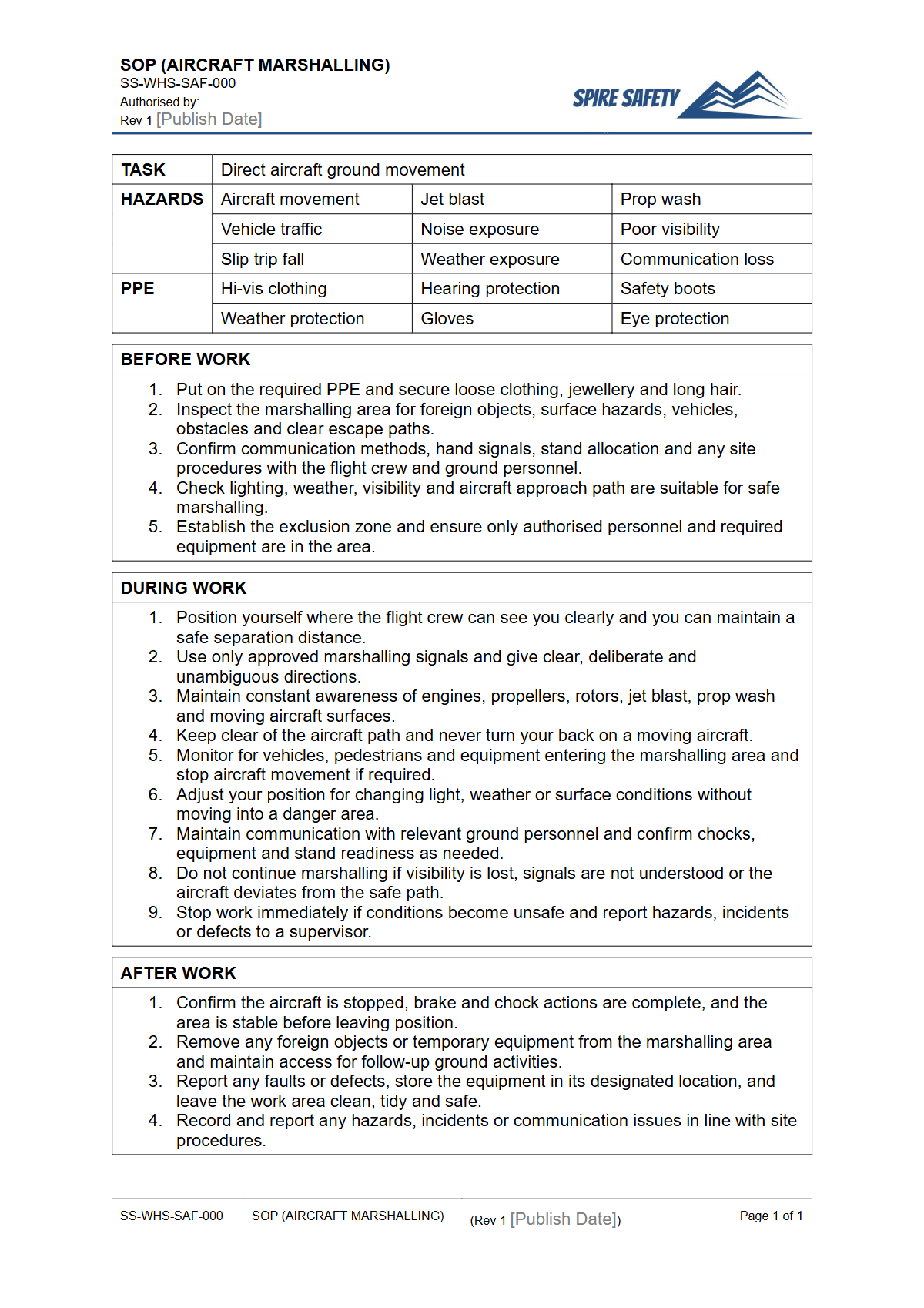
Effectively managing aircraft ground movements is critical for preventing accidents, protecting personnel, and avoiding costly damage to equipment. This Free Safe Operating Procedure (Aircraft Marshalling) Template provides a structured framework for documenting the required steps to guide aircraft safely on the apron, in parking bays, and around the hangar.
A well-defined SOP is a fundamental component of any effective aviation safety program, forming part of a broader commitment to developing a WHS management system that actively identifies and controls risks.
This template is designed to help your organisation establish clear, consistent, and safe work methods for aircraft marshallers. It covers key areas including pre-operational checks, communication protocols (including standard hand signals), required Personal Protective Equipment (PPE), and emergency procedures.
By formalising these steps, you create a reliable reference for training and a clear benchmark for operational conduct, much like our Safe Operating Procedure for telehandlers helps standardise the use of specific ground support equipment.
Video walkthrough
How to use the Free Safe Operating Procedure (Aircraft Marshalling) Template
This document is provided in an easy-to-edit DOCX format, allowing you to tailor it to the unique requirements of your aerodrome or facility. To use it, download the file and systematically work through each section, replacing the placeholder text with information specific to your site, aircraft types, ground support equipment, and personnel roles.
This includes specifying the responsibilities of the PCBU, marshallers, pilots, and other ground crew.
Customising the Safe Operating Procedure
You must adapt the procedures to reflect the specific hazards and control measures relevant to your operations. This includes detailing the exact ICAO or site-specific hand signals to be used, defining clear zones for personnel and vehicles, and outlining step-by-step instructions for various marshalling scenarios (e.g., arrival, departure, pushback, and towing).
Important Note: This document is a template and not a complete Safe Operating Procedure. It is intended to be a starting point.
We have created this resource to be customised for your organisation's specific needs, and it should not be used 'as is'. You must review and adapt it to ensure it reflects your unique operational risks and legal obligations.
When to use it
A formal SOP for aircraft marshalling should be implemented and actively used in several key situations. It is essential for the initial training and competency assessment of all new aircraft marshallers.
It also serves as a vital tool for conducting regular refresher training to prevent skill fade and reinforce safety standards. This procedure should be referenced during the planning of any non-routine aircraft movements and reviewed as part of any incident investigation. Regular reviews are also a core part of due diligence, which can be verified through internal or external WHS compliance auditing services.
The SOP should be readily accessible in the workplace for quick reference by supervisors and ground crew. It is a living document that should be consulted and updated whenever there is a change in airport layout, equipment, or operational procedures, ensuring it always reflects current best practice. This approach to procedural safety is applicable across various high-risk tasks, similar to the protocols outlined in our body truck SOP template.
Who should use it
This template is designed for use by individuals responsible for workplace safety and operational management within the aviation industry. This includes, but is not limited to, WHS Managers, Aviation Safety Officers, Aerodrome Managers, and Ground Operations Supervisors.
Line managers and team leaders who oversee aircraft ground handling crews will find it invaluable for standardising procedures and delivering effective training. Even simple tasks benefit from clear procedures, as shown in our step ladder use SOP.
Consultation is a key part of developing effective SOPs. It is crucial to involve the aircraft marshallers and pilots who will be using the procedure in its development and review.
Their firsthand experience is essential for creating a practical and effective document that genuinely enhances safety. Explore our complete free WHS resources library for more tools to support your safety management system.
Common mistakes
Common mistakes to avoid
- Failing to establish positive eye contact with the flight crew before initiating signals.
- Using non-standard, improvised, or unclear hand signals that could be misinterpreted.
- Not adequately accounting for environmental factors like poor visibility, night operations, or adverse weather.
- Becoming complacent and moving inside minimum safe distances from the aircraft or its engines.
Legal references
Legal considerations
The following legal requirements may be relevant to this type of work.
- Work Health and Safety Act (Harmonised) — Provides the primary duties for protecting workers and other people from work health and safety risks.
- Work Health and Safety Regulations (Harmonised) — Sets out requirements supporting the management of workplace hazards and risks.
The following codes may be relevant to this type of work.
- Managing WHS Risks Code of Practice — Provides practical guidance on identifying hazards, assessing risks and applying effective controls.
- Work Health and Safety Consultation, Cooperation and Coordination Code of Practice — Provides practical guidance on consulting workers and coordinating with other duty holders.
- Managing the Work Environment and Facilities Code of Practice — Provides practical guidance on safe work environments, workplace facilities and related controls.
Did you know
Silent Language
Aircraft marshalling relies on a globally recognised set of hand signals, ensuring pilots and ground crew can communicate clearly despite loud engine noise and potential language barriers.
Danger Zones
The area around a jet engine's intake and exhaust is extremely hazardous. A primary function of an aircraft marshaller is to ensure all personnel and equipment remain clear of these invisible danger zones during engine operation.
FAQ
Frequently asked questions
01What are the standard aircraft marshalling signals?
02Is a Safe Operating Procedure a legal requirement for aircraft marshalling?
03What PPE is required for an aircraft marshaller?
04How often should aircraft marshalling procedures be reviewed?
Share this resource
Free Safe Operating Procedure (Aircraft Marshalling) Template
Browse Categories
How To Use It
- 1Download and open in Word or PDF.
- 2Replace the placeholders with your business details.
- 3Get it reviewed by a WHS specialist before rollout.
Need it customised?
Our WHS consultants can adapt this template to your site, run a gap analysis, or audit what you already have in place.
Book a Free Consultation WHS consulting servicesor call 1300 156 382
Related templates
- Free Safe Operating Procedure (Aircraft Refuelling) Template
- Free Safe Operating Procedure (Aircraft Seat Cleaning) Template
- Free Safe Operating Procedure (Aircraft Towbar) Template
- Free Safe Operating Procedure (Aircraft Tug) Template
- Free Safe Operating Procedure (Aircraft Tyre Change) Template
- Free Safe Operating Procedure (Aircraft Washing) Template