
Free Safe Operating Procedure (Aircraft Refuelling) Template
Formalise your high-risk aviation procedures with our free Safe Operating Procedure for aircraft refuelling. Download the DOCX & PDF template to start now.
Free Safe Operating Procedure (Aircraft Refuelling) Template
DOCX • 126 KB + PDF
Updated Oct 2026
No signup required
Purpose of the Free Safe Operating Procedure (Aircraft Refuelling) Template
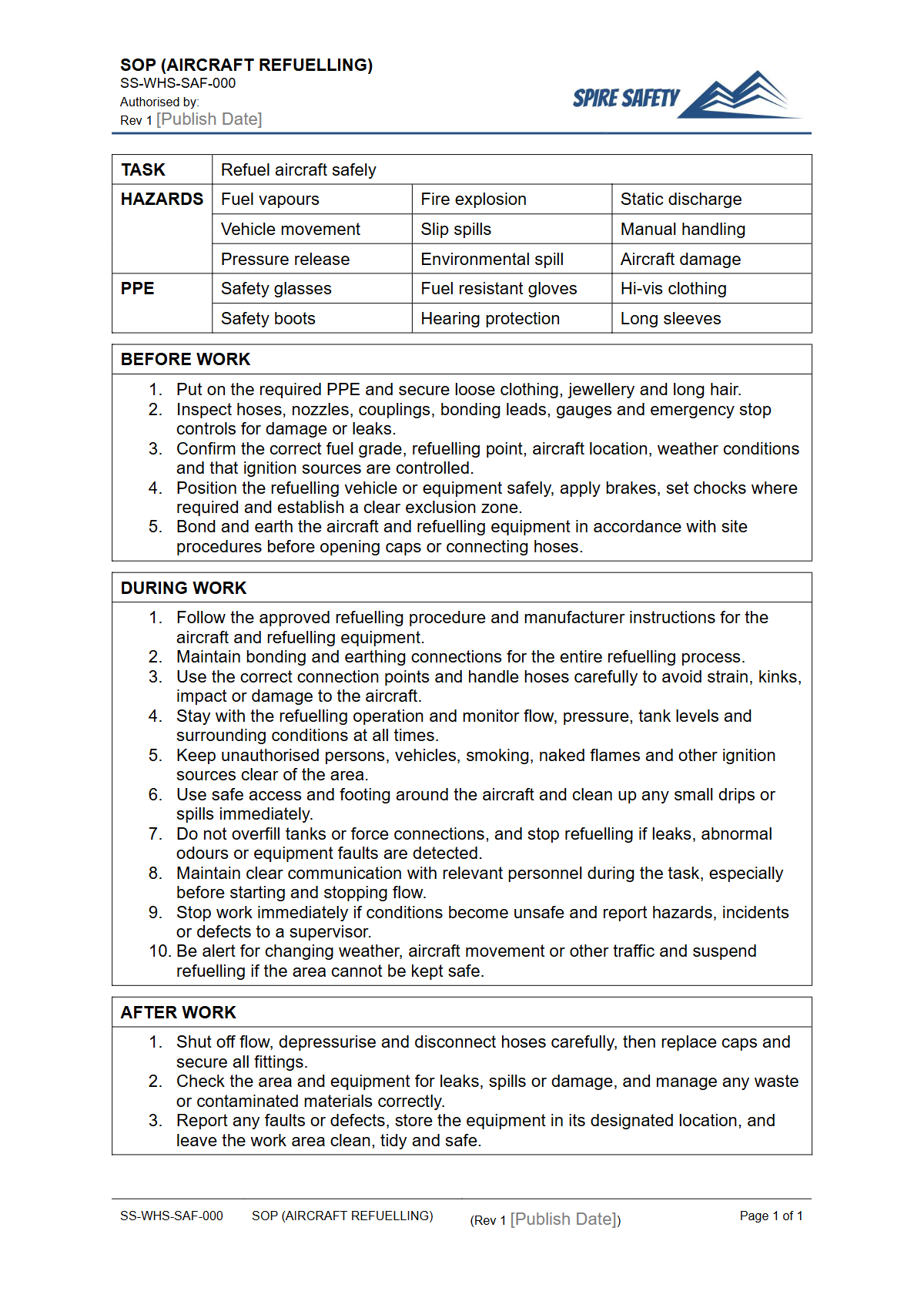
Aircraft refuelling is a high-risk activity that demands precision, awareness, and strict adherence to safety protocols. This free Safe Operating Procedure (Aircraft Refuelling) Template provides a structured framework for documenting the step-by-step process required to perform this task safely.
Its primary purpose is to help your organisation manage significant risks, including fire, explosion, fuel spills, and personal injury. By clearly defining roles, responsibilities, and procedural steps, this SOP serves as a critical tool for worker training, competency verification, and operational consistency.
A well-defined SOP is a cornerstone of a robust safety framework. It helps ensure that all personnel, from seasoned ground crew to new trainees, follow the same approved methodology every time.
This document is designed to integrate into a complete WHS management system, providing auditable evidence that your organisation has established formal processes to control known hazards associated with aviation fuel handling.
Key Hazards Addressed
This template prompts you to consider and control numerous hazards inherent in aircraft refuelling operations, including:
- Fire and Explosion: Aviation fuels like Jet A-1 and Avgas have low flash points and are highly flammable. The SOP outlines critical controls such as establishing exclusion zones, enforcing strict no-smoking policies, and ensuring correct fire extinguisher types are present and accessible.
- Static Electricity: The movement of fuel can generate a significant static charge, which could discharge as a spark and ignite fuel vapours. The procedure emphasises the mandatory sequence for bonding the aircraft to the refuelling vehicle and grounding them to dissipate static electricity safely.
- Hazardous Manual Tasks: Handling heavy fuel hoses, nozzles, and access equipment can lead to musculoskeletal injuries. The SOP encourages planning for ergonomic risks and using mechanical aids where possible.
- Chemical Exposure: Direct contact with jet fuel or inhalation of its vapours can be harmful. The procedure specifies the required Personal Protective Equipment (PPE), such as fuel-resistant gloves, safety glasses, and appropriate respiratory protection if required.
- Working from Height: Accessing high wing fuel ports may require ladders or elevated work platforms. Using our step ladder SOP as a reference can help detail the safety checks and correct usage procedures for such equipment.
- Environmental Spills: A fuel spill poses a significant environmental and fire risk. The SOP includes steps for pre-operation equipment checks, vigilant monitoring during refuelling, and immediate actions to take in the event of a leak or spill.
Video walkthrough
How to use the Free Safe Operating Procedure (Aircraft Refuelling) Template
This document is provided in DOCX format for easy editing and PDF for immediate use. To use it effectively, you must adapt it to the specific context of your workplace.
This involves a thorough review and customisation process to ensure it accurately reflects your equipment, personnel, and operational environment. Generic procedures are insufficient for managing high-risk tasks; site-specific details are essential for the SOP to be a useful and effective control measure.
The template provides sections for pre-operational checks, the step-by-step refuelling process (both over-wing and single-point pressure refuelling), post-operational tasks, and emergency procedures. When customising, consider the different types of aircraft you service and the refuelling equipment used, such as bowsers or hydrant dispenser vehicles.
If your refuellers are truck-based, you might also reference a specific safe operating procedure for a body truck to cover vehicle-specific safety checks.
Important: This template provides a structured starting point. It is essential that you customise this document to reflect the specific aircraft, refuelling equipment, fuel types (e.g., Jet A-1, Avgas), environment, and legislative requirements of your operation.
We are not liable for any incidents that may arise from the use of this template.
When to use it
A Safe Operating Procedure for aircraft refuelling should be used consistently as a core part of your daily operations. Its application includes before, during, and after the task.
It is a critical resource during the initial training and induction of new ground crew and should be a central part of periodic refresher training and competency assessments for all relevant staff. Furthermore, the SOP should be readily available at the point of work for reference. It is also a key document reviewed during internal safety reviews and external WHS compliance audits.
Who should use it
This SOP is intended for all personnel involved in the aircraft refuelling process. This includes, but is not limited to, aircraft refuellers, ground support equipment (GSE) operators, line service technicians, and maintenance engineers.
Supervisors and managers should also use the document to oversee operations and ensure procedures are being followed correctly. The ultimate goal is to ensure that anyone who might perform or supervise the task has been trained on, and is deemed competent in, the procedures outlined in your customised SOP.
This principle extends to other high-risk ground support tasks, where a specific document like a Telehandler SOP is crucial for trained operators.
This is just one of many templates we offer to help Australian businesses improve their safety management. You can explore our entire free WHS resources library for more downloadable checklists, procedures, and forms.
Common mistakes
Common mistakes to avoid
- Forgetting or incorrectly applying bonding and grounding connections.
- Using mobile phones or other non-intrinsically safe electronics within the refuelling safety zone.
- Failing to conduct a thorough pre-use inspection of hoses, nozzles, and emergency shut-offs.
- Leaving a refuelling operation unattended at any point.
Legal references
Legal considerations
The following legal requirements may be relevant to this type of work.
- Work Health and Safety Act (Harmonised) — Provides the primary duties for protecting workers and other people from work health and safety risks.
- Work Health and Safety Regulations (Harmonised) — Sets out requirements supporting the management of workplace hazards and risks.
The following codes may be relevant to this type of work.
- Managing WHS Risks Code of Practice — Provides practical guidance on identifying hazards, assessing risks and applying effective controls.
- Work Health and Safety Consultation, Cooperation and Coordination Code of Practice — Provides practical guidance on consulting workers and coordinating with other duty holders.
- Managing the Work Environment and Facilities Code of Practice — Provides practical guidance on safe work environments, workplace facilities and related controls.
Did you know
Static Spark Danger
A static spark with as little as 0.2 millijoules of energy—less than you'd feel—can be enough to ignite flammable jet fuel vapours, making correct bonding and grounding procedures non-negotiable.
FAQ
Frequently asked questions
01What is a Safe Operating Procedure for aircraft refuelling?
02Is bonding and grounding the same thing in aircraft refuelling?
03Who is responsible for developing an SOP for aircraft refuelling?
04How often should an aircraft refuelling SOP be reviewed?
Share this resource
Free Safe Operating Procedure (Aircraft Refuelling) Template
Browse Categories
How To Use It
- 1Download and open in Word or PDF.
- 2Replace the placeholders with your business details.
- 3Get it reviewed by a WHS specialist before rollout.
Need it customised?
Our WHS consultants can adapt this template to your site, run a gap analysis, or audit what you already have in place.
Book a Free Consultation WHS consulting servicesor call 1300 156 382
Related templates
- Free Safe Operating Procedure (Aircraft Seat Cleaning) Template
- Free Safe Operating Procedure (Aircraft Towbar) Template
- Free Safe Operating Procedure (Aircraft Tug) Template
- Free Safe Operating Procedure (Aircraft Tyre Change) Template
- Free Safe Operating Procedure (Aircraft Washing) Template
- Free Safe Operating Procedure (Aircraft Water Service) Template