
Free Safe Operating Procedure (Aircraft Deicing Prep) Template
Download our free Safe Operating Procedure (Aircraft Deicing Prep) template. A structured starting point for Australian aviation operations.
Free Safe Operating Procedure (Aircraft Deicing Prep) Template
DOCX • 126 KB + PDF
Updated Oct 2026
No signup required
Purpose of the Free Safe Operating Procedure (Aircraft Deicing Prep) Template
Preparing aircraft for deicing is a critical, high-risk task that demands precision, clear communication, and strict adherence to safety protocols. This free Safe Operating Procedure (Aircraft Deicing Prep) template provides a structured framework for documenting the essential steps to manage this process safely.
Using a standardised SOP helps your organisation minimise risks to personnel, prevent damage to aircraft, and ensure operational continuity during adverse weather conditions. It establishes a clear, repeatable process that supports effective training and promotes consistent, safe work behaviour among all ground crew members.
A well-defined SOP is a cornerstone of a robust safety management system. It details the specific hazards associated with deicing preparation, including slips on icy surfaces, exposure to hazardous chemicals like glycols, and potential collisions between ground support equipment and aircraft.
By outlining control measures for these risks, this procedure helps you meet your primary duty of care under Australian WHS legislation. Documenting these steps also provides a clear reference for incident investigations and continuous improvement of your safety practices.
The procedure can be integrated into your broader WHS management systems to ensure alignment with company-wide safety objectives.
Video walkthrough
How to use the Free Safe Operating Procedure (Aircraft Deicing Prep) Template
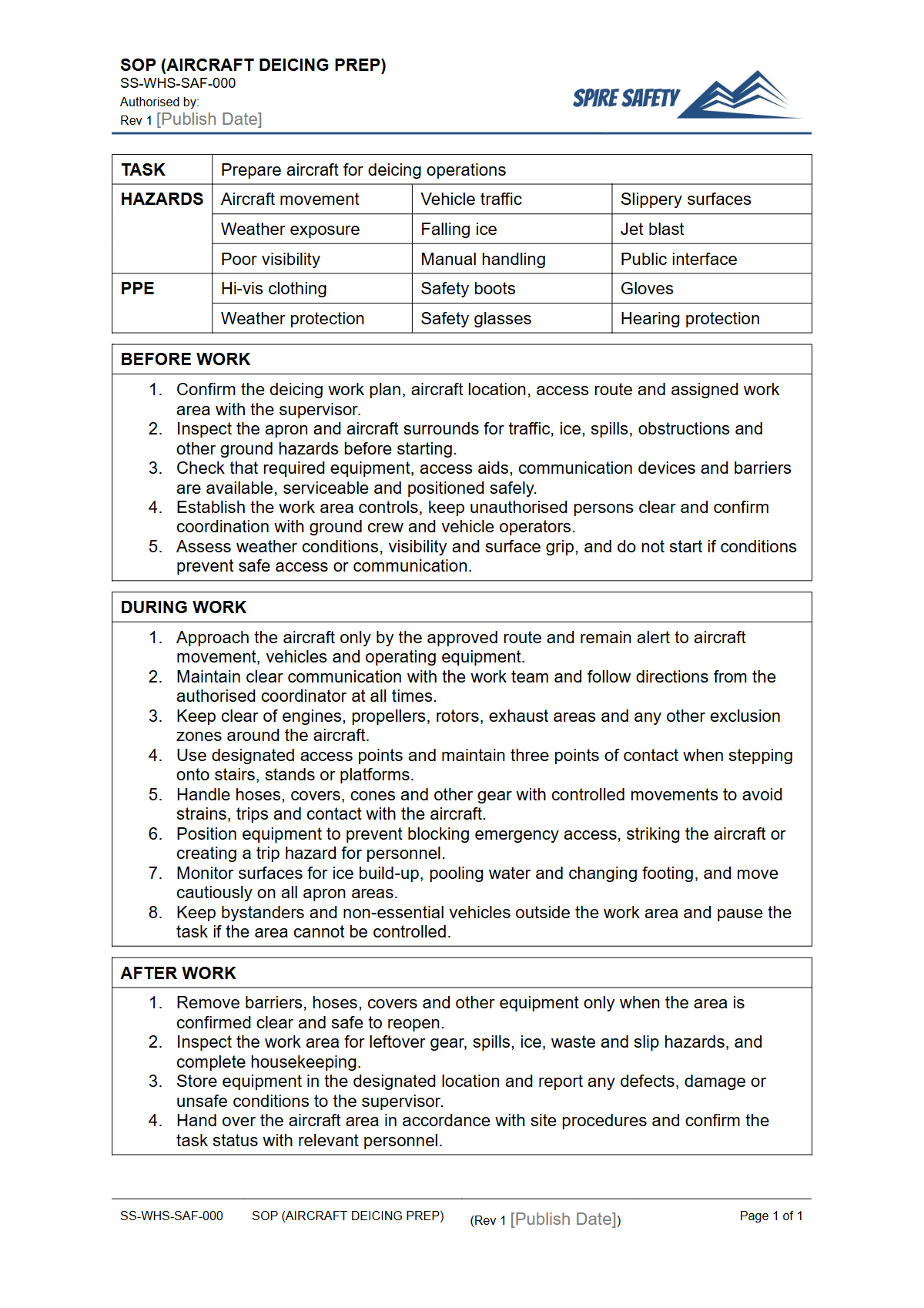
This template is available for download as a DOCX file for easy editing or a PDF for straightforward printing and distribution. It is designed as a comprehensive starting point, pre-filled with common sections relevant to aircraft deicing preparation, such as required PPE, pre-operational checks, step-by-step instructions, and emergency procedures.
The goal is to save you time in developing your documentation, allowing you to focus on tailoring the content to your specific operational environment.
Important: This document is a template, not a finished procedure. To be effective and align with WHS duties, you must customise it to reflect the unique aspects of your workplace. We recommend a competent person reviews and adapts the content, considering factors such as: specific aircraft models you service, the types of deicing and anti-icing fluids used, your site layout and designated deicing pads, local communication protocols, and the specific models of ground support equipment, such as those covered in our FREE Body Truck SOP (Safe Operating Procedure) Template.
When to use this Safe Operating Procedure
This SOP should be implemented whenever ground staff are required to prepare for and support aircraft deicing operations. This is typically triggered by forecasted or present icing conditions, such as frost, snow, ice, or freezing rain.
It applies from the initial equipment setup and fluid preparation stage through to the final post-deicing checks and equipment stand-down. Its use is essential for pre-season readiness drills, live deicing events, and post-event reporting.
Regularly reviewing procedures against operational realities is key, a process often scrutinised during a WHS compliance auditing program to ensure ongoing effectiveness.
Who should use this Safe Operating Procedure
This procedure is intended for all personnel involved in the aircraft deicing process. This includes trained deicing vehicle operators, wing walkers, ramp supervisors, and maintenance staff who prepare and handle the deicing fluids and equipment.
It also serves as a critical training and induction tool for new team members. Supervisors and WHS managers should use this document to verify that safe work practices are being followed and that all team members are competent for their assigned roles. Competency may also involve operating other relevant airfield equipment, like the machinery outlined in our FREE Telehandler SOP (Safe Operating Procedure) Template.
Ultimately, the Person Conducting a Business or Undertaking (PCBU) is responsible for ensuring a safe system of work is in place. This SOP provides the practical framework to help discharge that duty.
For complex aviation environments, seeking external advice can provide valuable insights, and our WHS consulting services can assist in developing site-specific solutions. Simple tasks like accessing components may also require documented procedures, such as a FREE Step Ladder SOP (Safe Operating Procedure) Template, ensuring safety at every level of the operation.
By systematically addressing the risks involved, you create a safer environment for your crew and protect valuable aviation assets. Feel free to explore our complete free WHS resources library for more templates to support your operational safety.
Common mistakes
Common mistakes to avoid
- Failing to consult the correct holdover time (HOT) chart for current weather conditions.
- Applying deicing fluid to incorrect areas, such as engine inlets or pitot tubes.
- Inadequate communication between the deicing crew and the flight crew, leading to premature taxiing.
- Neglecting post-deicing inspections to confirm all critical surfaces are completely free of contamination.
Legal references
Legal considerations
The following legal requirements may be relevant to this type of work.
- Work Health and Safety Act (Harmonised) — Provides the primary duties for protecting workers and other people from work health and safety risks.
- Work Health and Safety Regulations (Harmonised) — Sets out requirements supporting the management of workplace hazards and risks.
The following codes may be relevant to this type of work.
- Managing WHS Risks Code of Practice — Provides practical guidance on identifying hazards, assessing risks and applying effective controls.
- Work Health and Safety Consultation, Cooperation and Coordination Code of Practice — Provides practical guidance on consulting workers and coordinating with other duty holders.
- Managing the Work Environment and Facilities Code of Practice — Provides practical guidance on safe work environments, workplace facilities and related controls.
Did you know
Deicing Fluid Colour Codes
Aircraft deicing and anti-icing fluids are dyed for easy identification. Type I fluids are typically orange and have short-term effectiveness, while Type IV fluids are green and provide longer 'holdover time' protection against re-freezing.
Holdover Time (HOT)
Holdover Time is the estimated duration that anti-icing fluid will prevent frost, ice, or snow from forming on aircraft surfaces. This time is highly dependent on the fluid type, mixture ratio, and current weather conditions like precipitation and temperature.
FAQ
Frequently asked questions
01What personal protective equipment (PPE) is required for aircraft deicing preparation?
02Does this SOP cover both Type I and Type IV deicing fluids?
03How often should an aircraft deicing SOP be reviewed?
04Is a specific licence required to operate deicing equipment in Australia?
Share this resource
Free Safe Operating Procedure (Aircraft Deicing Prep) Template
Browse Categories
How To Use It
- 1Download and open in Word or PDF.
- 2Replace the placeholders with your business details.
- 3Get it reviewed by a WHS specialist before rollout.
Need it customised?
Our WHS consultants can adapt this template to your site, run a gap analysis, or audit what you already have in place.
Book a Free Consultation WHS consulting servicesor call 1300 156 382
Related templates
- Free Safe Operating Procedure (Aircraft Door Check) Template
- Free Safe Operating Procedure (Aircraft Galley Cleaning) Template
- Free Safe Operating Procedure (Aircraft Interior Clean) Template
- Free Safe Operating Procedure (Aircraft Jacking) Template
- Free Safe Operating Procedure (Aircraft Lavatory Clean) Template
- Free Safe Operating Procedure (Aircraft Marshalling) Template