
Free Safe Operating Procedure (Aircraft Door Check) Template
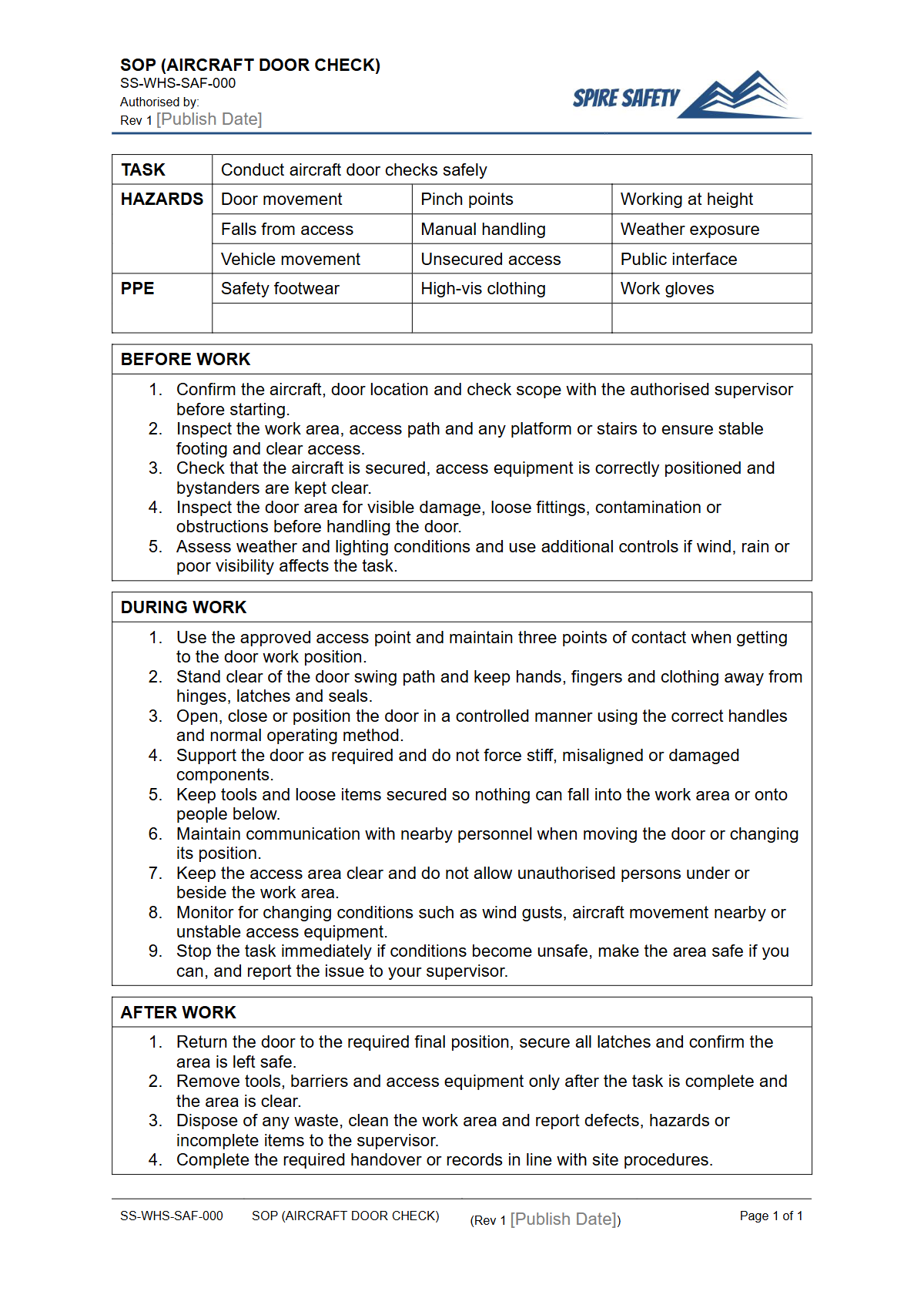
Download our free Safe Operating Procedure (Aircraft Door Check) template. This structured DOCX and PDF helps formalise aircraft door check procedures.
Free Safe Operating Procedure (Aircraft Door Check) Template
DOCX • 126 KB + PDF
Updated Oct 2026
No signup required
Purpose of the Free Safe Operating Procedure (Aircraft Door Check) Template
Ensuring the correct and safe operation of aircraft doors is a critical task in aviation. A single mistake can have severe consequences for safety and operational integrity.
Our Free Safe Operating Procedure (Aircraft Door Check) Template provides a structured framework for documenting the required steps, safety precautions, and responsibilities associated with this high-risk activity. This resource is designed for Australian aviation organisations seeking to formalise their safety processes and provide clear guidance to their teams.
The primary purpose of this template is to provide a clear, step-by-step guide for personnel responsible for operating and verifying the status of aircraft doors. It helps standardise procedures across different shifts and teams, reducing the chance of human error.
A well-defined SOP for aircraft door checks mitigates risks such as incorrect pressurisation during flight, accidental door opening, security breaches, and falls from height for ground crew. Documenting this process is a fundamental part of developing comprehensive WHS management systems within an aviation context.
Video walkthrough
How to use the Free Safe Operating Procedure (Aircraft Door Check) Template
Download the template in your preferred format (DOCX for easy editing or PDF for straightforward printing) and integrate it into your safety documentation. This document is a starting point, aligned with Australian WHS principles, not a finished product.
Important Customisation Note
This template provides a solid foundation based on recognised safety principles. However, to be effective and meet your specific obligations, you must customise it. We've designed the document to be easily edited in Microsoft Word.
You'll need to add details specific to your aircraft models (e.g., Airbus A320, Boeing 737, Dash 8), unique ground support equipment, personnel roles, and site-specific hazards identified through your risk assessment process. A regular review of your safety documents by a third party can also identify gaps, a service provided through WHS compliance auditing.
When to use this Safe Operating Procedure
This SOP should be used as a procedural guide and training tool for all tasks involving the operation of aircraft doors. Key situations include:
- Pre-departure checks by cabin crew or ground staff to ensure all doors are armed and secure.
- Post-arrival checks for disarming and opening doors safely.
- During aircraft maintenance where doors need to be operated for access or testing.
- As a reference during emergency procedure training.
It forms an essential part of the daily operational workflow for many aviation professionals. In a maintenance environment, it sits alongside other key procedures like our Free Air Compressor SOP (Safe Operating Procedure) Template, which might be used for tooling and maintenance tasks.
Who should use this document
This procedure is intended for any worker whose role involves interacting with aircraft doors. This includes:
- Ground Handling Agents: Responsible for opening and closing cargo and passenger doors from the exterior.
- Cabin Crew: Responsible for arming, disarming, and operating doors from the inside.
- Aircraft Maintenance Engineers (AMEs/LAMEs): Who operate doors for maintenance access and perform functional checks.
- Flight Crew: Who have ultimate responsibility for verifying the aircraft's secure state before flight.
- Safety Managers and Training Coordinators: Who use the SOP for developing training programs and conducting safety audits.
For related ground operations, procedures for vehicles are also crucial, such as those outlined in our FREE Body Truck SOP (Safe Operating Procedure) Template for ground support movements.
Integrating the SOP into Your Safety Framework
A standalone SOP is useful, but its true value is realised when it's part of a connected safety system. This procedure should be referenced in your risk assessments, training matrices, and incident investigation protocols.
Ensuring all workers are trained and competent in the procedure is vital. For maintenance tasks that require working at height, even on stands or ladders, specific procedures are necessary.
Consider using our FREE Step Ladder SOP (Safe Operating Procedure) Template to complement this aircraft-specific document.
This SOP is just one of many useful documents available in our free WHS resources library, designed to help you build a safer workplace. If you need expert assistance in developing or refining your aviation-specific safety documents, our team can provide targeted WHS consulting to ensure your procedures are practical and effective for your unique operation.
Common mistakes
Common mistakes to avoid
- Assuming procedures are identical across different aircraft types.
- Poor communication between ground crew and cabin crew before door operation.
- Failing to visually confirm the 'disarmed' status before attempting to open a door from the outside.
- Neglecting to account for environmental factors like high winds when opening large cargo doors.
Legal references
Legal considerations
The following legal requirements may be relevant to this type of work.
- Work Health and Safety Act (Harmonised) — Provides the primary duties for protecting workers and other people from work health and safety risks.
- Work Health and Safety Regulations (Harmonised) — Sets out requirements supporting the management of workplace hazards and risks.
The following codes may be relevant to this type of work.
- Managing WHS Risks Code of Practice — Provides practical guidance on identifying hazards, assessing risks and applying effective controls.
- Work Health and Safety Consultation, Cooperation and Coordination Code of Practice — Provides practical guidance on consulting workers and coordinating with other duty holders.
- Managing the Work Environment and Facilities Code of Practice — Provides practical guidance on safe work environments, workplace facilities and related controls.
Did you know
Costly Mistake
The inadvertent deployment of an emergency evacuation slide during ground operations can cost an airline anywhere from $20,000 to over $100,000 in repair, repackaging, and operational disruption costs.
Pressurisation Force
Even a small pressure differential can exert immense force on an aircraft door. Attempting to open a door before the cabin is fully depressurised can be impossible and extremely dangerous.
FAQ
Frequently asked questions
01What should be included in an aircraft door check SOP?
02Why is a specific SOP for aircraft doors necessary?
03Is this template suitable for all types of aircraft?
04How often should an SOP for aircraft door checks be reviewed?
Share this resource
Free Safe Operating Procedure (Aircraft Door Check) Template
Browse Categories
How To Use It
- 1Download and open in Word or PDF.
- 2Replace the placeholders with your business details.
- 3Get it reviewed by a WHS specialist before rollout.
Need it customised?
Our WHS consultants can adapt this template to your site, run a gap analysis, or audit what you already have in place.
Book a Free Consultation WHS consulting servicesor call 1300 156 382
Related templates
- Free Safe Operating Procedure (Aircraft Galley Cleaning) Template
- Free Safe Operating Procedure (Aircraft Interior Clean) Template
- Free Safe Operating Procedure (Aircraft Jacking) Template
- Free Safe Operating Procedure (Aircraft Lavatory Clean) Template
- Free Safe Operating Procedure (Aircraft Marshalling) Template
- Free Safe Operating Procedure (Aircraft Refuelling) Template