
Free Safe Operating Procedure (Aircraft Catering Load) Template
Download our Free Safe Operating Procedure (Aircraft Catering Load) Template.
Free Safe Operating Procedure (Aircraft Catering Load) Template
DOCX • 126 KB + PDF
Updated Oct 2026
No signup required
Purpose of the Free Safe Operating Procedure (Aircraft Catering Load) Template
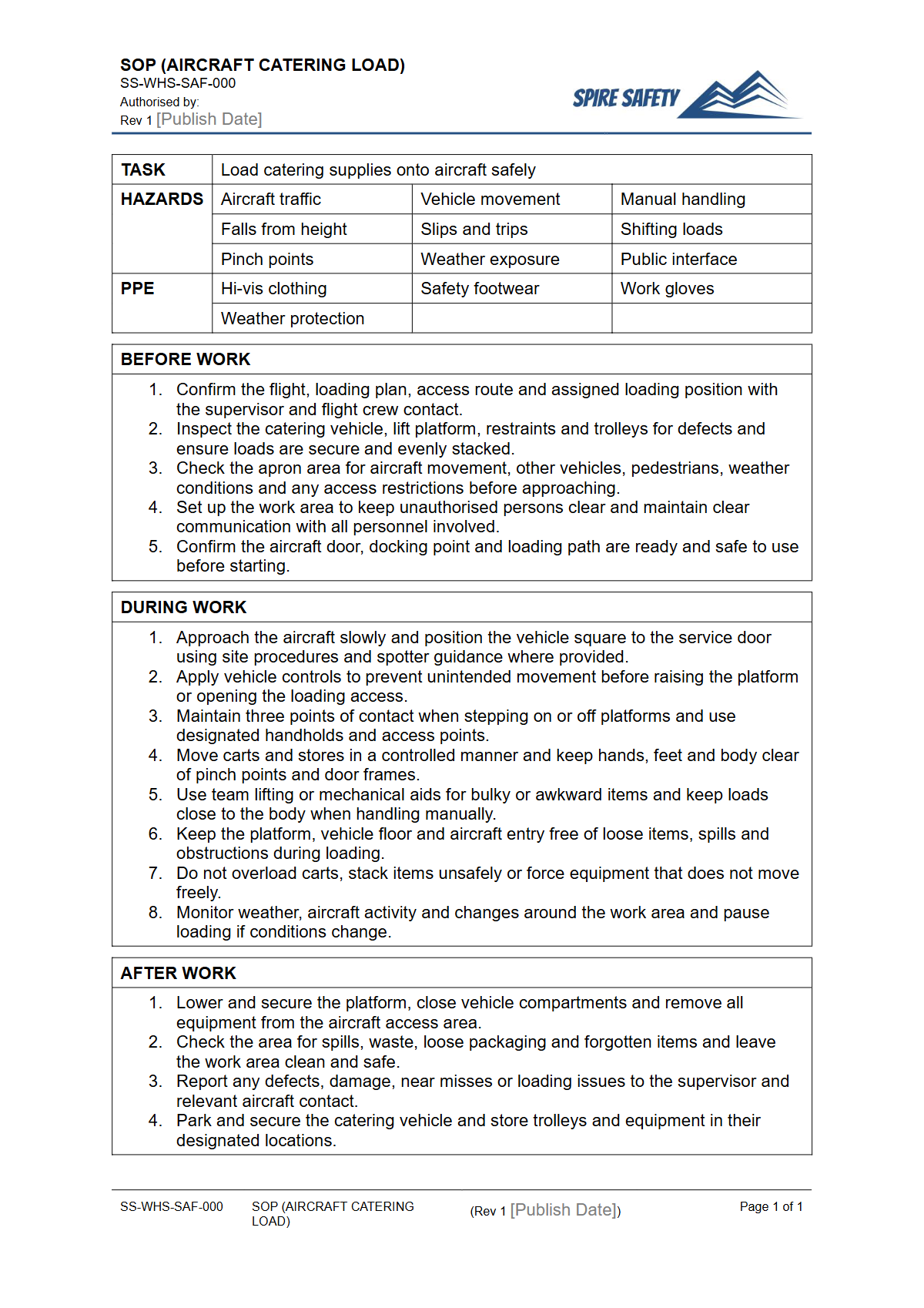
This Free Safe Operating Procedure (Aircraft Catering Load) Template provides a structured framework for managing the health and safety risks associated with loading and unloading catering supplies onto aircraft. The primary goal is to establish a clear, repeatable process that minimises hazards for ground crew, protects equipment, and ensures operational efficiency.
By documenting the step-by-step process, required safety checks, and emergency protocols, organisations can standardise work practices and provide a vital training tool for employees.
Key risks addressed in this Safe Operating Procedure include the operation of hi-lift vehicles, hazardous manual tasks, working at height, and potential interaction with other ground support equipment. Implementing a robust SOP is a fundamental step in fulfilling a PCBU's duty of care.
It forms a key part of an effective safety management system, demonstrating a commitment to proactive risk management aligned with Australian WHS principles. For instance, tasks may involve using portable stairs or platforms, making it essential to have clear guidelines similar to those found in a step ladder SOP.
Video walkthrough
How to use the Free Safe Operating Procedure (Aircraft Catering Load) Template
This document is designed as a comprehensive starting point, not a finished product. You must adapt it to the specific aircraft, catering trucks, equipment, and operating environment at your workplace.
To use it effectively, download the DOCX file and work through each section, consulting with vehicle operators, ground crew, and supervisors to ensure the procedures accurately reflect your on-the-ground reality.
Customise for Your Workplace
It is critical that you customise this template. We have no way of knowing your specific site conditions, equipment, or worker capabilities.
Add your company branding, specify the exact models of catering trucks used, and detail site-specific hazards like airside traffic rules or communication protocols. A generic document offers limited protection; a tailored one is an effective control measure. Integrating this customised SOP into your broader safety framework is a key step towards a safer workplace, which is a core component of well-designed WHS management systems.
When to use it
This Safe Operating Procedure should be used every time aircraft catering loading or unloading operations are performed. It applies to all phases of the task, including pre-start vehicle inspections, positioning the truck at the aircraft, operating the lift mechanism, transferring trolleys and containers, and securing the vehicle after the job is complete.
It should also be a primary reference document during worker induction, training, and competency assessments. Regular reviews of the SOP should be scheduled, especially after an incident, when new equipment is introduced, or if operational procedures change.
Who should use it
This SOP is intended for all personnel involved in aircraft catering logistics. This includes catering truck operators, ground support crew assisting with the transfer, and supervisors overseeing airside operations.
WHS managers and safety officers will also use the document for training, auditing, and incident investigation purposes. For example, while this SOP is specific to catering trucks, the operational principles of vehicle safety are shared across many roles, similar to the protocols outlined in our FREE Body Truck SOP Template. Ensuring all relevant personnel are trained and deemed competent in the procedure is essential for its success.
Conducting periodic checks to ensure procedures are being followed is a key part of the safety lifecycle, often verified through a formal WHS compliance auditing process.
Common mistakes
Common mistakes to avoid
- Failing to conduct thorough pre-start checks on the catering truck, particularly the hi-lift mechanism and emergency stop functions.
- Incorrectly positioning stabilisers on uneven ground, creating an unstable platform during lifting operations.
- Attempting to reposition the truck while the lift is raised, even slightly.
- Poor communication and lack of clear signals between the vehicle operator and staff inside the aircraft galley.
Legal references
Legal considerations
The following legal requirements may be relevant to this type of work.
- Work Health and Safety Act (Harmonised) — Provides the primary duties for protecting workers and other people from work health and safety risks.
- Work Health and Safety Regulations (Harmonised) — Sets out requirements supporting the management of workplace hazards and risks.
The following codes may be relevant to this type of work.
- Managing WHS Risks Code of Practice — Provides practical guidance on identifying hazards, assessing risks and applying effective controls.
- Work Health and Safety Consultation, Cooperation and Coordination Code of Practice — Provides practical guidance on consulting workers and coordinating with other duty holders.
- Managing the Work Environment and Facilities Code of Practice — Provides practical guidance on safe work environments, workplace facilities and related controls.
Did you know
Ergonomic Risk
Musculoskeletal disorders from hazardous manual tasks are one of the most common causes of workplace injury in the aviation ground handling sector. A well-defined SOP is a key administrative control to help mitigate these risks.
Vehicle Safety
A significant percentage of airside incidents involve collisions between ground support equipment and aircraft or personnel. Clear, documented operating procedures are critical for preventing costly damage and serious injuries.
FAQ
Frequently asked questions
01What are the main hazards in aircraft catering loading?
02Is a Safe Operating Procedure a legal requirement for this task?
03How often should an SOP for aircraft catering be reviewed?
04Can this template be used for other ground support equipment?
Share this resource
Free Safe Operating Procedure (Aircraft Catering Load) Template
Browse Categories
How To Use It
- 1Download and open in Word or PDF.
- 2Replace the placeholders with your business details.
- 3Get it reviewed by a WHS specialist before rollout.
Need it customised?
Our WHS consultants can adapt this template to your site, run a gap analysis, or audit what you already have in place.
Book a Free Consultation WHS consulting servicesor call 1300 156 382
Related templates
- Free Safe Operating Procedure (Aircraft Chocking) Template
- Free Safe Operating Procedure (Aircraft Deicing Prep) Template
- Free Safe Operating Procedure (Aircraft Door Check) Template
- Free Safe Operating Procedure (Aircraft Galley Cleaning) Template
- Free Safe Operating Procedure (Aircraft Interior Clean) Template
- Free Safe Operating Procedure (Aircraft Jacking) Template