
Free Safe Operating Procedure (Air Tool Operation) Template
Download our Free Safe Operating Procedure (Air Tool Operation) Template.
Free Safe Operating Procedure (Air Tool Operation) Template
DOCX • 152 KB + PDF
Updated Oct 2026
No signup required
Purpose of the Free Safe Operating Procedure (Air Tool Operation) Template
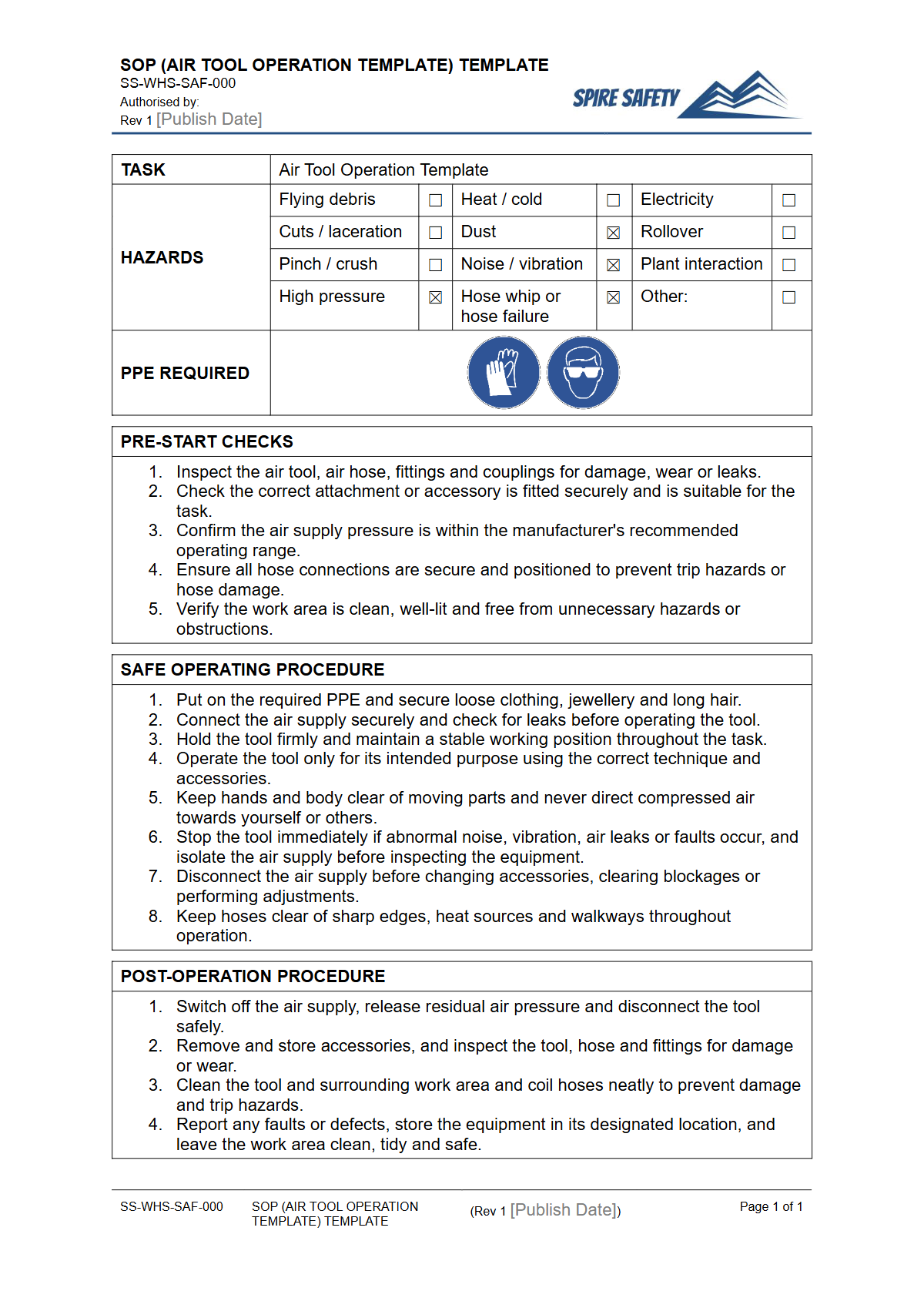
This Free Safe Operating Procedure (Air Tool Operation) Template provides a structured framework for documenting the safe use of pneumatic tools in your workplace. It helps Persons Conducting a Business or Undertaking (PCBUs) meet their duty of care by systematically identifying hazards and outlining control measures.
Using this Safe Operating Procedure helps reduce risks associated with air tools, such as high-pressure air injection, excessive noise, vibration, dust, and projectile hazards from tool attachments or fastenings.
By implementing a clear and concise Safe Operating Procedure, you can standardise work practices, facilitate effective worker training, and demonstrate a commitment to workplace health and safety. The document is designed as a starting point, aligned with the principles of Australian WHS legislation, to help you formalise your safety processes and manage operational risks effectively.
Video walkthrough
How to use the Free Safe Operating Procedure (Air Tool Operation) Template
This template is provided in an easily editable DOCX format. To use it, download the file and systematically work through each section, tailoring the content to the specific types of air tools, tasks, and environmental conditions found in your workplace.
You must add details relevant to your site, including the specific makes and models of equipment, required Personal Protective Equipment (PPE), and your organisation's emergency procedures.
It is crucial to consult with workers who operate the air tools during the drafting and review process. Their hands-on experience is invaluable for identifying practical hazards and effective control measures.
Integrating this SOP is a key step in developing a complete WHS management system that protects your team.
Important Note
This is a template and not a complete Safe Operating Procedure. It must be customised to your specific workplace, equipment, and processes.
We recommend a competent person, such as a WHS professional or experienced supervisor, reviews the final document before it is implemented to ensure it is comprehensive and relevant.
When to use a Safe Operating Procedure
A Safe Operating Procedure for air tool operation should be developed and implemented before any worker is permitted to use the equipment. It serves as a core document for initial training and induction for new employees or those new to the task.
It should also be used for refresher training and be readily accessible in the work area for quick reference.
The SOP is a critical reference during risk assessments and incident investigations. Regularly reviewing and updating the procedure ensures it remains relevant as equipment changes or new hazards are identified. Remember to consider the entire system, including the power source, by also documenting a Safe Operating Procedure for air compressors.
Who should use this Safe Operating Procedure
This Safe Operating Procedure is intended for use by several key groups within an organisation:
- Workers and Operators: To understand the safe and correct way to operate air tools, including pre-start checks, operation, and shutdown procedures.
- Supervisors and Managers: To train workers, enforce safe work practices, and monitor compliance with established safety protocols. They can use the SOP as a tool for workplace inspections and performance conversations.
- WHS Personnel and PCBUs: To ensure that formal processes are in place to manage risks associated with pneumatic equipment, forming part of the organisation's overall safety management framework. Regular WHS compliance audits can verify that the procedures outlined in the SOP are being followed correctly.
Key Elements of an Effective Air Tool Operation SOP
A robust SOP for air tools should cover several critical areas to be effective. These include identifying hazards like excessive noise, which may require hearing protection, and ergonomic risks from vibration and tool weight.
For tasks creating airborne contaminants, such as when conducting abrasive blasting, specific controls detailed in documents like our template for safe sand blasting procedures will be required.
Your SOP must detail all required PPE, such as safety glasses or goggles, hearing protection, gloves, and protective footwear. It should also outline pre-operational checks, including inspecting air hoses for damage, ensuring couplings are secure, and verifying that safety guards and devices are functional.
These principles apply to all powered equipment; for example, a circular saw Safe Operating Procedure would contain similar sections tailored to that tool's specific risks.
Finally, the document should specify correct operating techniques, such as maintaining a firm grip and stable footing, as well as procedures for clearing jams and what to do in an emergency. Clearly defining these elements ensures the SOP is a practical and useful tool for workers.
You can find more templates for a wide range of plant and equipment in our free WHS resources library to build a comprehensive set of procedures.
Common mistakes
Common mistakes to avoid
- Using incorrect or damaged hose fittings, leading to dangerous high-pressure leaks or hose whip.
- Failing to conduct pre-start checks on air hoses, connections, and tool safety mechanisms.
- Neglecting to wear appropriate PPE, especially mandatory eye and hearing protection.
- Using compressed air for cleaning clothes or work surfaces, creating projectile hazards and risking injection injuries.
Legal references
Legal considerations
The following legal requirements may be relevant to this type of work.
- Work Health and Safety Act (Harmonised) — Provides the primary duties for protecting workers and other people from work health and safety risks.
- Work Health and Safety Regulations (Harmonised) — Sets out requirements supporting the management of workplace hazards and risks.
The following codes may be relevant to this type of work.
- Managing WHS Risks Code of Practice — Provides practical guidance on identifying hazards, assessing risks and applying effective controls.
- Work Health and Safety Consultation, Cooperation and Coordination Code of Practice — Provides practical guidance on consulting workers and coordinating with other duty holders.
- Managing the Work Environment and Facilities Code of Practice — Provides practical guidance on safe work environments, workplace facilities and related controls.
Did you know
Noise Exposure
Many pneumatic tools operate at noise levels above 85 decibels (dB), the exposure standard for noise in Australia. Without proper hearing protection, prolonged use can lead to permanent, irreversible hearing loss.
Air Injection Injury
A high-pressure jet of compressed air can penetrate the skin and enter the bloodstream, causing a serious medical emergency known as an embolism. Never point an air hose at yourself or another person.
FAQ
Frequently asked questions
01What should be included in a Safe Operating Procedure for air tools?
02Why is PPE so important when using air tools?
03How often should an Air Tool Operation SOP be reviewed?
04Can a generic air tool SOP be used for all types of air tools?
Share this resource
Free Safe Operating Procedure (Air Tool Operation) Template
Browse Categories
How To Use It
- 1Download and open in Word or PDF.
- 2Replace the placeholders with your business details.
- 3Get it reviewed by a WHS specialist before rollout.
Need it customised?
Our WHS consultants can adapt this template to your site, run a gap analysis, or audit what you already have in place.
Book a Free Consultation WHS consulting servicesor call 1300 156 382
Related templates
- Free Safe Operating Procedure (Airbag Isolation) Template
- Free Safe Operating Procedure (Aircraft Battery Cart) Template
- Free Safe Operating Procedure (Aircraft Cabin Cleaning) Template
- Free Safe Operating Procedure (Aircraft Cabin Restock) Template
- Free Safe Operating Procedure (Aircraft Catering Load) Template
- Free Safe Operating Procedure (Aircraft Chocking) Template