
Free Safe Operating Procedure (Airbag Isolation) Template
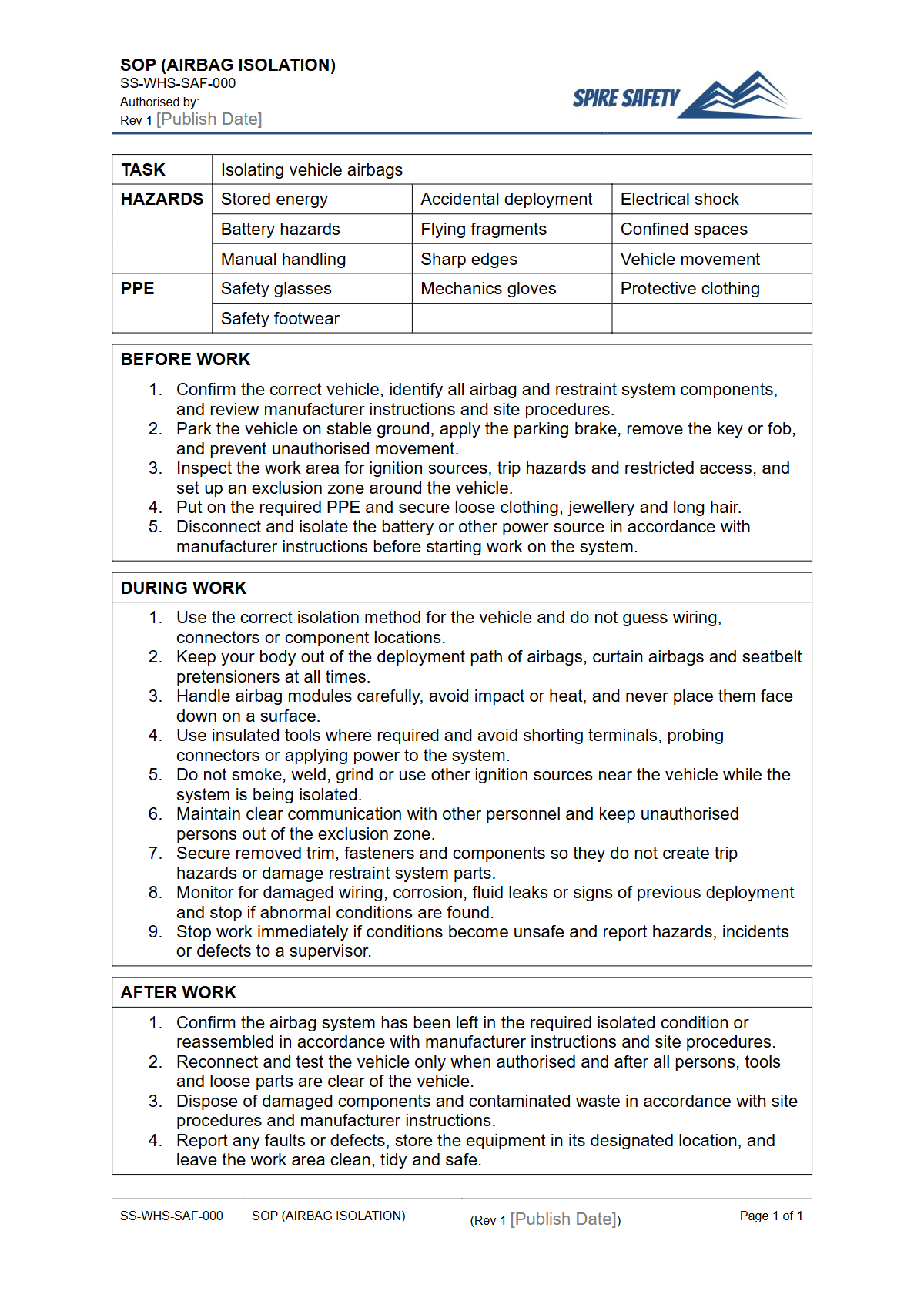
Download our free Safe Operating Procedure (Airbag Isolation) template. This customisable DOCX & PDF resource helps formalise safe work methods.
Free Safe Operating Procedure (Airbag Isolation) Template
DOCX • 126 KB + PDF
Updated Oct 2026
No signup required
Purpose of the Free Safe Operating Procedure (Airbag Isolation) Template
Working on modern vehicles presents unique hazards, particularly from supplementary restraint systems (SRS) like airbags. This Free Safe Operating Procedure (Airbag Isolation) Template provides a structured starting point for developing a documented process to safely de-energise and isolate these systems.
The primary purpose is to control the significant risk of accidental deployment, which can cause serious injury from the explosive force and chemical exposure. By establishing a clear, step-by-step procedure, organisations can ensure workers are protected during maintenance, repairs, dismantling, or vehicle modification tasks.
A documented SOP demonstrates a commitment to managing risks associated with stored energy in vehicle components. It outlines the required pre-work checks, isolation steps, and post-isolation verifications necessary for a safe system of work.
Formalising this process helps standardise behaviour, reduce the chance of error, and provides a valuable tool for worker training and competency assessment. This Safe Operating Procedure template forms a crucial component of your overall WHS management system, helping to demonstrate due diligence and a proactive approach to safety in your workshop.
Video walkthrough
How to use the Free Safe Operating Procedure (Airbag Isolation) Template
This downloadable Safe Operating Procedure for airbag isolation is provided in both DOCX and PDF formats for your convenience. The DOCX file is fully editable, allowing you to adapt the content to the specific needs of your workplace, the types of vehicles you service, and the tools and equipment your team uses.
It is essential to customise this document before implementation.
To effectively use the template, a person with knowledge of both the task and workplace health and safety should conduct a thorough risk assessment. This involves identifying hazards specific to your environment and incorporating controls into the procedure.
This includes specifying the exact tools, personal protective equipment (PPE), and manufacturer-recommended wait times for capacitor discharge for the vehicles you work on. Remember that procedures for all high-risk workshop tasks should be formalised; for example, a plasma cutter SOP is essential when performing vehicle modifications or dismantling.
Note: We have designed this template as a foundational guide aligned with Australian WHS principles. To ensure it is effective, you must customise it by adding your company name, logo, and specific procedural details relevant to your site, equipment, and state or territory regulations.
Its implementation and effectiveness are the responsibility of the user.
When to use this Safe Operating Procedure
An SOP for airbag isolation should be used whenever a worker needs to perform tasks on or near SRS components where there is a risk of accidental deployment. This is not limited to direct work on the airbag modules themselves. Key situations include:
- Vehicle Servicing and Repair: Any work involving the steering column, dashboard, seats, door panels, or wiring harnesses connected to the SRS control unit.
- Collision Repair: Essential for panel beaters and technicians working on damaged vehicles, where sensors or modules may be compromised.
- Vehicle Dismantling: Critical for auto wreckers and recyclers to safely handle and remove undeployed airbag modules before scrapping a vehicle.
- Vehicle Modification: When installing aftermarket equipment, such as new stereos, alarms, or custom steering wheels, that requires accessing areas near SRS components.
For organisations that also manage heavy vehicles, integrating this procedure alongside others, like a body truck safe operating procedure, ensures comprehensive coverage across your fleet's safety requirements.
Who should use this Safe Operating Procedure
This procedure is intended for use by qualified and competent personnel who have been trained in the specific hazards of vehicle SRS. This includes:
- Automotive Technicians and Mechanics: For routine maintenance and repair tasks.
- Auto Electricians: When working on vehicle wiring and electronic control units.
- Collision Repair Technicians (Panel Beaters): As a standard part of assessing and repairing crash damage.
- Vehicle Dismantlers: To ensure the safe handling of potentially live modules during the recycling process.
- Supervisors and WHS Managers: To implement the procedure, provide training, and supports your compliance efforts within the workplace. Regular reviews and checks, potentially as part of a formal WHS compliance audit, will ensure the procedure remains effective and relevant.
Successful implementation requires not just the document, but also adequate training and supervision. If you need assistance developing or implementing your safety procedures, our WHS consulting services can provide expert guidance.
You can also explore our full free WHS resources library for more templates and guides to support your safety management efforts.
Common mistakes
Common mistakes to avoid
- Failing to disconnect the vehicle's battery as the very first step.
- Not waiting long enough for the backup power capacitor to fully discharge before starting work.
- Incorrectly handling or storing an undeployed airbag module, such as placing it face down.
- Assuming the isolation procedure is the same for all vehicle makes and models.
Legal references
Legal considerations
The following legal requirements may be relevant to this type of work.
- Work Health and Safety Act (Harmonised) — Provides the primary duties for protecting workers and other people from work health and safety risks.
- Work Health and Safety Regulations (Harmonised) — Sets out requirements supporting the management of workplace hazards and risks.
The following codes may be relevant to this type of work.
- Managing WHS Risks Code of Practice — Provides practical guidance on identifying hazards, assessing risks and applying effective controls.
- Work Health and Safety Consultation, Cooperation and Coordination Code of Practice — Provides practical guidance on consulting workers and coordinating with other duty holders.
- Managing the Work Environment and Facilities Code of Practice — Provides practical guidance on safe work environments, workplace facilities and related controls.
Did you know
Speed of Deployment
An airbag deploys from the steering wheel or dashboard at speeds of up to 320 km/h. This incredible speed is necessary to inflate the cushion before a person makes contact with the vehicle's interior during a crash.
Chemical Reaction
Airbag inflation is caused by a rapid chemical reaction, typically involving sodium azide. When ignited, it produces nitrogen gas to fill the bag, but the dust released can be an irritant to the skin and respiratory system.
FAQ
Frequently asked questions
01What is an airbag isolation procedure?
02Is an SOP legally required for airbag isolation in Australia?
03How long does it take to isolate an airbag system?
04Can I use this airbag isolation template for any vehicle?
Share this resource
Free Safe Operating Procedure (Airbag Isolation) Template
Browse Categories
How To Use It
- 1Download and open in Word or PDF.
- 2Replace the placeholders with your business details.
- 3Get it reviewed by a WHS specialist before rollout.
Need it customised?
Our WHS consultants can adapt this template to your site, run a gap analysis, or audit what you already have in place.
Book a Free Consultation WHS consulting servicesor call 1300 156 382
Related templates
- Free Safe Operating Procedure (Aircraft Battery Cart) Template
- Free Safe Operating Procedure (Aircraft Cabin Cleaning) Template
- Free Safe Operating Procedure (Aircraft Cabin Restock) Template
- Free Safe Operating Procedure (Aircraft Catering Load) Template
- Free Safe Operating Procedure (Aircraft Chocking) Template
- Free Safe Operating Procedure (Aircraft Deicing Prep) Template