
Free Safe Operating Procedure (Aircraft Cabin Cleaning) Template
Download our free Safe Operating Procedure (Aircraft Cabin Cleaning) Template.
Free Safe Operating Procedure (Aircraft Cabin Cleaning) Template
DOCX • 126 KB + PDF
Updated Oct 2026
No signup required
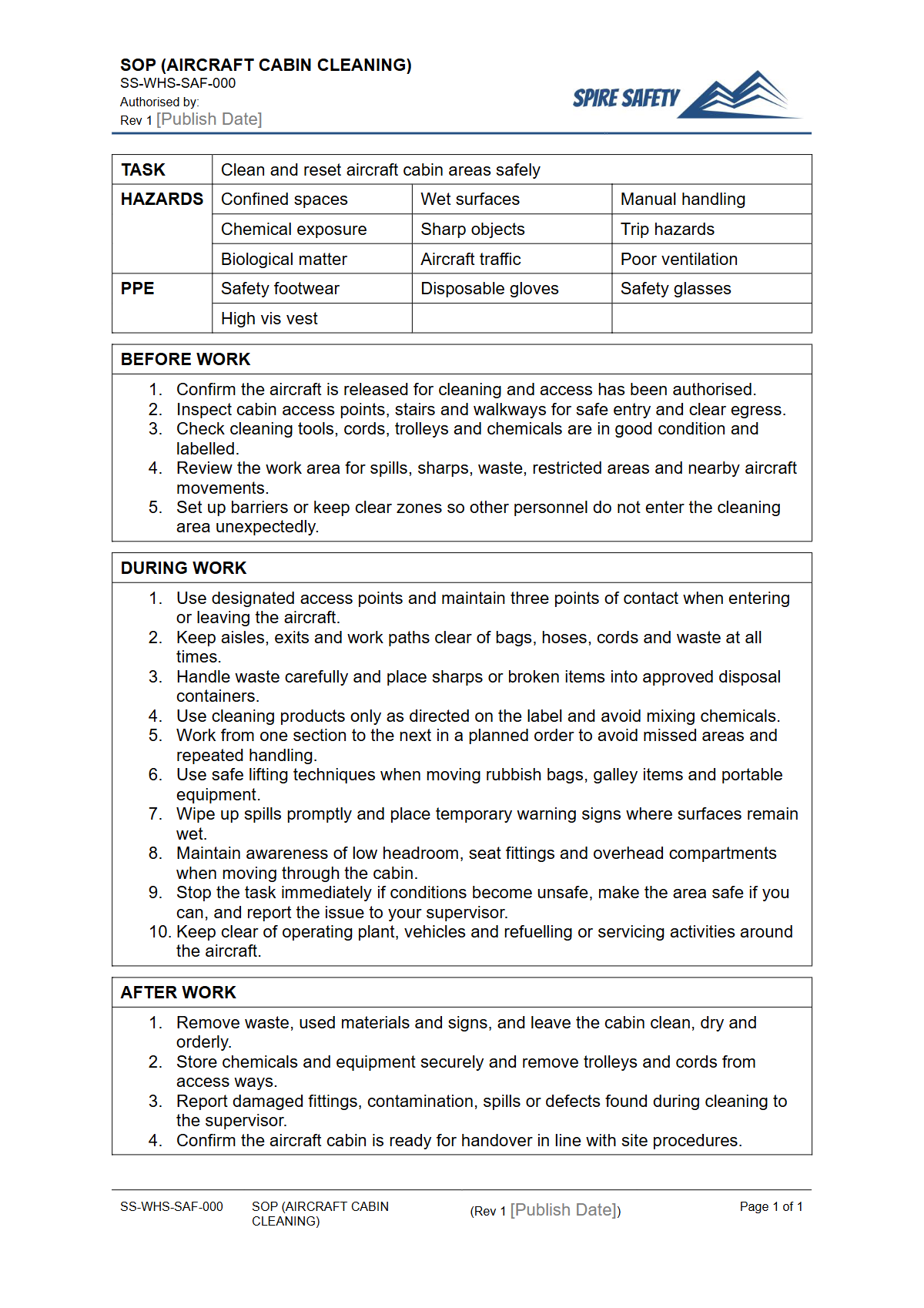
Purpose of the Free Safe Operating Procedure (Aircraft Cabin Cleaning) Template
Aircraft cabin cleaning is a high-pressure task with unique workplace hazards. This free Safe Operating Procedure (Aircraft Cabin Cleaning) Template provides a structured framework for documenting the safest method to perform cleaning duties.
It helps organisations manage risks associated with chemical exposure, manual tasks, biological hazards, and working in confined spaces. A documented SOP is a critical tool for training staff, ensuring consistent work practices, and demonstrating a commitment to health and safety.
By formalising procedures, you can significantly reduce the likelihood of injuries and incidents. This SOP serves as a foundational document within your broader safety framework, forming a key component of effective WHS management systems. It helps your business meet its primary duty of care under Australian WHS laws by providing a clear, step-by-step guide for workers to follow.
Video walkthrough
How to use the Free Safe Operating Procedure (Aircraft Cabin Cleaning) Template
This document is a starting point. To make it effective, you must adapt it to the specific conditions of your workplace.
Download the DOCX file and customise it to reflect your unique aircraft types, cleaning products, equipment, and team structure. It is essential to consult with your workers during this customisation process, as their direct experience is invaluable for identifying practical risks and controls.
Important: We have developed this template as a guide. Before use, you must customise it to your specific work environment, tasks, tools, and the types of aircraft you service.
You must conduct your own risk assessment and implement controls relevant to your workplace. Spire Safety accepts no liability for the use of this template.
Once customised, the SOP should be used as a primary training document for all new and existing cleaning staff. If you require assistance in adapting this template or conducting the necessary risk assessments, our WHS consulting team can provide expert guidance.
When to use this Safe Operating Procedure
A Safe Operating Procedure for aircraft cabin cleaning should be an active part of daily operations. It is not a document to be filed away and forgotten. Use it for:
- Induction and Training: Onboarding new cleaning crew members to ensure they understand the approved, safe methods from day one.
- Pre-shift Briefings: Reviewing key steps or specific hazards (e.g., a known contamination) before a cleaning shift begins.
- On-the-job Reference: Allowing workers to quickly refer to the procedure if they are unsure about a step or safety control.
- Incident Investigations: Using the SOP as a baseline to understand what should have happened when investigating a near miss or injury.
- Performance Reviews and Audits: Assessing worker competency and compliance with established safety protocols.
The procedure is particularly crucial when tasks involve specific hazards, such as using elevated platforms or ladders to reach high areas. For these situations, it should be used in conjunction with other specific procedures, such as those outlined in our FREE Step Ladder SOP Template.
Who should use this Safe Operating Procedure
This SOP is intended for use by multiple roles within an aviation service or cleaning organisation:
- Cleaning Personnel: The primary users who must follow the procedure to perform their tasks safely.
- Supervisors and Team Leaders: Responsible for ensuring the SOP is followed, providing necessary resources (like PPE), and conducting on-the-job supervision.
- WHS Managers and Officers: Use the SOP as a tool for risk management, training development, and compliance monitoring. Regular checks against the procedure can be a key part of your safety assurance activities, similar to formal WHS compliance auditing.
- Training Coordinators: Integrate the customised SOP into the core curriculum for all relevant staff training programs.
The equipment specified in the procedure, such as vacuums or blowers, also needs to be maintained and used correctly. If your processes involve specific equipment like industrial vacuums or air compressors for cleaning, consider developing equipment-specific SOPs, like our Free Air Compressor SOP Template. For more guides and checklists, you can browse our complete free WHS resources library.
Common mistakes
Common mistakes to avoid
- Using the template "as is" without performing a site-specific risk assessment and customisation.
- Providing inadequate or incorrect Personal Protective Equipment (PPE) for the chemicals and biohazards involved.
- Failing to train workers on the finalised SOP or verify they understand and follow it.
- Not storing cleaning chemicals correctly or making Safety Data Sheets (SDS) readily available to workers.
Legal references
Legal considerations
The following legal requirements may be relevant to this type of work.
- Work Health and Safety Act (Harmonised) — Provides the primary duties for protecting workers and other people from work health and safety risks.
- Work Health and Safety Regulations (Harmonised) — Sets out requirements supporting the management of workplace hazards and risks.
The following codes may be relevant to this type of work.
- Managing WHS Risks Code of Practice — Provides practical guidance on identifying hazards, assessing risks and applying effective controls.
- Work Health and Safety Consultation, Cooperation and Coordination Code of Practice — Provides practical guidance on consulting workers and coordinating with other duty holders.
- Managing the Work Environment and Facilities Code of Practice — Provides practical guidance on safe work environments, workplace facilities and related controls.
Did you know
The Need for Speed
Aircraft turnarounds are incredibly fast, with cleaning crews sometimes having less than 30 minutes to fully clean, sanitise, and restock a narrow-body aircraft cabin between flights.
Biohazard Risk
Cabin cleaners are on the front line of biosecurity, handling everything from general waste to potentially infectious materials left behind by passengers, requiring strict adherence to hygiene protocols.
FAQ
Frequently asked questions
01What are the main hazards in aircraft cabin cleaning?
02Does this SOP template cover chemical safety for cleaning agents?
03How often should an Aircraft Cabin Cleaning SOP be reviewed?
04Is a Safe Operating Procedure a legal requirement for aircraft cleaning in Australia?
Share this resource
Free Safe Operating Procedure (Aircraft Cabin Cleaning) Template
Browse Categories
How To Use It
- 1Download and open in Word or PDF.
- 2Replace the placeholders with your business details.
- 3Get it reviewed by a WHS specialist before rollout.
Need it customised?
Our WHS consultants can adapt this template to your site, run a gap analysis, or audit what you already have in place.
Book a Free Consultation WHS consulting servicesor call 1300 156 382
Related templates
- Free Safe Operating Procedure (Aircraft Cabin Restock) Template
- Free Safe Operating Procedure (Aircraft Catering Load) Template
- Free Safe Operating Procedure (Aircraft Chocking) Template
- Free Safe Operating Procedure (Aircraft Deicing Prep) Template
- Free Safe Operating Procedure (Aircraft Door Check) Template
- Free Safe Operating Procedure (Aircraft Galley Cleaning) Template