
Free Safe Operating Procedure (Aircraft Battery Cart) Template
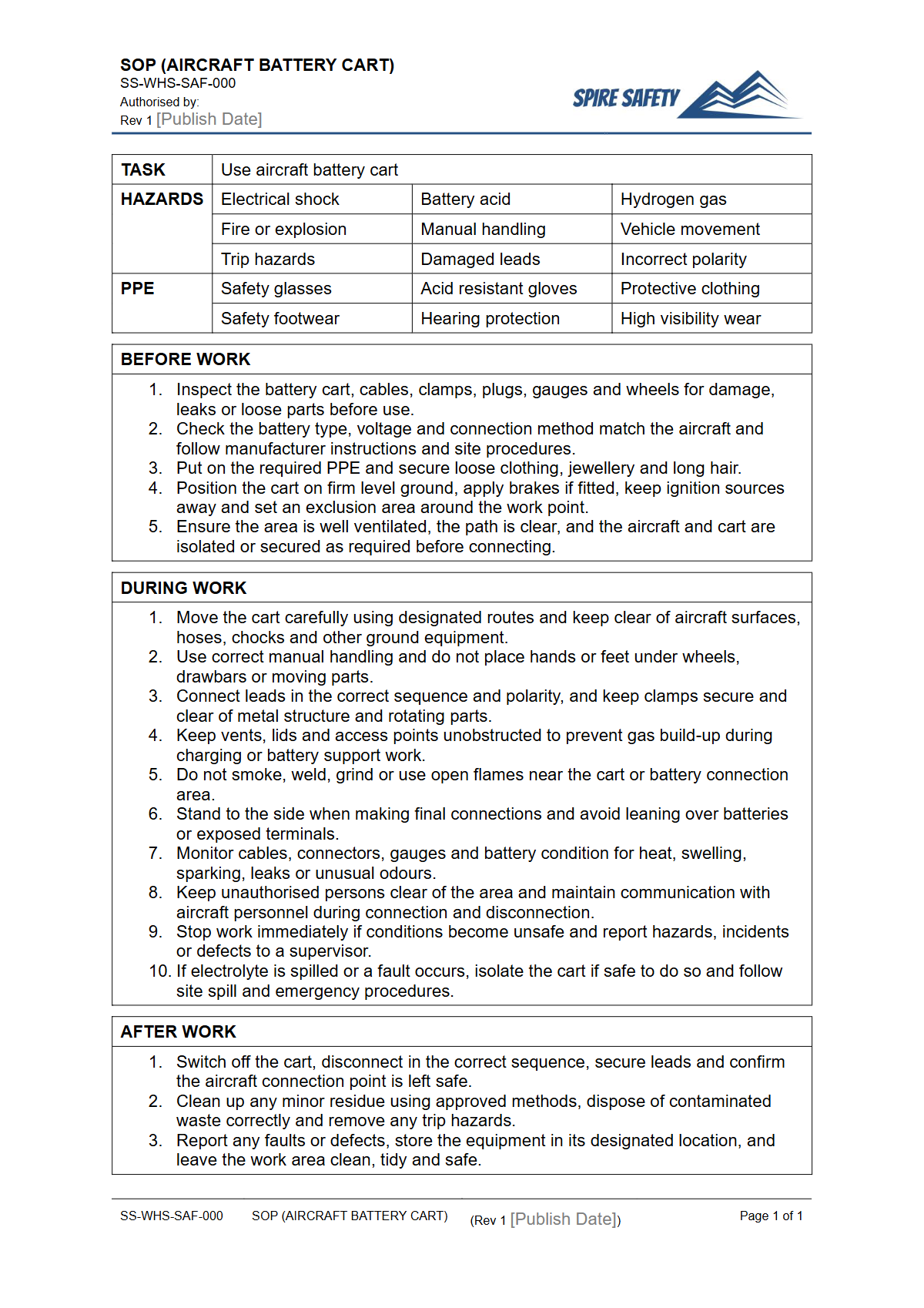
Download our free Safe Operating Procedure (Aircraft Battery Cart) Template. This user-friendly Word and PDF document helps outline safe work practices.
Free Safe Operating Procedure (Aircraft Battery Cart) Template
DOCX • 126 KB + PDF
Updated Oct 2026
No signup required
Purpose of the Free Safe Operating Procedure (Aircraft Battery Cart) Template
Operating ground support equipment in an aviation environment requires strict adherence to safety protocols to prevent injury and costly aircraft damage. This free Safe Operating Procedure (Aircraft Battery Cart) Template provides a structured framework for documenting the safe use of aircraft battery carts.
It helps your organisation manage significant risks, including electrical hazards, chemical spills from batteries, manual handling injuries, and the potential for fire or explosion on the tarmac.
Video walkthrough
A well-documented SOP is a critical component of a systematic approach to workplace health and safety. It serves as a clear training tool for ground crew and a reference point for competent operators.
Integrating this procedure into your broader WHS management systems demonstrates a commitment to proactively managing risks associated with ground handling operations. This document helps formalise pre-use checks, operational steps, and post-use procedures to ensure consistent and safe work practices are followed every time.
How to use the Free Safe Operating Procedure (Aircraft Battery Cart) Template
This downloadable resource is provided in a fully editable DOCX format, allowing for comprehensive customisation to suit your specific operational needs. While aligned with Australian WHS principles, this Safe Operating Procedure for an aircraft battery cart must be adapted to reflect the unique models of equipment you use, the types of aircraft you service, and the specific environment of your aerodrome or maintenance facility.
Please note: this document is a template. To ensure it addresses the specific risks at your site, we strongly recommend you customise it in consultation with your team.
If you require assistance with risk assessments or procedure development, engaging expert WHS consulting can provide tailored support.
To implement this SOP effectively, follow these steps:
- Download the template and open the DOCX file.
- Consult with equipment operators, maintenance engineers, and supervisors to identify all relevant steps and hazards.
- Modify the document to include specifics such as your battery cart's make and model, required personal protective equipment (PPE), site-specific emergency contacts, and shutdown procedures. The principles are often similar to those found in a FREE Body Truck SOP (Safe Operating Procedure) Template, focusing on pre-start checks and situational awareness.
- Train all relevant personnel on the finalised SOP and ensure they understand every step.
- Schedule regular reviews of the procedure to ensure it remains current.
When to use it
This Safe Operating Procedure should be used as the primary reference document for all tasks involving the aircraft battery cart. Its application covers the full cycle of use, from initial setup to completion of the task and storage of the equipment.
Key moments to refer to the SOP include conducting pre-operational safety checks, moving the cart into position, connecting and disconnecting the unit from the aircraft, and performing post-use inspections and battery charging.
It is also an essential tool during worker inductions, competency training, and refresher courses. Using SOPs consistently, even for seemingly simple tasks, is a cornerstone of a strong safety culture.
This is as true for ground power units as it is for basic equipment like that covered in our FREE Step Ladder SOP Template, where complacency can lead to incidents.
Who should use it
This SOP is intended for all personnel who may interact with or work in the vicinity of aircraft battery carts. The primary users will be:
- Ground Support Equipment (GSE) Operators
- Aircraft Maintenance Engineers (AMEs)
- Licenced Aircraft Maintenance Engineers (LAMEs)
- Ramp Supervisors and Team Leaders
- WHS Managers and Safety Officers
Supervisors should use the SOP to guide training and to verify that correct procedures are being followed by their teams. Regular verification is a key part of ensuring ongoing safety, a process that can be formalised through scheduled WHS compliance auditing to check that documented procedures match workplace practice.
This ensures the document is a living part of your safety system, not just paperwork.
While this SOP is specific to battery carts, the principles of documenting machinery procedures are universal. For other common workshop equipment, you might find our Free Air Compressor SOP (Safe Operating Procedure) Template a useful reference for establishing similar safe work methods.
Creating a library of clear, customised SOPs is a powerful step towards a safer workplace. You can find many more templates in our free WHS resources library to build out your safety documentation.
Common mistakes
Common mistakes to avoid
- Failing to wear appropriate PPE, especially acid-resistant gloves and safety glasses.
- Connecting or disconnecting the power cable from the aircraft while the cart's power is switched on.
- Skipping pre-use inspections of cables, plugs, and the cart's overall condition.
- Using incorrect manual handling techniques when moving heavy batteries or positioning the cart.
Legal references
Legal considerations
The following legal requirements may be relevant to this type of work.
- Work Health and Safety Act (Harmonised) — Provides the primary duties for protecting workers and other people from work health and safety risks.
- Work Health and Safety Regulations (Harmonised) — Sets out requirements supporting the management of workplace hazards and risks.
The following codes may be relevant to this type of work.
- Managing WHS Risks Code of Practice — Provides practical guidance on identifying hazards, assessing risks and applying effective controls.
- Work Health and Safety Consultation, Cooperation and Coordination Code of Practice — Provides practical guidance on consulting workers and coordinating with other duty holders.
- Managing the Work Environment and Facilities Code of Practice — Provides practical guidance on safe work environments, workplace facilities and related controls.
Did you know
Thermal Runaway Risk
Aircraft batteries, particularly older nickel-cadmium (NiCd) types, can experience 'thermal runaway'—a dangerous, uncontrolled increase in temperature and current that can lead to fire or explosion if not managed.
Ground Power Role
Ground Power Units (GPUs), including battery carts, are essential on the tarmac. They power an aircraft's entire electrical system while it's on the ground, saving fuel and wear on the aircraft's engines or Auxiliary Power Unit (APU).
FAQ
Frequently asked questions
01What are the main hazards of using an aircraft battery cart?
02Does this SOP template cover battery charging procedures?
03How often should an SOP for an aircraft battery cart be reviewed?
04Is specific training required to operate an aircraft battery cart?
Share this resource
Free Safe Operating Procedure (Aircraft Battery Cart) Template
Browse Categories
How To Use It
- 1Download and open in Word or PDF.
- 2Replace the placeholders with your business details.
- 3Get it reviewed by a WHS specialist before rollout.
Need it customised?
Our WHS consultants can adapt this template to your site, run a gap analysis, or audit what you already have in place.
Book a Free Consultation WHS consulting servicesor call 1300 156 382
Related templates
- Free Safe Operating Procedure (Aircraft Cabin Cleaning) Template
- Free Safe Operating Procedure (Aircraft Cabin Restock) Template
- Free Safe Operating Procedure (Aircraft Catering Load) Template
- Free Safe Operating Procedure (Aircraft Chocking) Template
- Free Safe Operating Procedure (Aircraft Deicing Prep) Template
- Free Safe Operating Procedure (Aircraft Door Check) Template