
Free Safe Operating Procedure (Air Sander) Template
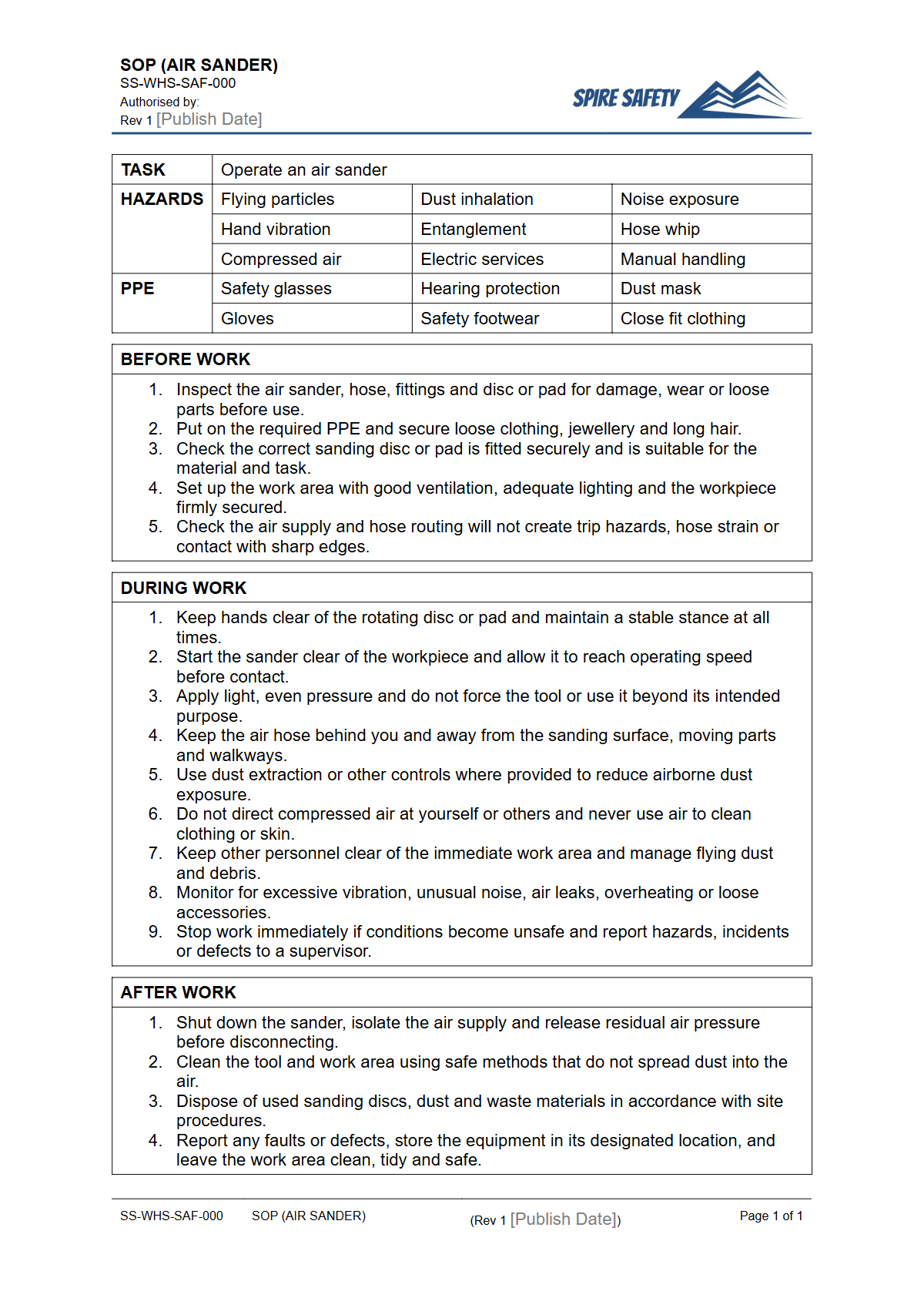
Download our free Safe Operating Procedure (Air Sander) template. This DOCX & PDF resource helps you outline safe work practices for using air sanders.
Free Safe Operating Procedure (Air Sander) Template
DOCX • 126 KB + PDF
Updated Oct 2026
No signup required
Purpose of the Free Safe Operating Procedure (Air Sander) Template
Using pneumatic tools like air sanders introduces significant workplace hazards, including airborne dust, noise, vibration, and compressed air risks. This free Safe Operating Procedure (Air Sander) template provides a structured starting point for documenting a safe system of work.
An SOP is a critical administrative control that standardises procedures, forms a basis for worker training and competency assessment, and helps demonstrate how your organisation is meeting its duties under WHS law. It systematically identifies the hazards associated with operating an air sander and details the control measures required to eliminate or minimise risks.
Developing robust SOPs is a fundamental part of effective WHS management systems. This template guides you through documenting pre-start checks, operational steps, required PPE, and finishing procedures to ensure tasks are completed safely and consistently every time.
Video walkthrough
How to use the Free Safe Operating Procedure (Air Sander) Template
This resource is available as a fully editable DOCX file, with a PDF version included for easy distribution. To get the most from this template, you must adapt it to your specific operational context.
Start by downloading the file and opening the DOCX version. Go through each section, consulting with operators and supervisors to ensure the content accurately reflects the models of air sanders used, the materials being worked on, and the specific environment.
Important: This is a template, not a finished document. We have pre-filled it with common steps and controls, but you must review and customise every section to reflect the specific hazards and control measures relevant to your workplace.
This includes referencing the correct air supply equipment, which may require its own Air Compressor SOP to manage associated risks.
What's included in the template?
- A section for listing required Personal Protective Equipment (PPE).
- A step-by-step pre-operational inspection checklist.
- A sequence for safely starting up, operating, and shutting down the sander.
- A list of common hazards and their corresponding control measures.
- Space to add your company branding and specific site details.
When to use an Air Sander SOP
A Safe Operating Procedure for an air sander should be used as a primary training document for all new workers before they operate the equipment. It should be readily accessible in the work area for quick reference.
The SOP is also a vital tool for conducting refresher training, especially if work practices change or new materials are introduced. Following an incident or a near miss involving an air sander, the SOP should be formally reviewed and updated to incorporate any learnings.
It serves as a benchmark for expected safe behaviour, similar to how a Circular Saw SOP would be used in a workshop setting.
Who should use this document
This SOP should be used by several key people within an organisation. Supervisors and team leaders are responsible for implementing the procedure, ensuring workers follow it, and providing adequate supervision.
WHS managers and advisors can use the template to establish a baseline for safe work practices across a site or company. Most importantly, operators of the air sander must be trained on the SOP's contents and understand their responsibility to adhere to it. The document also provides a clear standard against which to measure performance during safety observations or formal WHS compliance auditing.
By establishing and following documented procedures for all high-risk equipment, including other fabrication tools covered in documents like our Plasma Cutter SOP, you create a safer and more predictable work environment. If you need assistance developing comprehensive safety documents tailored to your business, our WHS consulting services can provide expert support.
This document is just one of many available in our free WHS resources library, which offers a wide range of templates to help you manage workplace health and safety.
Common mistakes
Common mistakes to avoid
- Using the template without customising it for specific workplace equipment, materials, and tasks.
- Failing to connect the sander to a suitable local exhaust ventilation (LEV) or dust extraction system.
- Neglecting to check air pressure settings, leading to excessive speed, vibration, and premature wear.
- Not providing or enforcing the use of appropriate Personal Protective Equipment (PPE), particularly respiratory and hearing protection.
Legal references
Legal considerations
The following legal requirements may be relevant to this type of work.
- Work Health and Safety Act (Harmonised) — Provides the primary duties for protecting workers and other people from work health and safety risks.
- Work Health and Safety Regulations (Harmonised) — Sets out requirements supporting the management of workplace hazards and risks.
The following codes may be relevant to this type of work.
- Managing WHS Risks Code of Practice — Provides practical guidance on identifying hazards, assessing risks and applying effective controls.
- Work Health and Safety Consultation, Cooperation and Coordination Code of Practice — Provides practical guidance on consulting workers and coordinating with other duty holders.
- Managing the Work Environment and Facilities Code of Practice — Provides practical guidance on safe work environments, workplace facilities and related controls.
Did you know
Vibration Risks
Prolonged use of vibrating tools like air sanders can lead to Hand-Arm Vibration Syndrome (HAVS), a permanent and debilitating condition affecting nerves, blood vessels, and joints.
Hidden Dust Dangers
The fine dust produced by sanding can contain hazardous substances like crystalline silica or isocyanates from painted surfaces, requiring specific respiratory protection and dust extraction systems.
FAQ
Frequently asked questions
01What are the main hazards of using an air sander?
02Is a Safe Operating Procedure a legal requirement in Australia?
03How often should an air sander SOP be reviewed?
04What PPE is required when using an air sander?
Share this resource
Free Safe Operating Procedure (Air Sander) Template
Browse Categories
How To Use It
- 1Download and open in Word or PDF.
- 2Replace the placeholders with your business details.
- 3Get it reviewed by a WHS specialist before rollout.
Need it customised?
Our WHS consultants can adapt this template to your site, run a gap analysis, or audit what you already have in place.
Book a Free Consultation WHS consulting servicesor call 1300 156 382
Related templates
- Free Safe Operating Procedure (Air Tool Operation) Template
- Free Safe Operating Procedure (Airbag Isolation) Template
- Free Safe Operating Procedure (Aircraft Battery Cart) Template
- Free Safe Operating Procedure (Aircraft Cabin Cleaning) Template
- Free Safe Operating Procedure (Aircraft Cabin Restock) Template
- Free Safe Operating Procedure (Aircraft Catering Load) Template