
Free Safe Operating Procedure (Air Riveter) Template
Download our free Safe Operating Procedure (Air Riveter) Template to create clear, documented instructions for safe equipment use. Get your DOCX and PDF now.
Free Safe Operating Procedure (Air Riveter) Template
DOCX • 126 KB + PDF
Updated Oct 2026
No signup required
Purpose of the Free Safe Operating Procedure (Air Riveter) Template
An air riveter, or pneumatic rivet gun, is a powerful tool common in manufacturing, automotive, and construction industries. While efficient, it presents significant hazards, including projectiles from spent mandrels, high-pressure air injection, noise, and vibration.
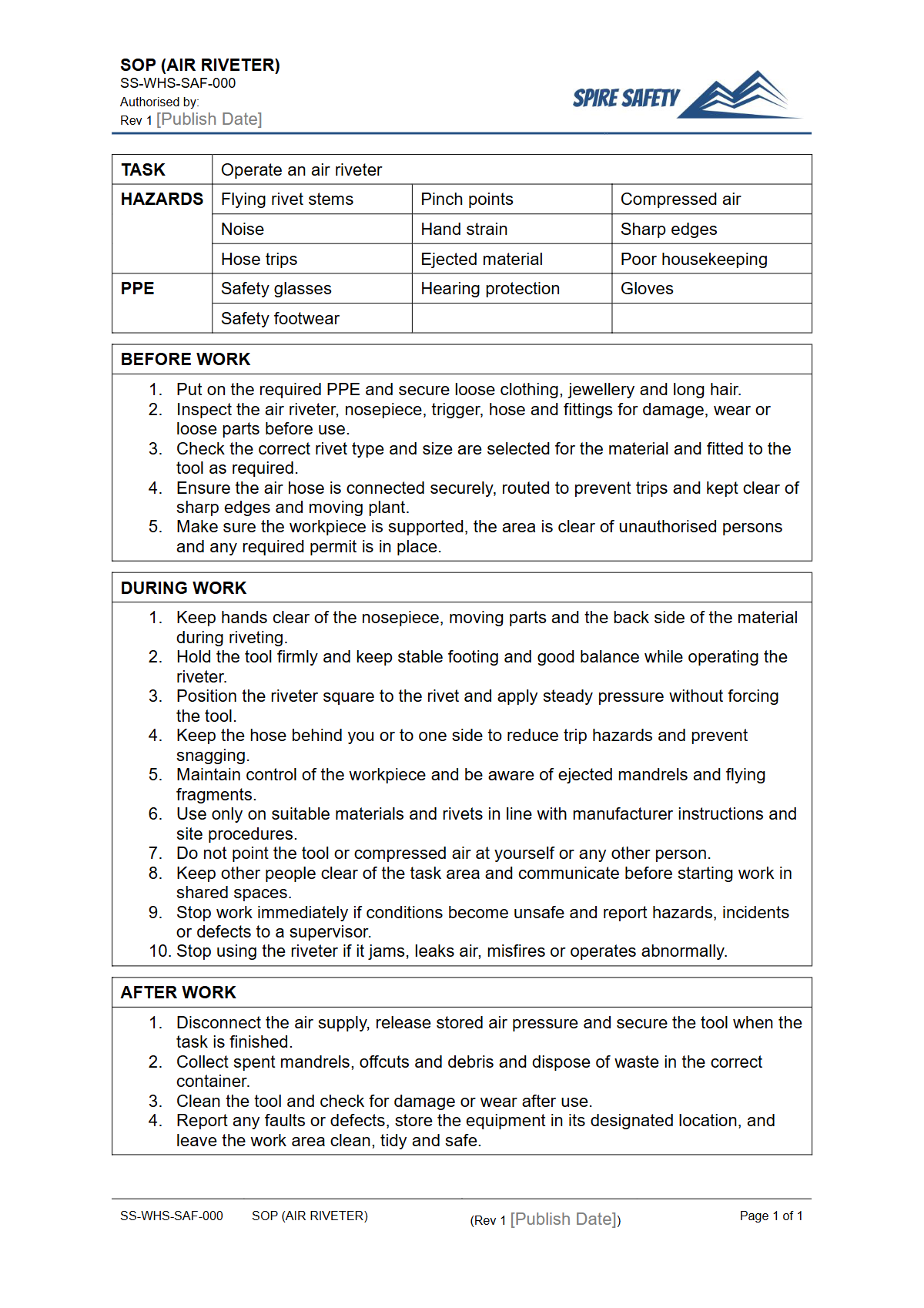
This Free Safe Operating Procedure (Air Riveter) Template provides a structured framework for documenting the specific risks and control measures associated with its use in your workplace. A documented SOP is a critical administrative control that formalises your safety process, ensuring every operator understands the required steps for pre-start checks, safe operation, and shutdown.
It serves as a key training and reference document, helping to standardise safe work practices and meet your WHS obligations.
Using a well-defined SOP helps to systematically manage risks. It prompts you to consider every stage of the task, from setting up the air supply to cleaning up the work area.
By following a template aligned with Australian WHS principles, you can create a comprehensive document that forms a vital part of your overall safety management system. Proper documentation not only protects your workers but also provides clear evidence of your organisation's commitment to providing a safe work environment. This can be supported by a robust framework like our services for developing WHS management systems.
Video walkthrough
How to use the Free Safe Operating Procedure (Air Riveter) Template
This resource is available for instant download in both DOCX and PDF formats. The DOCX file is fully editable, allowing you to tailor the content directly to your operational needs.
Simply download the file and open it in Microsoft Word or a compatible program. You will find sections covering required PPE, potential hazards, pre-operational checks, operational steps, and emergency procedures.
Fill in the details specific to your brand and model of air riveter, the types of rivets used, and the unique conditions of your work environment.
IMPORTANT NOTE: We have drafted this document as a general template to serve as a starting point. To be effective and meet your safety duties, you must customise it with your specific site details, machinery models, risk controls, and emergency procedures.
A generic SOP that doesn't reflect your actual workplace practices is insufficient. We recommend a competent person, such as a supervisor or WHS manager, conducts a risk assessment and uses the findings to complete this procedure.
When to use an Air Riveter SOP
A Safe Operating Procedure for an air riveter should be developed and implemented before any worker is authorised to use the tool. It is an essential document for worker induction, training, and competency verification.
The SOP should be readily accessible in the work area where the air riveter is used, serving as a constant on-the-job reminder of safety requirements. It's also a critical tool for supervisors when conducting safety observations or incident investigations.
Regular reviews of the SOP are necessary, particularly when new models of riveters are introduced, the task changes, or a near-miss or incident occurs. For workshops with multiple pneumatic tools, consider developing similar procedures using our Free Air Compressor SOP (Safe Operating Procedure) Template to ensure the entire system is managed safely.
Who should use this Safe Operating Procedure
This template is designed for use by anyone responsible for workplace health and safety. This includes WHS managers, supervisors, team leaders, and business owners in sectors like sheet metal fabrication, vehicle body repair, aviation maintenance, and general manufacturing.
It provides the person conducting a business or undertaking (PCBU) with a tool to fulfil their primary duty of care. Workers who operate air riveters should be trained using the customised SOP and consult it regularly.
If your organisation needs expert assistance in developing and implementing site-specific procedures, consider engaging professional WHS consulting services.
Beyond the immediate operators, the SOP is also a useful resource for maintenance personnel who need to understand the safe isolation and depressurisation procedures before conducting repairs. It standardises the expected safety behaviour for everyone interacting with the equipment.
In complex fabrication environments, it is good practice to have clear procedures for all major equipment. For example, you may also benefit from our FREE Plasma Cutter SOP (Safe Operating Procedure) Template to build a consistent safety documentation system.
Ultimately, a library of well-written SOPs demonstrates a mature approach to safety management. You can find more templates to build out your documentation in our free WHS resources library. Regular reviews and updates ensure these documents remain relevant and effective, which can be verified through a systematic process such as WHS compliance auditing.
Common mistakes
Common mistakes to avoid
- Failing to disconnect the air supply before attempting to clear a jammed rivet or perform maintenance.
- Using the incorrect size or type of nosepiece for the rivet, leading to jams and poor fastening.
- Pointing the tool at people or body parts, even when it is not being actuated.
- Leaving air hoses across walkways, creating a significant trip hazard for others in the work area.
Legal references
Legal considerations
The following legal requirements may be relevant to this type of work.
- Work Health and Safety Act (Harmonised) — Provides the primary duties for protecting workers and other people from work health and safety risks.
- Work Health and Safety Regulations (Harmonised) — Sets out requirements supporting the management of workplace hazards and risks.
The following codes may be relevant to this type of work.
- Managing WHS Risks Code of Practice — Provides practical guidance on identifying hazards, assessing risks and applying effective controls.
- Work Health and Safety Consultation, Cooperation and Coordination Code of Practice — Provides practical guidance on consulting workers and coordinating with other duty holders.
- Managing the Work Environment and Facilities Code of Practice — Provides practical guidance on safe work environments, workplace facilities and related controls.
Did you know
Invention of the 'POP' Rivet
The 'POP' rivet, a type of blind rivet commonly used with pneumatic riveters, was invented in the 1930s for the British aviation industry to allow riveting with access to only one side of a panel.
Noise Hazard
A single actuation from a pneumatic riveter can produce noise levels well over 100 decibels (dB), far exceeding the 85 dB exposure standard where hearing protection becomes mandatory.
FAQ
Frequently asked questions
01What are the main hazards of using an air riveter?
02Is a Safe Operating Procedure legally required for an air riveter in Australia?
03What PPE is required for using a pneumatic riveter?
04How often should an Air Riveter SOP be reviewed?
Share this resource
Free Safe Operating Procedure (Air Riveter) Template
Browse Categories
How To Use It
- 1Download and open in Word or PDF.
- 2Replace the placeholders with your business details.
- 3Get it reviewed by a WHS specialist before rollout.
Need it customised?
Our WHS consultants can adapt this template to your site, run a gap analysis, or audit what you already have in place.
Book a Free Consultation WHS consulting servicesor call 1300 156 382
Related templates
- Free Safe Operating Procedure (Air Sampling Pump) Template
- Free Safe Operating Procedure (Air Sander) Template
- Free Safe Operating Procedure (Air Tool Operation) Template
- Free Safe Operating Procedure (Airbag Isolation) Template
- Free Safe Operating Procedure (Aircraft Battery Cart) Template
- Free Safe Operating Procedure (Aircraft Cabin Cleaning) Template