
Free Safe Operating Procedure (Air Receiver Drain) Template
Download our Free Safe Operating Procedure (Air Receiver Drain) Template.
Free Safe Operating Procedure (Air Receiver Drain) Template
DOCX • 126 KB + PDF
Updated Oct 2026
No signup required
Purpose of the Free Safe Operating Procedure (Air Receiver Drain) Template
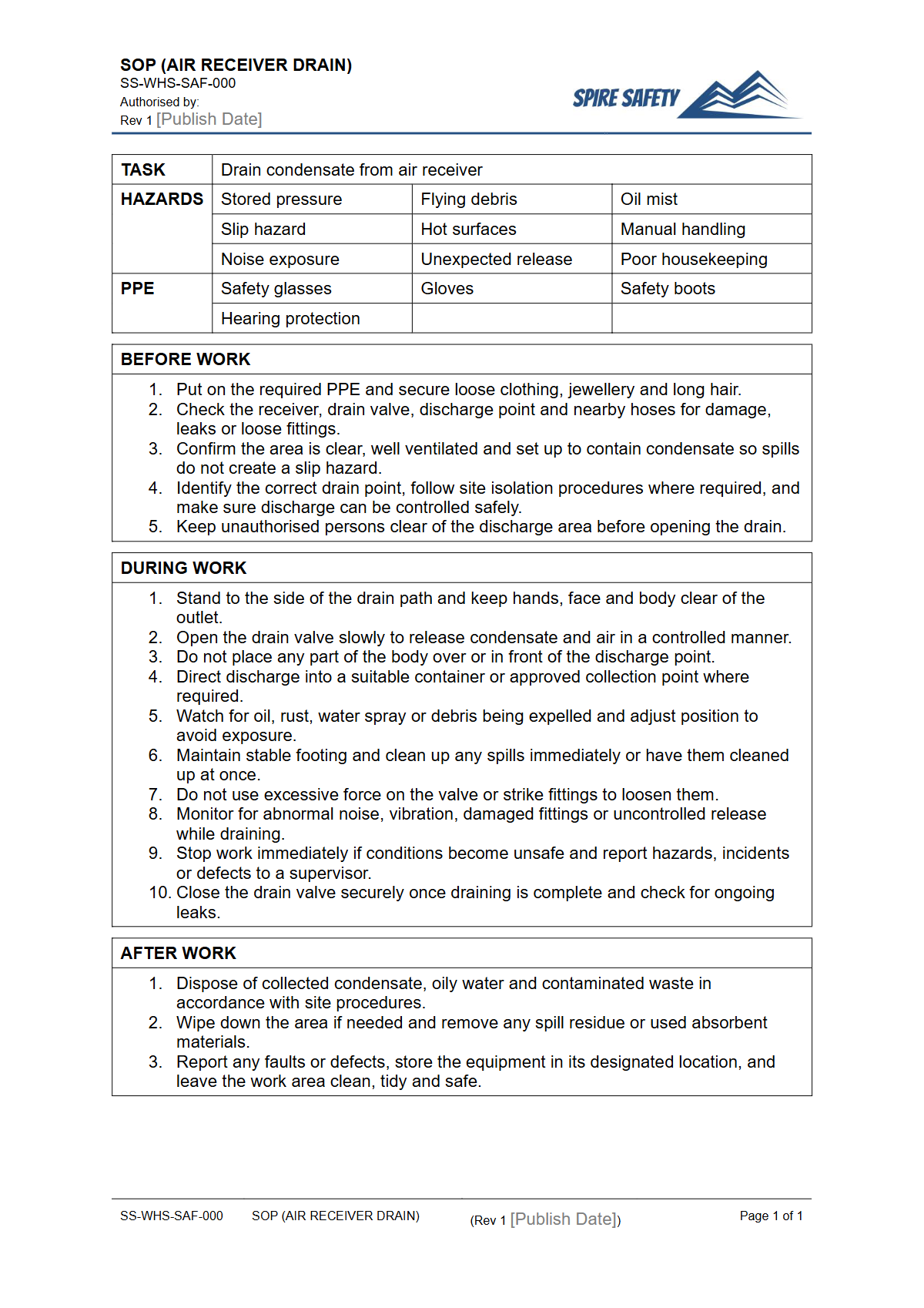
Effectively managing workshop equipment is fundamental to workplace safety. This Free Safe Operating Procedure (Air Receiver Drain) Template provides a structured framework for documenting the steps required to safely drain moisture and contaminants from a compressed air receiver tank.
Draining is a critical maintenance task that prevents internal corrosion, which can weaken the vessel walls and lead to catastrophic failure under pressure. Regular draining also ensures the air compressor operates efficiently and delivers clean, dry air for pneumatic tools and processes, extending the life of your equipment.
Using a documented SOP ensures this task is performed consistently and correctly by all personnel. It formalises the process, identifies potential hazards, and outlines essential control measures, such as depressurising the system and using appropriate personal protective equipment (PPE).
A clear procedure minimises the risk of injury from sudden releases of compressed air or exposure to contaminants within the condensate. This document serves as a vital tool for worker training and competency verification.
Video walkthrough
How to use the Free Safe Operating Procedure (Air Receiver Drain) Template
This template is available as a fully editable DOCX file, allowing for complete customisation, and also as a printable PDF for immediate use. To get started, download the file and systematically work through each section.
Fill in the specific details of your workplace, including the makes and models of your air compressors, the location of drain valves, and your designated maintenance schedules. The procedure for draining the main compressor tank may be similar but should be documented separately; you can use our Free Air Compressor SOP (Safe Operating Procedure) Template as a guide for that task.
Important: Customise to Your Workplace
This document is a template, not a finished procedure. It is essential that you adapt it to reflect the specific equipment, hazards, and control measures present in your unique work environment. We strongly recommend conducting a risk assessment on the task at your site and incorporating your findings into the final document.
Consult with operators and maintenance staff who perform the task to ensure the SOP is practical and accurate.
When to use it
The Safe Operating Procedure for draining an air receiver should be used as a key component of your preventative maintenance program. The frequency of draining depends on factors like humidity, compressor usage, and manufacturer recommendations, but it is often required daily or weekly.
This SOP should be referenced during the induction and training of new employees, as a refresher for existing staff, and as a formal record within your overall WHS management systems. It serves as the benchmark against which the task is performed and supervised.
Who should use it
This SOP is intended for use by competent personnel who have been trained and authorised to operate and maintain compressed air systems. This typically includes maintenance technicians, fitters, and experienced machine operators.
Supervisors should also be thoroughly familiar with the procedure to effectively oversee the work and ensure it is being performed safely. The clear, step-by-step format makes it an excellent training aid for apprentices and trainees under direct supervision.
Ensuring all equipment has a corresponding SOP, such as for a FREE Plasma Cutter SOP, creates a consistent safety standard across your workshop.
Documented procedures are not just for high-risk equipment. Standardising routine tasks like this is a cornerstone of a proactive safety culture.
By formalising the process, you remove ambiguity and ensure every worker, regardless of experience level, follows a safe and approved method. This commitment to procedural discipline can be verified during a WHS compliance auditing process, demonstrating your organisation's diligence.
A well-written SOP is a practical tool that empowers workers to complete tasks safely. While this document covers draining an air receiver, similar principles apply to other machinery. For instance, documenting the setup and operation of a brake press requires its own detailed procedure, which you can develop using our Free Brake Press SOP Template.
By implementing robust SOPs for all critical tasks, you build a safer, more efficient, and more organised workplace. We encourage you to explore our complete free WHS resources library for more templates and guides to support your safety management efforts.
Common mistakes
Common mistakes to avoid
- Forgetting to fully depressurise the receiver tank before opening the drain valve.
- Opening the drain valve too quickly, causing a violent and uncontrolled release of condensate and air.
- Draining condensate directly onto the floor instead of into an appropriate container for proper disposal.
- Assuming a single SOP works for all air compressors, rather than customising it for each specific model and location.
Legal references
Legal considerations
The following legal requirements may be relevant to this type of work.
- Work Health and Safety Act (Harmonised) — Provides the primary duties for protecting workers and other people from work health and safety risks.
- Work Health and Safety Regulations (Harmonised) — Sets out requirements supporting the management of workplace hazards and risks.
The following codes may be relevant to this type of work.
- Managing WHS Risks Code of Practice — Provides practical guidance on identifying hazards, assessing risks and applying effective controls.
- Work Health and Safety Consultation, Cooperation and Coordination Code of Practice — Provides practical guidance on consulting workers and coordinating with other duty holders.
- Managing the Work Environment and Facilities Code of Practice — Provides practical guidance on safe work environments, workplace facilities and related controls.
Did you know
Corrosion Risk
For every 10°C increase in temperature, the water-holding capacity of air doubles, increasing the amount of moisture that can condense inside an air receiver if not drained regularly.
FAQ
Frequently asked questions
01How often should an air receiver tank be drained?
02What are the hazards of not draining an air receiver?
03Is a Safe Operating Procedure a legal requirement in Australia?
04What PPE is required for draining an air receiver?
Share this resource
Free Safe Operating Procedure (Air Receiver Drain) Template
Browse Categories
How To Use It
- 1Download and open in Word or PDF.
- 2Replace the placeholders with your business details.
- 3Get it reviewed by a WHS specialist before rollout.
Need it customised?
Our WHS consultants can adapt this template to your site, run a gap analysis, or audit what you already have in place.
Book a Free Consultation WHS consulting servicesor call 1300 156 382
Related templates
- Free Safe Operating Procedure (Air Return Cleaning) Template
- Free Safe Operating Procedure (Air Riveter) Template
- Free Safe Operating Procedure (Air Sampling Pump) Template
- Free Safe Operating Procedure (Air Sander) Template
- Free Safe Operating Procedure (Air Tool Operation) Template
- Free Safe Operating Procedure (Airbag Isolation) Template