
Free Safe Operating Procedure (Air Line Isolation) Template
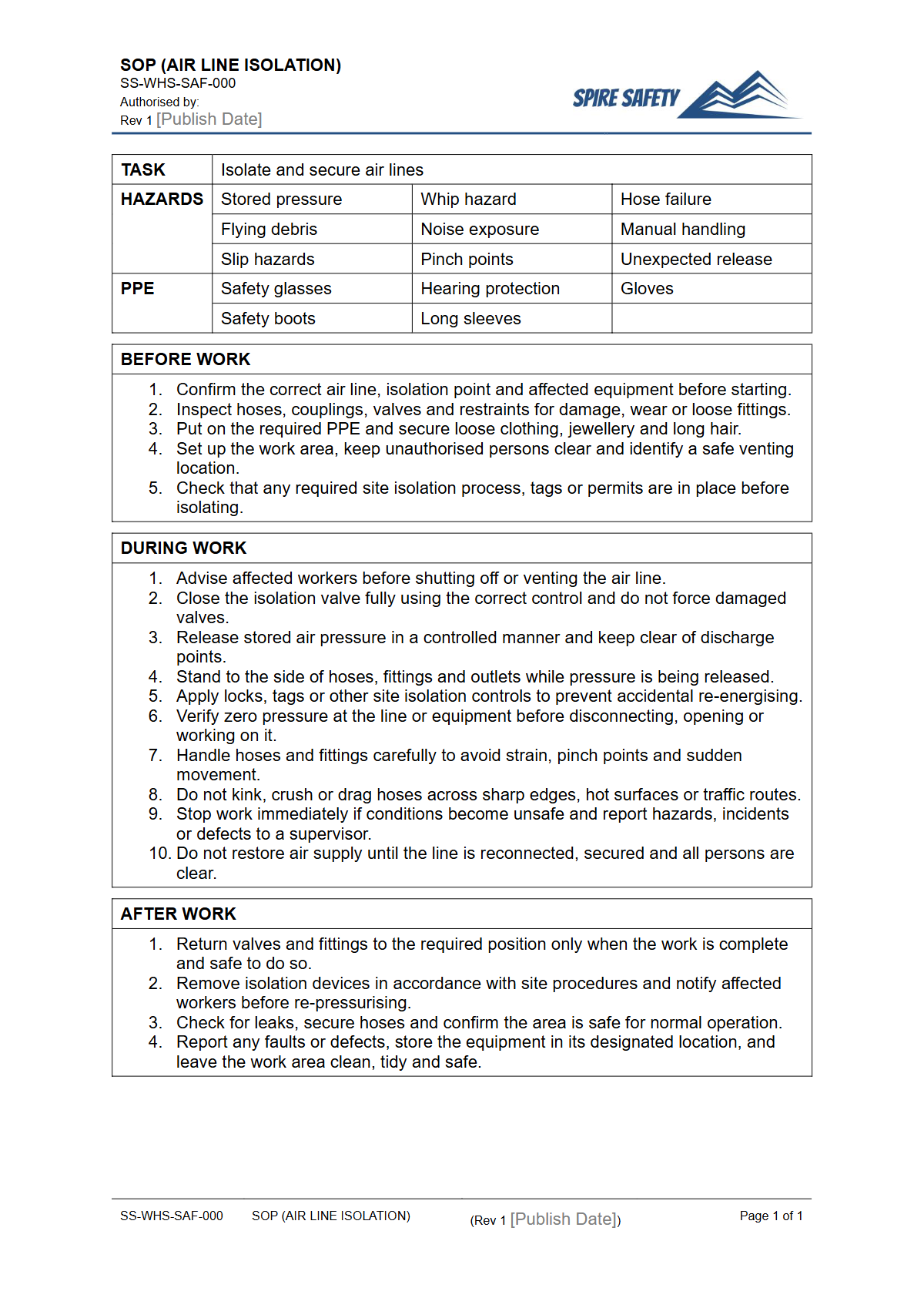
Download our free Safe Operating Procedure for Air Line Isolation. This template outlines the steps for safely de-energising pneumatic systems.
Free Safe Operating Procedure (Air Line Isolation) Template
DOCX • 126 KB + PDF
Updated Oct 2026
No signup required
Purpose of the Free Safe Operating Procedure (Air Line Isolation) Template
Working on machinery powered by compressed air presents significant risks if not managed correctly. Stored pneumatic energy can cause unexpected movement or projectile hazards, leading to serious injuries.
This page provides a Free Safe Operating Procedure (Air Line Isolation) Template to help your organisation establish a robust system of work for controlling these hazards.
The primary purpose of this SOP is to provide a formal, step-by-step guide for safely isolating and de-energising pneumatic equipment before maintenance, cleaning, or repair tasks. It serves as a critical administrative control measure that standardises behaviour, reduces the chance of human error, and provides a clear reference for training and supervision.
Implementing documented procedures like this is a fundamental part of an effective WHS management system, helping a Person Conducting a Business or Undertaking (PCBU) meet their primary duty of care.
Video walkthrough
How to use the Free Safe Operating Procedure (Air Line Isolation) Template
This Safe Operating Procedure template is provided as a user-friendly starting point. It comes in an easily editable DOCX format, allowing you to add your company logo and specific details.
The PDF version is also included for straightforward printing and distribution.
Important: This is a template and must be customised to your specific workplace. You are responsible for ensuring the final document reflects the unique equipment, processes, and risks present in your operations.
We cannot be held liable for incidents arising from the use of an un-adapted or improperly implemented procedure.
1. Conduct a Risk Assessment
Before customising the template, perform a thorough risk assessment for the task of isolating air lines on your equipment. Identify all potential hazards, including stored energy (pressure), uncontrolled equipment movement, noise, and ergonomic risks.
Use the findings to inform the specific steps and precautions in your SOP.
2. Detail the Procedure Steps
Fill in the template with clear, sequential instructions for the entire isolation process. This must include:
- Preparation: Identifying the correct machine and isolation points.
- Notification: Informing all affected workers and supervisors.
- Shutdown: Following the normal equipment shutdown procedure.
- Isolation: Closing the designated valve or energy-isolating device. For example, the valve from the equipment detailed in a Free Air Compressor SOP Template.
- Lockout/Tagout: Applying a lock and tag to the isolation device to prevent it from being operated.
- De-energisation: Bleeding, venting, or otherwise dissipating all stored downstream pressure to achieve a zero-energy state. This is the most critical step and is often missed.
3. Document the Re-energisation Process
A safe return to service is just as important as the isolation itself. Your SOP should also detail the steps for removing locks and re-introducing energy to the system.
This typically involves ensuring all tools and personnel are clear, removing locks and tags, notifying workers that power is being restored, and slowly re-opening the isolation valve.
When to use this Safe Operating Procedure
This Safe Operating Procedure for Air Line Isolation should be used whenever a worker is required to place any part of their body in a danger zone where the unexpected release of pneumatic energy could cause harm. It is not just for major overhauls; it applies to routine tasks as well.
Common situations include:
- Performing maintenance on pneumatic cylinders or actuators.
- Replacing air hoses, fittings, or filters.
- Clearing jams in machinery with pneumatic components, such as a brake press.
- Servicing air-powered tools and equipment like a plasma cutter.
- Cleaning parts of a machine that are normally in motion.
Who should use this document
The isolation of hazardous energy must only be performed by personnel who are trained, competent, and explicitly authorised by the organisation to do so. This document should be used by:
- Authorised Personnel: Maintenance staff, fitters, electricians, and technicians tasked with performing the isolation.
- Supervisors: To verify that the correct procedure is being followed and to ensure that only authorised individuals perform the task.
- WHS Managers: As a tool for training, inductions, and risk management. The existence and correct application of such procedures are often key verification points during WHS compliance auditing.
The SOP also informs 'affected persons'—operators or other workers in the vicinity—about the process, ensuring they do not attempt to restart equipment that is locked out. By implementing a clear procedure, you build a safer, more predictable work environment. To find more templates and checklists to strengthen your safety framework, explore our complete free WHS resources library.
Common mistakes
Common mistakes to avoid
- Assuming the system is safe just because the compressor is turned off, ignoring residual pressure in lines.
- Failing to bleed or vent all downstream air pressure after closing the main isolation valve.
- Using makeshift or damaged hardware for locking out, instead of designated, robust locks and tags.
- Allowing untrained or unauthorised staff to perform isolations or remove someone else's lock.
Legal references
Legal considerations
The following legal requirements may be relevant to this type of work.
- Work Health and Safety Act (Harmonised) — Provides the primary duties for protecting workers and other people from work health and safety risks.
- Work Health and Safety Regulations (Harmonised) — Sets out requirements supporting the management of workplace hazards and risks.
The following codes may be relevant to this type of work.
- Managing WHS Risks Code of Practice — Provides practical guidance on identifying hazards, assessing risks and applying effective controls.
- Work Health and Safety Consultation, Cooperation and Coordination Code of Practice — Provides practical guidance on consulting workers and coordinating with other duty holders.
- Managing the Work Environment and Facilities Code of Practice — Provides practical guidance on safe work environments, workplace facilities and related controls.
Did you know
Hidden Danger
Even low-pressure compressed air, as low as 70 kPa (10 psi), can cause a fatal air embolism if it penetrates the skin and enters the bloodstream. Never use compressed air for cleaning skin or clothing.
Cost of Leaks
A tiny 1.5mm hole in a compressed air line operating at 700 kPa (100 psi) can waste over $2,000 in electricity costs per year. Properly maintained and isolated systems are not just safer, they are more efficient.
FAQ
Frequently asked questions
01What is air line isolation?
02Is an SOP a legal requirement for air line isolation in Australia?
03Who can perform an air line isolation?
04What's the difference between isolation and just turning off the air compressor?
Share this resource
Free Safe Operating Procedure (Air Line Isolation) Template
Browse Categories
How To Use It
- 1Download and open in Word or PDF.
- 2Replace the placeholders with your business details.
- 3Get it reviewed by a WHS specialist before rollout.
Need it customised?
Our WHS consultants can adapt this template to your site, run a gap analysis, or audit what you already have in place.
Book a Free Consultation WHS consulting servicesor call 1300 156 382
Related templates
- Free Safe Operating Procedure (Air Operated Pump) Template
- Free Safe Operating Procedure (Air Ratchet) Template
- Free Safe Operating Procedure (Air Receiver Drain) Template
- Free Safe Operating Procedure (Air Return Cleaning) Template
- Free Safe Operating Procedure (Air Riveter) Template
- Free Safe Operating Procedure (Air Sampling Pump) Template