
Free Safe Operating Procedure (Air Operated Pump) Template
Get started with our Free Safe Operating Procedure (Air Operated Pump) Template.
Free Safe Operating Procedure (Air Operated Pump) Template
DOCX • 126 KB + PDF
Updated Oct 2026
No signup required
Purpose of the Free Safe Operating Procedure (Air Operated Pump) Template
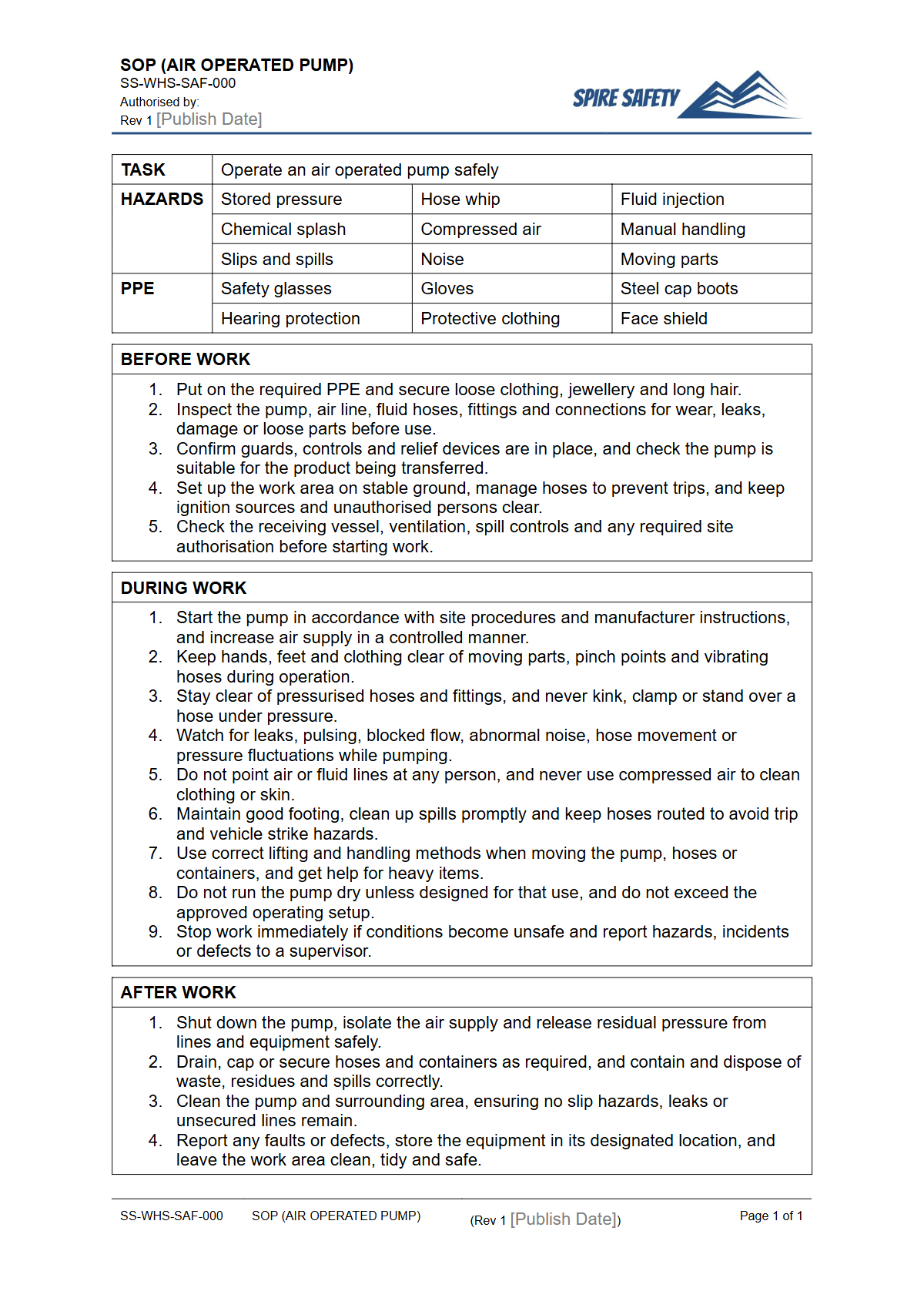
This Free Safe Operating Procedure (Air Operated Pump) Template provides a structured framework for documenting the safe use of air-operated pumps in your workplace. Air-operated pumps, often used for transferring fluids, present unique hazards including high-pressure air injection, exposure to hazardous substances, and manual handling risks.
A documented SOP is a critical tool for managing these risks, ensuring all workers follow a consistent, safe process for setup, operation, and shutdown. It serves as a key component of a robust WHS management system, helping your organisation meet its duty of care obligations.
Implementing a clear SOP helps to standardise training, simplify supervision, and provide a clear reference point for operators. By outlining required PPE, pre-operational checks, and emergency procedures, this template helps minimise the likelihood of incidents and injuries.
As air pumps rely on a separate power source, it is also beneficial to have a corresponding free Air Compressor SOP template to manage associated risks.
Video walkthrough
How to use the Free Safe Operating Procedure (Air Operated Pump) Template
This template is provided in both DOCX and PDF formats for your convenience. The DOCX file is fully editable, allowing you to tailor it to your specific operational needs, equipment models, and workplace environment.
It is crucial to customise this document to reflect the actual risks and control measures relevant to your site.
Important: This is a template only. We are not familiar with your specific machinery, work environment, or operator competency.
You MUST consult with your team and conduct a site-specific risk assessment to ensure the final document is comprehensive and accurate for your business. An SOP is most effective when developed in consultation with the workers who will use it.
Customisation Steps:
- Download the DOCX template.
- Conduct a risk assessment for the task of using the air-operated pump, identifying all potential hazards.
- Consult with operators and supervisors to capture practical, on-the-ground knowledge.
- Fill in the specific details for your pump model, including pre-start checks (e.g., hose integrity, coupling security, air pressure settings), step-by-step operating instructions, and shutdown procedures.
- Specify the required Personal Protective Equipment (PPE) based on the substance being pumped and other environmental factors (e.g., chemical-resistant gloves, safety glasses, hearing protection).
- Document emergency procedures, such as managing a fluid spill or ruptured hose.
- Ensure the finalised SOP is reviewed and approved by a competent person before being issued. While the core principles of an SOP are similar across plant, the specific steps will differ significantly from those in an SOP for a boom pump.
When to use it
A Safe Operating Procedure for an air-operated pump should be developed and implemented before the equipment is first used. It is a living document that should be integrated into daily operations and referenced regularly.
Key times to use the SOP include during new worker inductions, task-specific training for operators, and as a basis for refresher training sessions or toolbox talks. It also serves as an essential reference document during routine safety inspections and formal WHS compliance auditing.
Who should use it
This SOP template is designed for use by any person or organisation responsible for workplace safety and the management of plant. This includes:
- Persons Conducting a Business or Undertaking (PCBUs) to fulfil their primary duty of care.
- Managers and Supervisors to ensure workers are trained and operate equipment according to established safe procedures.
- WHS/HSE Advisors to integrate the procedure into the broader safety management system.
- Workers and Operators as a practical guide to performing their tasks safely and consistently.
Having clear, task-specific procedures is fundamental for any workplace using powered equipment. A detailed SOP for an air pump is as important as a Plasma Cutter SOP is for a fabrication workshop. If your business uses a variety of plant and equipment, you may find other relevant templates in our free WHS resources library.
Common mistakes
Common mistakes to avoid
- Using a generic SOP without customising it for the specific pump model and work environment.
- Failing to consult with experienced operators during the drafting process, missing critical safety details.
- Neglecting to provide practical training to workers on the finalised SOP.
- Not reviewing or updating the SOP after an incident or when operational processes change.
Legal references
Legal considerations
The following legal requirements may be relevant to this type of work.
- Work Health and Safety Act (Harmonised) — Provides the primary duties for protecting workers and other people from work health and safety risks.
- Work Health and Safety Regulations (Harmonised) — Sets out requirements supporting the management of workplace hazards and risks.
The following codes may be relevant to this type of work.
- Managing WHS Risks Code of Practice — Provides practical guidance on identifying hazards, assessing risks and applying effective controls.
- Work Health and Safety Consultation, Cooperation and Coordination Code of Practice — Provides practical guidance on consulting workers and coordinating with other duty holders.
- Managing the Work Environment and Facilities Code of Practice — Provides practical guidance on safe work environments, workplace facilities and related controls.
Did you know
Inherent Safety
Because they run on compressed air rather than electricity, air-operated diaphragm pumps are often considered intrinsically safe for use in flammable or explosive environments where sparks are a major hazard.
Air Line Safety
A whipping air hose from a failed coupling can cause serious impact injuries. Always ensure hose connections are secure and use whip checks or safety cables as a secondary restraint where high pressures are involved.
FAQ
Frequently asked questions
01What is a Safe Operating Procedure for an air-operated pump?
02Is using this template enough to be WHS-aligned?
03Who is responsible for creating and approving the SOP?
04How often should an SOP for an air-operated pump be reviewed?
Share this resource
Free Safe Operating Procedure (Air Operated Pump) Template
Browse Categories
How To Use It
- 1Download and open in Word or PDF.
- 2Replace the placeholders with your business details.
- 3Get it reviewed by a WHS specialist before rollout.
Need it customised?
Our WHS consultants can adapt this template to your site, run a gap analysis, or audit what you already have in place.
Book a Free Consultation WHS consulting servicesor call 1300 156 382
Related templates
- Free Safe Operating Procedure (Air Ratchet) Template
- Free Safe Operating Procedure (Air Receiver Drain) Template
- Free Safe Operating Procedure (Air Return Cleaning) Template
- Free Safe Operating Procedure (Air Riveter) Template
- Free Safe Operating Procedure (Air Sampling Pump) Template
- Free Safe Operating Procedure (Air Sander) Template