
Free Safe Operating Procedure (Air Intake Cleaning) Template
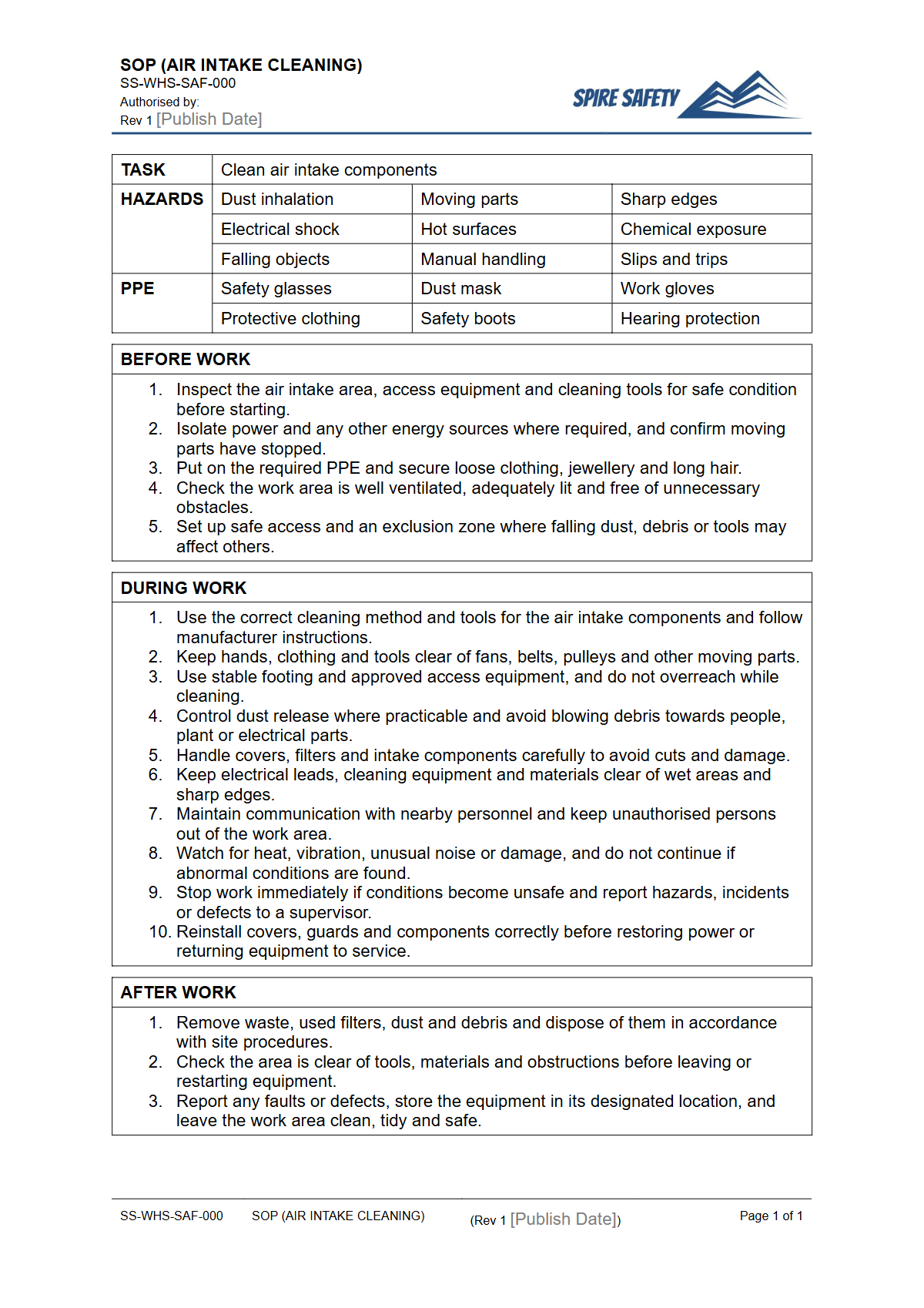
Download our Free Safe Operating Procedure (Air Intake Cleaning) Template. This user-friendly DOCX and PDF resource helps you outline safe work methods.
Free Safe Operating Procedure (Air Intake Cleaning) Template
DOCX • 126 KB + PDF
Updated Oct 2026
No signup required
Purpose of the Free Safe Operating Procedure (Air Intake Cleaning) Template
Effectively managing workplace safety starts with clear, documented procedures. This Free Safe Operating Procedure (Air Intake Cleaning) Template provides a structured framework for businesses to establish a safe system of work for cleaning air intakes on vehicles, plant, and machinery.
The primary purpose is to control hazards and minimise risks to workers, such as exposure to cleaning chemicals, airborne dust, and mechanical dangers from unexpected equipment start-up. By formalising the process, you ensure every worker performs the task consistently and safely, meeting their obligations under Australian WHS legislation.
A well-defined SOP helps prevent engine or component damage caused by improper cleaning techniques and ensures the longevity and efficiency of the equipment. It serves as a vital training tool for new employees and a reference point for experienced personnel.
Implementing this procedure is a key step in a proactive approach to safety, similar to the structured processes outlined in our free Air Compressor SOP, which also deals with systems requiring clean air.
Video walkthrough
How to use the Free Safe Operating Procedure (Air Intake Cleaning) Template
This Safe Operating Procedure is available as a fully editable DOCX file and a print-ready PDF. To use it, simply download the file and integrate it into your existing safety management system.
The template is designed as a comprehensive starting point, pre-filled with common steps and safety considerations relevant to air intake cleaning.
Important: This document must be customised to your specific workplace. Every piece of equipment and work environment has unique risks.
You need to conduct a site-specific risk assessment and update the SOP with details about the exact machinery, cleaning agents used, required PPE, and emergency protocols relevant to your operations. We have provided a solid foundation, but the final responsibility for its accuracy and suitability rests with the Person Conducting a Business or Undertaking (PCBU). A customised SOP is a critical document when you develop a comprehensive WHS management system.
When to use it
A Safe Operating Procedure for air intake cleaning should be used consistently before any worker undertakes the task. It is not just a document for initial training but a practical tool for day-to-day operations.
Its use is critical in several scenarios, including routine preventative maintenance schedules, corrective maintenance following a fault, and pre-operational checks in dusty or dirty environments. Furthermore, the SOP should be a central part of any refresher training programs to prevent procedural drift and reinforce safe work habits.
It's also essential to review and potentially update the SOP when new types of vehicles or plant are introduced to the fleet, such as those covered in our Dozer SOP template, which have their own specific maintenance requirements.
Who should use it
This template is designed for use by a range of personnel within an organisation. WHS Managers and Safety Officers can use it to develop and standardise procedures across the business.
Maintenance Managers and Supervisors will find it invaluable for directing and overseeing the work of their teams, ensuring every step is followed correctly. The final, customised SOP is intended for the workers who actually perform the cleaning task, including mechanics, apprentices, plant operators, and maintenance fitters.
It empowers them with the knowledge to work safely and effectively, providing clear, unambiguous instructions.
Key elements of a robust air intake cleaning SOP
To be effective, your customised SOP should detail several critical areas. These ensure that all foreseeable risks have been considered and controlled. Key sections to review and populate include:
- Required Personal Protective Equipment (PPE): Specify the exact PPE needed, such as safety glasses or goggles, chemical-resistant gloves, and respiratory protection suitable for the dusts or vapours present.
- Pre-operational Checks: List all checks to be performed before work begins. This must include steps for isolating energy sources (lockout/tagout), ensuring adequate ventilation, and inspecting tools and cleaning agents.
- Step-by-Step Cleaning Procedure: Detail the sequence of actions from start to finish. Include instructions on disassembly, application of cleaners, handling of filter elements, reassembly, and post-cleaning checks. This level of detail is crucial, much like in our free Plasma Cutter SOP.
- Waste Disposal: Outline the correct method for disposing of used filters, dirty rags, and residual cleaning chemicals in accordance with environmental and safety regulations.
- Emergency Procedures: Clearly state the immediate actions to take in case of an emergency, such as chemical spills, fire, or personal injury.
Integrating this procedure is a crucial part of maintaining safety standards, a process that can be verified through regular WHS compliance auditing. You can find many other useful documents in our free WHS resources library to support your safety goals.
Common mistakes
Common mistakes to avoid
- Using incorrect or non-approved cleaning chemicals that can damage components or pose health risks.
- Failing to properly isolate the equipment from all energy sources (lockout/tagout) before starting work.
- Neglecting to wear appropriate personal protective equipment (PPE), especially eye and respiratory protection.
- Not allowing for sufficient ventilation when using chemical cleaners, leading to vapour build-up.
Legal references
Legal considerations
The following legal requirements may be relevant to this type of work.
- Work Health and Safety Act (Harmonised) — Provides the primary duties for protecting workers and other people from work health and safety risks.
- Work Health and Safety Regulations (Harmonised) — Sets out requirements supporting the management of workplace hazards and risks.
The following codes may be relevant to this type of work.
- Managing WHS Risks Code of Practice — Provides practical guidance on identifying hazards, assessing risks and applying effective controls.
- Work Health and Safety Consultation, Cooperation and Coordination Code of Practice — Provides practical guidance on consulting workers and coordinating with other duty holders.
- Managing the Work Environment and Facilities Code of Practice — Provides practical guidance on safe work environments, workplace facilities and related controls.
Did you know
Engine Performance
A dirty or clogged air intake filter can reduce an engine's fuel efficiency by up to 10% and significantly decrease its overall power output.
Particulate Matter
The primary role of an air filter is to stop abrasive particles from entering an engine's cylinders, which can cause premature wear, internal damage, and oil contamination.
FAQ
Frequently asked questions
01What are the main hazards when cleaning an air intake?
02Is this template enough for WHS compliance on its own?
03How often should an Air Intake Cleaning SOP be reviewed?
04Who needs to be trained on this Safe Operating Procedure?
Share this resource
Free Safe Operating Procedure (Air Intake Cleaning) Template
Browse Categories
How To Use It
- 1Download and open in Word or PDF.
- 2Replace the placeholders with your business details.
- 3Get it reviewed by a WHS specialist before rollout.
Need it customised?
Our WHS consultants can adapt this template to your site, run a gap analysis, or audit what you already have in place.
Book a Free Consultation WHS consulting servicesor call 1300 156 382
Related templates
- Free Safe Operating Procedure (Air Line Isolation) Template
- Free Safe Operating Procedure (Air Operated Pump) Template
- Free Safe Operating Procedure (Air Ratchet) Template
- Free Safe Operating Procedure (Air Receiver Drain) Template
- Free Safe Operating Procedure (Air Return Cleaning) Template
- Free Safe Operating Procedure (Air Riveter) Template