
Free Safe Operating Procedure (Air Hose Whip Check) Template
Prevent high-pressure hose whip injuries with our structured Safe Operating Procedure for air hose whip checks. Download your free DOCX and PDF template now.
Free Safe Operating Procedure (Air Hose Whip Check) Template
DOCX • 126 KB + PDF
Updated Oct 2026
No signup required
Purpose of the Free Safe Operating Procedure (Air Hose Whip Check) Template
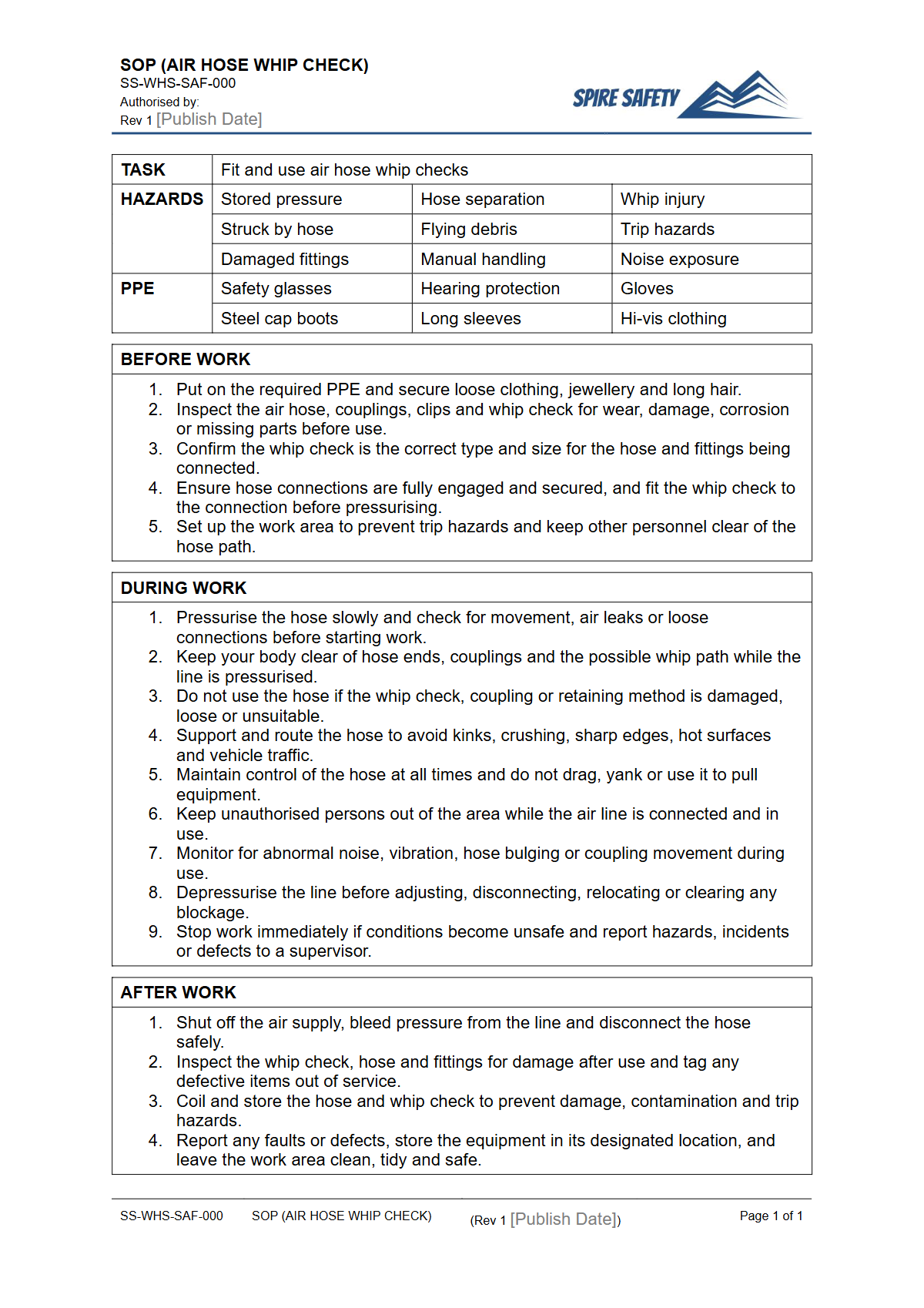
This Free Safe Operating Procedure (Air Hose Whip Check) Template provides a structured framework for documenting the safe use and inspection of air hose whip checks. Compressed air systems pose a significant risk; a failure at a coupling can cause a hose to whip violently, leading to serious injuries or property damage.
This SOP is designed to help your organisation establish and standardise a clear, step-by-step process for mitigating this specific hazard. By implementing a formal procedure, you can enhance worker training, improve risk management, and demonstrate due diligence in maintaining a safe work environment.
A documented SOP is a critical component of robust WHS management systems, ensuring safety practices are consistently applied across all operations involving pressurised air lines.
Video walkthrough
How to use the Free Safe Operating Procedure (Air Hose Whip Check) Template
This document serves as a comprehensive starting point, not a finished product. To be effective, it must be adapted to the specific context of your workplace.
Download the template and collaborate with workers, supervisors, and other stakeholders who directly interact with the equipment. Review and modify the steps to reflect your site's unique air compressors, hoses, pneumatic tools, and operating conditions.
We strongly advise that you customise this template to align with your specific machinery, risk assessments, and internal safety protocols before implementation. Once finalised, the SOP should be used as a primary tool for training operators and for ongoing competency verification. For other related procedural documents, you can explore our complete free WHS resources library.
When to use an Air Hose Whip Check SOP
This Safe Operating Procedure should be referenced whenever high-pressure air hoses are in use. It forms a critical part of the pre-start checks that operators must perform before pressurising any air line.
The procedure should be followed for initial setup, during connection or disconnection of tools, and as part of routine equipment inspections. It is particularly important in dynamic environments where hoses may be moved, repositioned, or subjected to potential damage.
This SOP should be used alongside other key procedural documents, such as a Free Air Compressor SOP Template, to create a holistic approach to compressed air safety.
Who should use this Safe Operating Procedure
This SOP is intended for all personnel who work with or near pressurised air equipment. This includes, but is not limited to, workshop mechanics, maintenance staff, mobile plant operators, and general labourers using pneumatic tools like nail guns or impact wrenches.
Supervisors and managers are responsible for ensuring workers are trained on this procedure and that its steps are followed correctly. WHS personnel can use this template to standardise safety practices across the organisation and as a reference during safety audits and incident investigations.
For expert guidance on defining roles and integrating SOPs effectively, consider our WHS consulting services.
Key Elements of an Air Hose Whip Check SOP
A thorough SOP for air hose whip checks should cover several critical areas to be effective. The procedure must detail the pre-use inspection of the whip check itself, looking for signs of wear, corrosion, or fraying on the cable.
It should also outline the inspection of the hose and its couplings for cracks, bulges, or other damage. The document must provide clear, unambiguous instructions on the correct installation method—securing the whip check from hose to hose or hose to equipment, ensuring it is not stretched taut but has enough slack to function correctly.
This is often done in conjunction with procedures for specific tools; for example, a FREE Plasma Cutter SOP (Safe Operating Procedure) Template would be complemented by this air hose safety document. Finally, it's vital to include steps for depressurising the system before making any connections or disconnections.
Integrating the SOP into Your Safety System
Simply having a written SOP is not enough; it must be a living document within your safety management system. Effective integration involves including the SOP in worker induction programs and providing refresher training at regular intervals.
Competency should be verified and recorded. The effectiveness of the procedure itself should be reviewed periodically and after any incident or near-miss involving air hoses.
Regular reviews as part of a WHS compliance auditing program can help identify gaps and opportunities for improvement, ensuring your safety procedures remain relevant and effective.
Common mistakes
Common mistakes to avoid
- Using a whip check that is the wrong size for the hose diameter.
- Attaching the whip check across a single quick-connect coupling instead of from hose-to-hose or hose-to-tool.
- Failing to inspect the whip check itself for fraying, corrosion, or damage before use.
- Relying on a whip check as a substitute for fully depressurising the air line before disconnection.
Legal references
Legal considerations
The following legal requirements may be relevant to this type of work.
- Work Health and Safety Act (Harmonised) — Provides the primary duties for protecting workers and other people from work health and safety risks.
- Work Health and Safety Regulations (Harmonised) — Sets out requirements supporting the management of workplace hazards and risks.
The following codes may be relevant to this type of work.
- Managing WHS Risks Code of Practice — Provides practical guidance on identifying hazards, assessing risks and applying effective controls.
- Work Health and Safety Consultation, Cooperation and Coordination Code of Practice — Provides practical guidance on consulting workers and coordinating with other duty holders.
- Managing the Work Environment and Facilities Code of Practice — Provides practical guidance on safe work environments, workplace facilities and related controls.
Did you know
Incredible Force
A 1-inch air hose that disconnects at 100 PSI can whip at over 200 km/h. The force is enough to cause severe injury, break bones, or even be fatal.
Material Matters
Whip checks are typically made from corrosion-resistant steel cable. Regular inspection for fraying, kinks, or rust is essential to ensure they remain effective and do not fail under load during a hose separation.
FAQ
Frequently asked questions
01What is an air hose whip check?
02Are whip checks legally required in Australia?
03How often should I inspect air hoses and whip checks?
04Can this Safe Operating Procedure be used for hydraulic hoses?
Share this resource
Free Safe Operating Procedure (Air Hose Whip Check) Template
Browse Categories
How To Use It
- 1Download and open in Word or PDF.
- 2Replace the placeholders with your business details.
- 3Get it reviewed by a WHS specialist before rollout.
Need it customised?
Our WHS consultants can adapt this template to your site, run a gap analysis, or audit what you already have in place.
Book a Free Consultation WHS consulting servicesor call 1300 156 382
Related templates
- Free Safe Operating Procedure (Air Intake Cleaning) Template
- Free Safe Operating Procedure (Air Line Isolation) Template
- Free Safe Operating Procedure (Air Operated Pump) Template
- Free Safe Operating Procedure (Air Ratchet) Template
- Free Safe Operating Procedure (Air Receiver Drain) Template
- Free Safe Operating Procedure (Air Return Cleaning) Template