
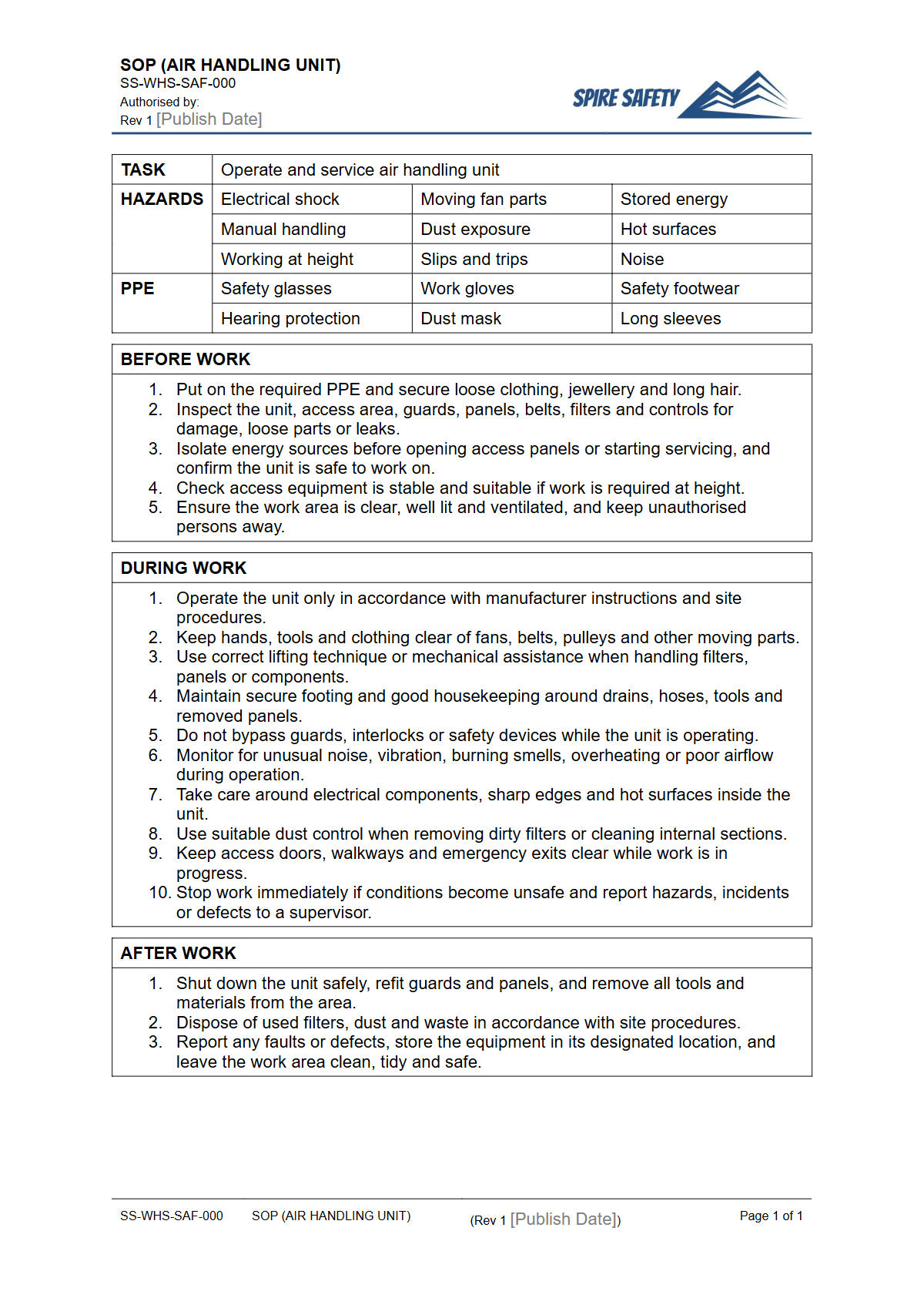
Free Safe Operating Procedure (Air Handling Unit) Template
Download our free Safe Operating Procedure (Air Handling Unit) template.
Free Safe Operating Procedure (Air Handling Unit) Template
DOCX • 126 KB + PDF
Updated Oct 2026
No signup required
Purpose of the Free Safe Operating Procedure (Air Handling Unit) Template
An Air Handling Unit (AHU) is a critical component of any building's HVAC system, but it also presents significant workplace health and safety risks if not managed correctly. This free Safe Operating Procedure (Air Handling Unit) template provides a structured starting point for documenting the required steps to safely perform tasks such as maintenance, cleaning, and inspection of AHUs.
Using a documented procedure helps your organisation manage hazards including electricity, moving parts (fans, belts), hazardous substances (cleaning chemicals, refrigerants), manual handling, and potential exposure to airborne contaminants.
Developing a specific SOP is a key control measure for managing risks associated with fixed plant. A well-drafted procedure standardises work methods, ensures workers are aware of hazards, and demonstrates due diligence in meeting WHS obligations. Just as you would for other pressurised plant, having a clear process is essential, similar to the requirements outlined in our free Air Compressor SOP.
Video walkthrough
How to use the Free Safe Operating Procedure (Air Handling Unit) Template
This document is a general template designed to be adapted to your specific workplace. To use it effectively, you must identify the unique hazards and control measures relevant to your AHU models, site conditions, and operational requirements.
Download the DOCX file to add your company branding and edit the content, or use the PDF as a reference.
Important: This is a template only. We've provided a solid framework, but you must customise it with your specific site details, AHU models, maintenance schedules, and workplace procedures to ensure it is effective.
An SOP should not be a standalone document; it should integrate into a complete WHS management system that includes training, supervision, and regular reviews.
Key Elements to Customise
- Site and Equipment Specifics: Detail the location, make, and model of the AHU.
- Risk Assessment Details: Reference your specific risk assessment for AHU tasks.
- Required PPE: List the exact personal protective equipment required, such as electrical gloves, safety glasses, respiratory protection, and hearing protection.
- Lockout/Tagout (LOTO) Procedure: Incorporate your site's specific LOTO steps for isolating energy sources before any work begins.
- Emergency Contacts: Include relevant phone numbers and emergency procedures.
When to use this Safe Operating Procedure
This Safe Operating Procedure should be used by workers before and during any interaction with an Air Handling Unit that is not part of normal, automated operation. It is essential for non-routine tasks that carry higher risk. Key activities include:
- Scheduled preventative maintenance (e.g., belt tensioning, lubrication).
- Filter inspection and replacement.
- Coil cleaning and servicing.
- Fault diagnosis and repairs.
- Decommissioning or installation work.
Many of these tasks may require working at heights to access roof-mounted or ceiling-suspended units. Your procedure should cross-reference other relevant SOPs, such as those for safe step ladder use or elevated work platforms.
Who should use this document
This SOP is intended for competent personnel who are authorised to conduct work on Air Handling Units. This typically includes:
- HVAC technicians
- Maintenance staff and fitters
- Electricians
- Facilities management personnel
- Specialist subcontractors
Supervisors and managers should also use the document to ensure work is being performed according to the agreed safe procedure and to assist in workplace inspections and training. If your team lacks the internal expertise to adapt and implement this procedure effectively, seeking expert WHS consulting can provide the necessary guidance to ensure your safety documentation is robust and practical.
The effectiveness of any SOP relies on its correct implementation and consistent use. Verifying that the procedures are being followed on the ground is just as important as writing the document itself.
This can be achieved through direct supervision, competency assessments, and periodic WHS compliance auditing to identify any gaps between the documented procedure and actual work practices.
This template is one of many tools available to help you build a safer workplace. Feel free to browse our complete free WHS resources library for other templates, checklists, and guides to support your safety management efforts.
Common mistakes
Common mistakes to avoid
- Using the template without customising it for the specific AHU model and workplace.
- Failing to include a detailed, site-specific Lockout/Tagout (LOTO) procedure.
- Not providing adequate training on the finalised SOP to all relevant workers.
- Neglecting to review and update the SOP after an incident or changes to the equipment.
Legal references
Legal considerations
The following legal requirements may be relevant to this type of work.
- Work Health and Safety Act (Harmonised) — Provides the primary duties for protecting workers and other people from work health and safety risks.
- Work Health and Safety Regulations (Harmonised) — Sets out requirements supporting the management of workplace hazards and risks.
The following codes may be relevant to this type of work.
- Managing WHS Risks Code of Practice — Provides practical guidance on identifying hazards, assessing risks and applying effective controls.
- Work Health and Safety Consultation, Cooperation and Coordination Code of Practice — Provides practical guidance on consulting workers and coordinating with other duty holders.
- Managing the Work Environment and Facilities Code of Practice — Provides practical guidance on safe work environments, workplace facilities and related controls.
Did you know
Indoor Air Quality
Properly maintained Air Handling Units are essential for managing indoor air quality (IAQ). The World Health Organization estimates that poor IAQ contributes to millions of deaths annually, making AHU maintenance a critical public health function.
Energy Isolation
Failing to properly isolate energy sources is a leading cause of serious injury during plant maintenance. A robust Lockout/Tagout (LOTO) procedure is the most critical control measure within an AHU SOP.
FAQ
Frequently asked questions
01What is an SOP for an Air Handling Unit?
02Is this AHU SOP template ready to use immediately?
03Who is responsible for creating and implementing an AHU SOP?
04How often should a Safe Operating Procedure for an AHU be reviewed?
Share this resource
Free Safe Operating Procedure (Air Handling Unit) Template
Browse Categories
How To Use It
- 1Download and open in Word or PDF.
- 2Replace the placeholders with your business details.
- 3Get it reviewed by a WHS specialist before rollout.
Need it customised?
Our WHS consultants can adapt this template to your site, run a gap analysis, or audit what you already have in place.
Book a Free Consultation WHS consulting servicesor call 1300 156 382
Related templates
- Free Safe Operating Procedure (Air Hose Connection) Template
- Free Safe Operating Procedure (Air Hose Whip Check) Template
- Free Safe Operating Procedure (Air Intake Cleaning) Template
- Free Safe Operating Procedure (Air Line Isolation) Template
- Free Safe Operating Procedure (Air Operated Pump) Template
- Free Safe Operating Procedure (Air Ratchet) Template