
Free Safe Operating Procedure (Air Diffuser Cleaning) Template
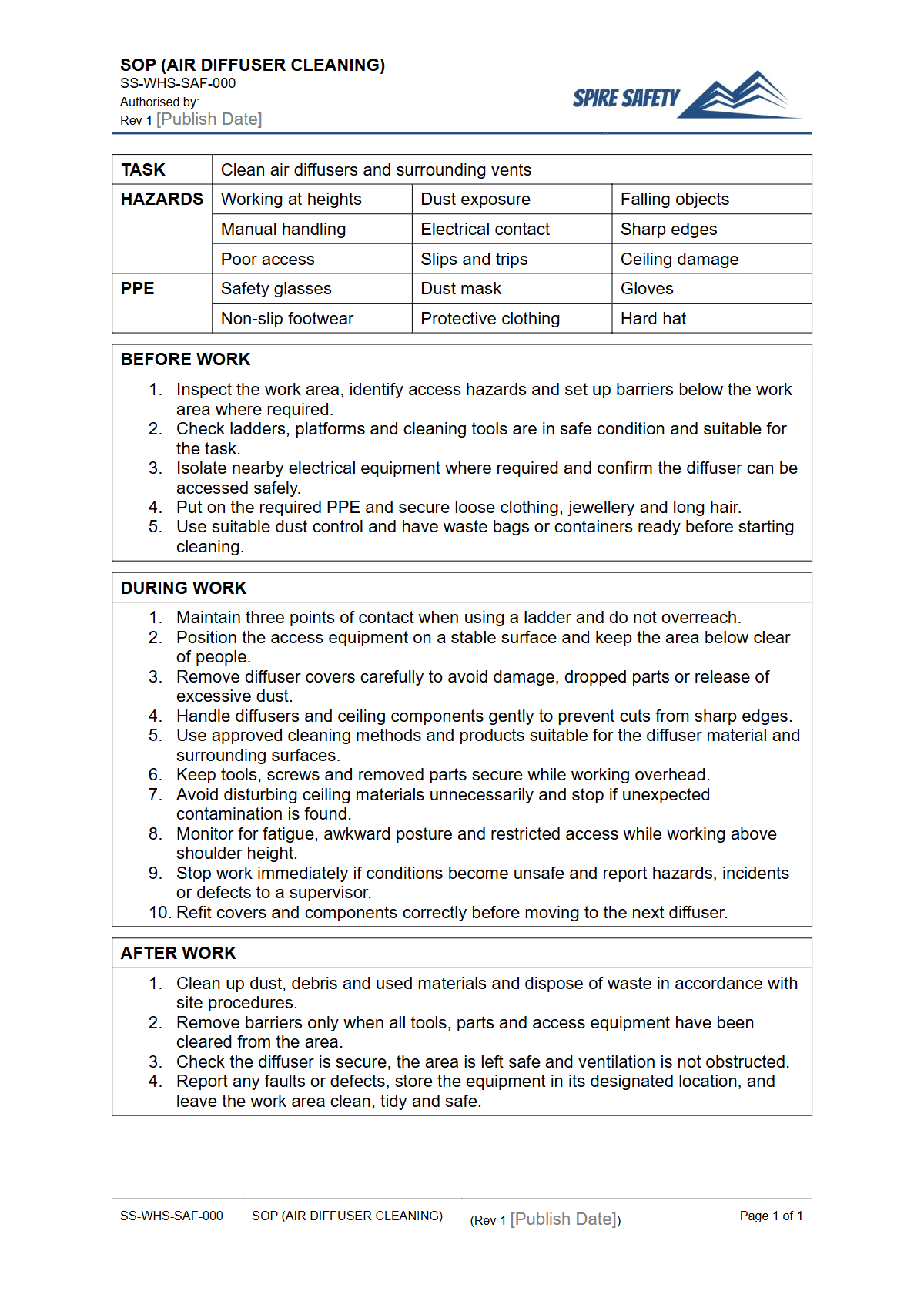
Download our free Safe Operating Procedure (Air Diffuser Cleaning) Template. This structured Word & PDF document helps you outline safe work practices.
Free Safe Operating Procedure (Air Diffuser Cleaning) Template
DOCX • 126 KB + PDF
Updated Oct 2026
No signup required
Purpose of the Free Safe Operating Procedure (Air Diffuser Cleaning) Template
Effectively managing workplace health and safety requires clear, documented processes for routine and non-routine tasks. This free Safe Operating Procedure (Air Diffuser Cleaning) Template provides a structured starting point for organisations to formalise their approach to this common maintenance activity.
Cleaning air diffusers, while seemingly simple, involves several potential hazards. These include risks associated with working at heights, manual handling of equipment, and potential exposure to airborne contaminants like dust, mould, and cleaning chemicals.
A well-drafted SOP ensures that workers have a clear, step-by-step guide to perform the task safely and consistently, minimising risks to themselves and others in the workplace.
Documenting these procedures helps in meeting your primary duty of care obligations under Australian WHS legislation. It provides a basis for training, supervision, and incident investigation.
For tasks involving ladders or elevated work platforms, having a clear process is critical. Our template can be used alongside other specific guides, such as a FREE Step Ladder SOP Template, to build a comprehensive safety plan for the entire job.
Video walkthrough
How to use the Free Safe Operating Procedure (Air Diffuser Cleaning) Template
This resource is provided in both DOCX and PDF formats for your convenience. The DOCX version is fully editable, allowing you to tailor it to the specific needs of your business.
To use the template, download the file and open it in a compatible word processor. Systematically work through each section, replacing the placeholder text with information relevant to your site.
This includes detailing the specific types of diffusers, the approved cleaning agents, the required personal protective equipment (PPE), and the step-by-step cleaning process from setup to completion.
It is crucial to remember that this is a template, not a finished document. We have provided a structured starting point aligned with Australian WHS principles, but you must adapt the content to reflect the specific equipment, environment, and control measures relevant to your workplace.
Once customised, this SOP should be integrated into your overall WHS management systems, serving as a key operational document.
When to use it
A Safe Operating Procedure for air diffuser cleaning should be developed and implemented before any worker undertakes the task. It forms an essential part of the training and induction process for any new maintenance staff, cleaners, or facilities personnel responsible for HVAC upkeep.
The SOP should be readily available in the work area as a reference guide for workers to consult before and during the cleaning activity. Furthermore, it serves as a critical tool during safety meetings, toolbox talks, and periodic skills verification.
Regular reviews of the SOP are also necessary, especially after an incident, when new equipment is introduced, or if processes change. These reviews can be incorporated into your schedule of WHS compliance auditing to ensure ongoing relevance and effectiveness.
In many facilities, air diffuser cleaning is part of a broader maintenance schedule that may involve other plant and equipment. Ensuring safe procedures are in place for all equipment is vital.
For example, if your work area includes industrial machinery, you might also need a Free Air Compressor SOP to manage associated risks.
Who should use it
This SOP template is designed for a range of personnel within an organisation. WHS managers and safety officers can use it as a foundation for developing site-specific procedures that align with the company's safety framework.
Facilities managers and maintenance supervisors are responsible for customising the template, ensuring its technical accuracy, and implementing it with their teams. The final, approved SOP is a mandatory tool for all employees and contractors who perform air diffuser cleaning tasks.
It provides them with the authorised, safe method for completing their work, helping to standardise behaviour and reduce the likelihood of incidents. If you require assistance tailoring this or other procedures, engaging external expertise through WHS consulting can provide valuable insight and ensure best practice.
By ensuring all relevant personnel are trained on and have access to this procedure, an organisation demonstrates a proactive approach to risk management. To discover other valuable procedural documents, you can browse our complete free WHS resources library, which contains a wide range of templates for various tasks and equipment.
Common mistakes
Common mistakes to avoid
- Forgetting to isolate the HVAC system or relevant zone before starting work.
- Using unstable access equipment, such as standing on office chairs or desks, instead of appropriate ladders or platforms.
- Neglecting to wear appropriate PPE, especially respiratory and eye protection, leading to dust or chemical exposure.
- Failing to clean up debris or chemical spills properly after the job, creating slip and trip hazards for others.
Legal references
Legal considerations
The following legal requirements may be relevant to this type of work.
- Work Health and Safety Act (Harmonised) — Provides the primary duties for protecting workers and other people from work health and safety risks.
- Work Health and Safety Regulations (Harmonised) — Sets out requirements supporting the management of workplace hazards and risks.
The following codes may be relevant to this type of work.
- Managing WHS Risks Code of Practice — Provides practical guidance on identifying hazards, assessing risks and applying effective controls.
- Work Health and Safety Consultation, Cooperation and Coordination Code of Practice — Provides practical guidance on consulting workers and coordinating with other duty holders.
- Managing the Work Environment and Facilities Code of Practice — Provides practical guidance on safe work environments, workplace facilities and related controls.
Did you know
Indoor Air Quality
Poorly maintained HVAC systems, including dirty diffusers, can be a major contributor to 'Sick Building Syndrome,' a condition where building occupants experience health issues and discomfort linked to time spent in the building.
Dust and Allergens
The dust that accumulates in air diffusers can contain a mix of skin cells, fibres, pollen, mould spores, and bacteria, which are then recirculated into the workspace when the HVAC system is active.
FAQ
Frequently asked questions
01What hazards are involved in cleaning air diffusers?
02How often should a Safe Operating Procedure be reviewed?
03Can I use this template for all types of air diffusers?
04What personal protective equipment (PPE) is needed for cleaning air diffusers?
Share this resource
Free Safe Operating Procedure (Air Diffuser Cleaning) Template
Browse Categories
How To Use It
- 1Download and open in Word or PDF.
- 2Replace the placeholders with your business details.
- 3Get it reviewed by a WHS specialist before rollout.
Need it customised?
Our WHS consultants can adapt this template to your site, run a gap analysis, or audit what you already have in place.
Book a Free Consultation WHS consulting servicesor call 1300 156 382
Related templates
- Free Safe Operating Procedure (Air Fed Respirator) Template
- Free Safe Operating Procedure (Air Grease Gun) Template
- Free Safe Operating Procedure (Air Handling Unit) Template
- Free Safe Operating Procedure (Air Hose Connection) Template
- Free Safe Operating Procedure (Air Hose Whip Check) Template
- Free Safe Operating Procedure (Air Intake Cleaning) Template