
Free Safe Operating Procedure (Air Die Grinder) Template
Download our free Safe Operating Procedure (Air Die Grinder) Template. This customisable DOCX & PDF helps you outline safe work methods for your team.
Free Safe Operating Procedure (Air Die Grinder) Template
DOCX • 126 KB + PDF
Updated Oct 2026
No signup required
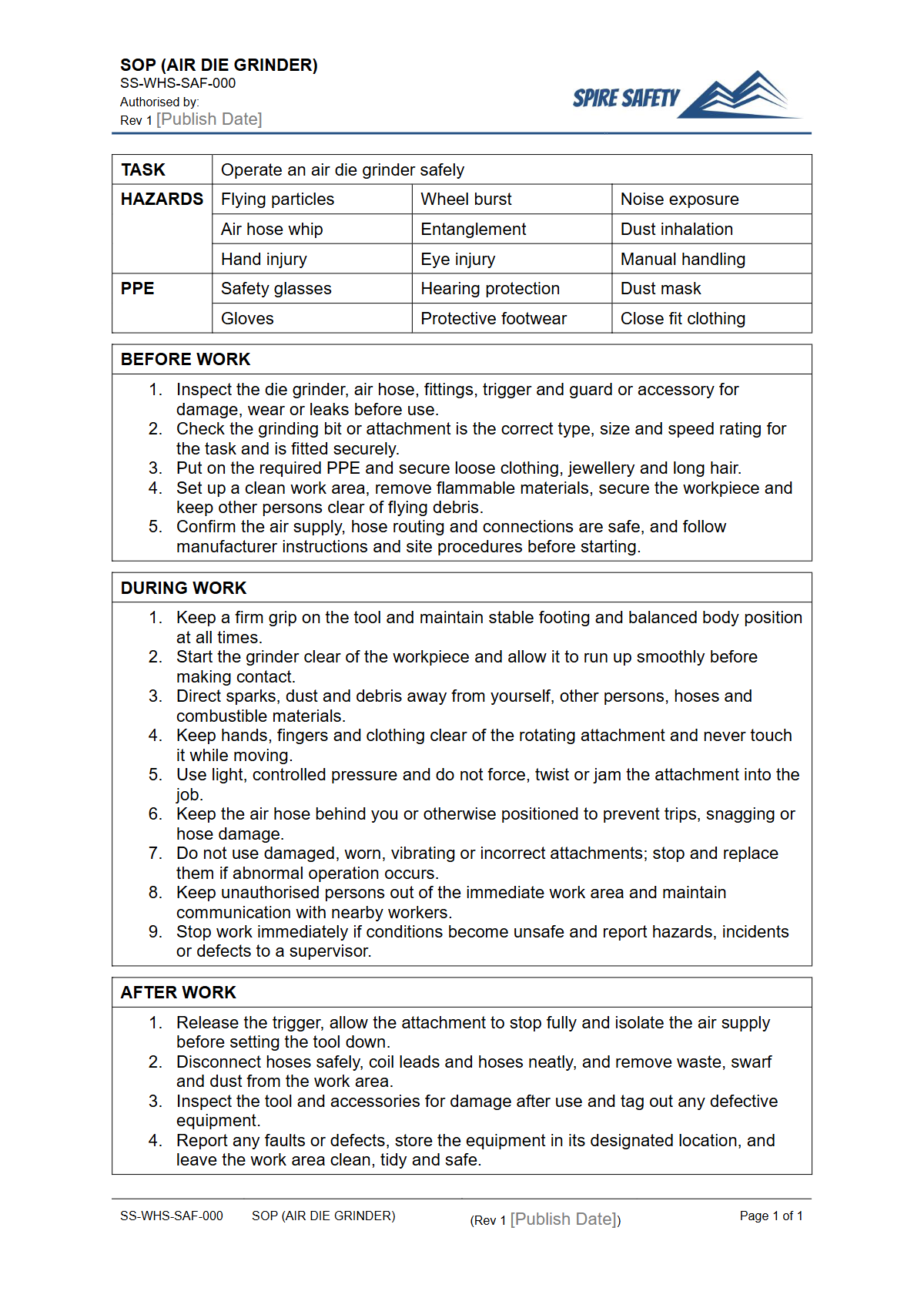
Purpose of the Free Safe Operating Procedure (Air Die Grinder) Template
An air die grinder is a powerful and versatile handheld tool used for grinding, sanding, polishing, or machining material. Due to its high rotational speed and the nature of the work, it presents significant risks if not used correctly.
This Free Safe Operating Procedure (Air Die Grinder) Template provides a structured framework for documenting the safest method to perform tasks using this equipment. It helps organisations meet their duty of care by formalising pre-operational checks, operational steps, and post-operational procedures, ensuring a consistent and safe approach for all users.
By implementing a clear SOP, you can effectively manage hazards such as flying debris, entanglement with rotating parts, high-pressure air injection, excessive noise, and vibration. This document serves as a critical training tool for new operators and a reference for experienced workers, reinforcing safe work habits.
It also forms a key part of your overall safety management system, demonstrating a commitment to proactive risk control. Because air die grinders depend on a power source, it is also vital to have controls in place for that equipment, as detailed in our Free Air Compressor SOP.
Video walkthrough
How to use the Free Safe Operating Procedure (Air Die Grinder) Template
This template is designed as a comprehensive starting point, aligned with Australian WHS principles. To make it effective for your specific workplace, you must customise it.
Download the DOCX file and methodically work through each section, adding, removing, and modifying content to reflect your exact make and model of air die grinder, the specific tasks it is used for, the materials being worked on, and the control measures you have in place.
Important: This is a template and not a complete, ready-to-use document. It is essential that you adapt this Safe Operating Procedure to the unique context of your business and worksite.
We have not conducted a risk assessment for your specific plant, equipment, or operational environment. You must ensure the final SOP is reviewed and approved by a competent person within your organisation before it is implemented.
A thorough customisation process ensures the SOP is practical, relevant, and integrated into your broader safety framework. Developing robust documentation is a core component of strong WHS management systems, helping to embed safety into your organisation's culture.
When to use it
A Safe Operating Procedure for an air die grinder should be a living document, used consistently throughout the equipment's lifecycle. It is a critical resource in several key situations:
- Worker Training and Induction: Use the SOP as the primary training document for any worker before they are authorised to use an air die grinder for the first time.
- Refresher Training: Periodically review the SOP with experienced operators to prevent complacency and reinforce safe practices.
- Task Planning: Refer to the SOP before commencing non-routine or complex grinding tasks to ensure all safety steps are considered.
- Post-Incident Investigation: Use the SOP as a benchmark to analyse what went wrong after an incident or near-miss and to identify areas for improvement.
- Audits and Reviews: The SOP serves as evidence of your established safety processes during internal or external safety audits. This is distinct from other tool-specific procedures, like those outlined in a Free Bench Grinder SOP, which cover different risks.
Who should use it
This SOP template is intended for a range of personnel within an organisation, each with a different role in ensuring workplace safety:
- WHS Managers/Advisors: To develop, implement, and review safety procedures as part of the overall WHS management system.
- Supervisors and Team Leaders: To train their team members, supervise the use of the equipment, and enforce the documented safety procedures on the workshop floor. They are responsible for ensuring operators are competent and follow the SOP.
- Workers/Operators: As a step-by-step guide for safely operating the air die grinder. They should be familiar with its contents and use it as a reference for pre-start checks and correct operational techniques.
- Maintenance Personnel: To understand the safety requirements for isolating, inspecting, and servicing the tool, particularly regarding energy isolation (disconnecting the air supply).
Ensuring that the right procedures are in place and that staff are competent to follow them is a fundamental WHS requirement. If you require assistance in developing your safety frameworks or training programs, Spire Safety offers expert WHS consulting to support your business needs. While this document covers grinding, other high-energy fabrication tools require their own distinct procedures, such as those in our FREE Plasma Cutter SOP Template.
Common mistakes
Common mistakes to avoid
- Using grinding discs, burrs, or other attachments not rated for the grinder's maximum RPM.
- Failing to disconnect the air supply before changing attachments or performing maintenance.
- Applying excessive force, which can cause the tool to kick back or the workpiece to be thrown.
- Neglecting pre-start checks of the air hose, fittings, trigger mechanism, and safety guards.
Legal references
Legal considerations
The following legal requirements may be relevant to this type of work.
- Work Health and Safety Act (Harmonised) — Provides the primary duties for protecting workers and other people from work health and safety risks.
- Work Health and Safety Regulations (Harmonised) — Sets out requirements supporting the management of workplace hazards and risks.
The following codes may be relevant to this type of work.
- Managing WHS Risks Code of Practice — Provides practical guidance on identifying hazards, assessing risks and applying effective controls.
- Work Health and Safety Consultation, Cooperation and Coordination Code of Practice — Provides practical guidance on consulting workers and coordinating with other duty holders.
- Managing the Work Environment and Facilities Code of Practice — Provides practical guidance on safe work environments, workplace facilities and related controls.
Did you know
Rotational Speed
Air die grinders can rotate at speeds exceeding 25,000 RPM. Using an attachment rated for a lower speed can cause it to shatter violently during operation.
Air Pressure Matters
Operating an air tool above its recommended pressure (PSI) not only wastes compressed air but also significantly increases wear and tear, potentially leading to premature and unsafe failure.
FAQ
Frequently asked questions
01What PPE is required when using an air die grinder?
02How often should an SOP for an air die grinder be reviewed?
03Can a Safe Operating Procedure replace a risk assessment?
04What are the main hazards of using an air die grinder?
Share this resource
Free Safe Operating Procedure (Air Die Grinder) Template
Browse Categories
How To Use It
- 1Download and open in Word or PDF.
- 2Replace the placeholders with your business details.
- 3Get it reviewed by a WHS specialist before rollout.
Need it customised?
Our WHS consultants can adapt this template to your site, run a gap analysis, or audit what you already have in place.
Book a Free Consultation WHS consulting servicesor call 1300 156 382
Related templates
- Free Safe Operating Procedure (Air Diffuser Cleaning) Template
- Free Safe Operating Procedure (Air Fed Respirator) Template
- Free Safe Operating Procedure (Air Grease Gun) Template
- Free Safe Operating Procedure (Air Handling Unit) Template
- Free Safe Operating Procedure (Air Hose Connection) Template
- Free Safe Operating Procedure (Air Hose Whip Check) Template