
Free Safe Operating Procedure (Cattle Loading) Template
Download our Free Safe Operating Procedure (Cattle loading) Template.
Free Safe Operating Procedure (Cattle Loading) Template
DOCX • 126 KB + PDF
Updated Oct 2026
No signup required
Purpose of the Free Safe Operating Procedure (Cattle Loading) Template
Loading cattle is a high-risk task that combines the unpredictability of livestock with the dangers of heavy machinery and confined spaces. A Safe Operating Procedure (SOP) is a critical tool for managing these risks.
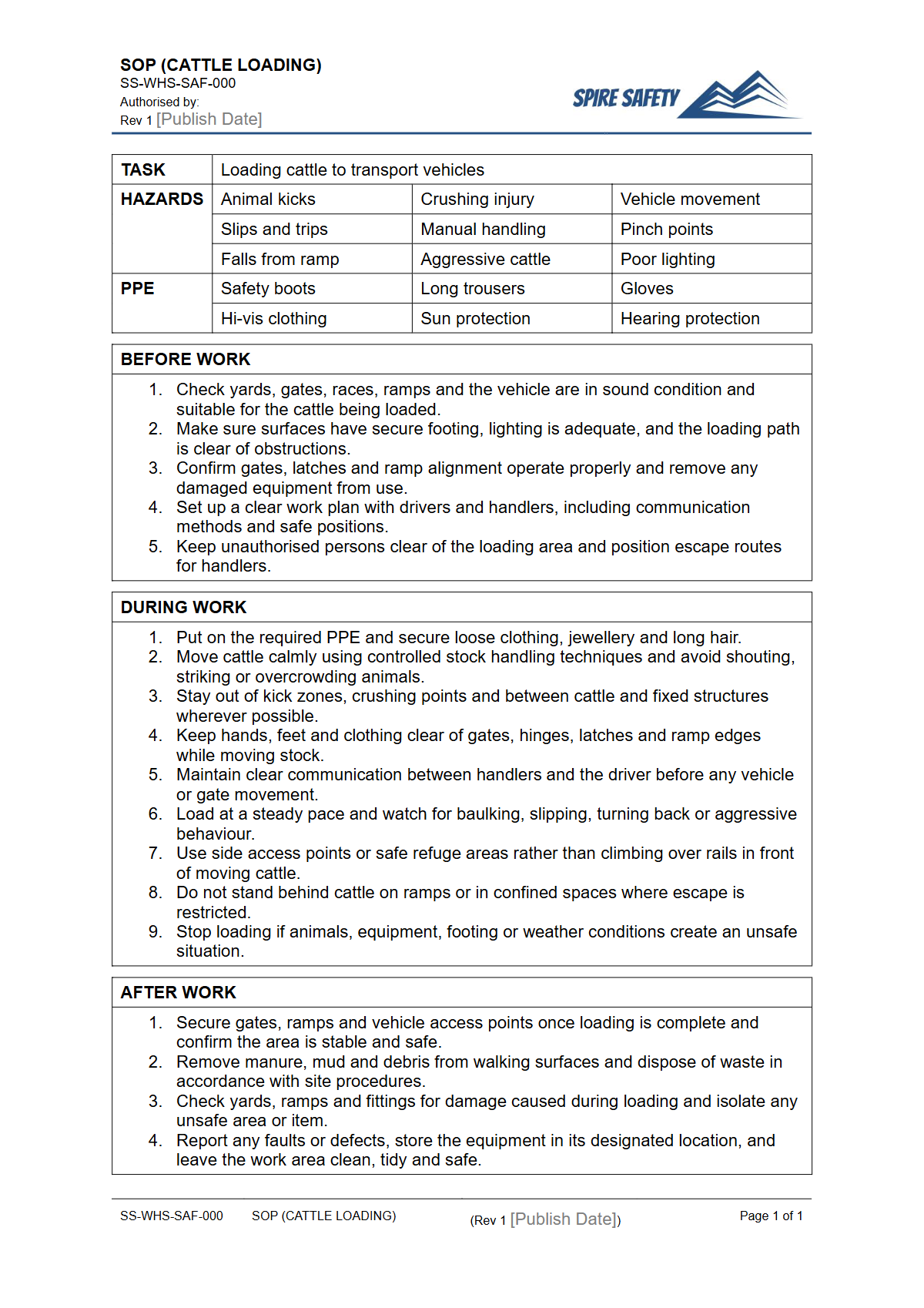
This Free Safe Operating Procedure (Cattle Loading) Template provides a structured framework to document the specific steps, hazards, and safety controls required for loading cattle safely at your workplace. It guides you in outlining procedures for pre-start checks, communication, animal handling, and emergency responses.
Using this template helps standardise your process, ensuring every worker understands their role and the required safety precautions. It serves as a key training document and a reference point for safe work. Documenting procedures for all high-risk agricultural tasks is essential; for other common farm machinery, you might also require our free Grain Drill SOP.
What this Safe Operating Procedure covers:
- Required Personal Protective Equipment (PPE)
- Pre-operational checks of yards, ramps, and vehicles
- Step-by-step instructions for the loading process
- Key hazards and risk controls (e.g., animal behaviour, crush zones, slips and trips)
- Communication protocols between stock handlers and drivers
- Post-loading procedures and emergency plans
Video walkthrough
How to use the Free Safe Operating Procedure (Cattle Loading) Template
This template is provided as a starting point, designed to be adapted to your specific operational needs. Download the DOCX or PDF file and open it.
Work through each section, consulting with your workers, supervisors, and other stakeholders to fill in the details. Your goal is to create a document that accurately reflects the reality of loading cattle at your site.
Important: This document is a template only. To be effective, you must customise it to reflect the specific equipment (e.g., ramps, yards, trucks), livestock, and environmental conditions at your workplace.
We recommend a competent person conducts a site-specific risk assessment to inform the content of your final SOP.
Once customised, the SOP should be used to train all relevant workers. It should be made easily accessible in the work area, such as in the yards or truck cabin.
SOPs are living documents; they are not a 'set and forget' exercise. They must be reviewed regularly and updated whenever there is a change in equipment, processes, or after an incident occurs.
This consistent review process is a fundamental part of a healthy safety culture.
When to use it
A Safe Operating Procedure for cattle loading should be formally consulted before any worker undertakes the task for the first time. It is a core component of worker induction, training, and competency verification.
It should also be used as a reference for refresher training and as a guide for supervisors monitoring work practices.
Regularly reviewing your SOPs is also a key activity within periodic safety reviews. These procedures form part of the evidence base checked during formal WHS compliance auditing to verify that risks are being managed effectively.
Who should use it
This template is designed for anyone responsible for the safety of livestock handling and transport operations. This includes:
- Farm owners and agricultural business operators (PCBUs)
- Livestock managers and station supervisors
- Livestock transport company owners and fleet managers
- Truck drivers and stock handlers
- WHS managers and advisors in the agricultural and transport sectors
By implementing clear and practical SOPs, you are building the foundation of a safer workplace. These documents are a cornerstone of robust WHS management systems, demonstrating a clear commitment to managing foreseeable hazards.
The process of loading cattle onto a truck shares many principles with operating the vehicle itself, where documented procedures are also essential. For vehicle-specific guidance, our free Body Truck SOP offers a useful starting point.
Furthermore, heavy machinery is often present on farms where loading occurs; for related procedures, consider adapting a Dozer SOP template for your specific plant. To explore more templates for your business, browse our complete free WHS resources library.
Common mistakes
Common mistakes to avoid
- Poor communication between the truck driver and ground crew, leading to uncoordinated movements.
- Using poorly maintained or unsuitable loading ramps, yards, or gates that fail under pressure.
- Over-crowding or rushing livestock, which increases stress, unpredictability, and the risk of injury.
- Failing to ensure the truck floor provides adequate footing, increasing the risk of animals slipping during loading and transport.
Legal references
Legal considerations
The following legal requirements may be relevant to this type of work.
- Work Health and Safety Act (Harmonised) — Provides the primary duties for protecting workers and other people from work health and safety risks.
- Work Health and Safety Regulations (Harmonised) — Sets out requirements supporting the management of workplace hazards and risks.
The following codes may be relevant to this type of work.
- Managing WHS Risks Code of Practice — Provides practical guidance on identifying hazards, assessing risks and applying effective controls.
- Work Health and Safety Consultation, Cooperation and Coordination Code of Practice — Provides practical guidance on consulting workers and coordinating with other duty holders.
- Managing the Work Environment and Facilities Code of Practice — Provides practical guidance on safe work environments, workplace facilities and related controls.
Did you know
Livestock Blind Spot
Cattle have a blind spot directly behind them. Handling staff should always work from the side, staying in the animal's field of vision to reduce the chance of startling them and causing a reactive kick.
Ramp Angle Matters
The Australian Animal Welfare Standards recommend that non-adjustable loading ramps should not be steeper than 20 degrees. A gentler slope encourages better livestock flow and reduces the risk of slips and falls for both animals and handlers.
FAQ
Frequently asked questions
01What is a Safe Operating Procedure (SOP) for cattle loading?
02Why is animal behaviour a key risk in cattle loading?
03Who is responsible for ensuring the cattle loading SOP is followed?
04How often should a cattle loading SOP be reviewed?
Share this resource
Free Safe Operating Procedure (Cattle Loading) Template
Browse Categories
How To Use It
- 1Download and open in Word or PDF.
- 2Replace the placeholders with your business details.
- 3Get it reviewed by a WHS specialist before rollout.
Need it customised?
Our WHS consultants can adapt this template to your site, run a gap analysis, or audit what you already have in place.
Book a Free Consultation WHS consulting servicesor call 1300 156 382
Related templates
- Free Safe Operating Procedure (Cattle Race) Template
- Free Safe Operating Procedure (Cattle Weighing) Template
- Free Safe Operating Procedure (Caustic Soda Handling) Template
- Free Safe Operating Procedure (CCTV Drain Camera) Template
- Free Safe Operating Procedure (CCTV Monitoring) Template
- Free Safe Operating Procedure (Ceiling Diffuser Clean) Template