
Free Safe Operating Procedure (Ceiling Diffuser Clean) Template
Download our free Safe Operating Procedure (Ceiling Diffuser Clean) Template. This customisable DOCX & PDF resource helps formalise cleaning processes.
Free Safe Operating Procedure (Ceiling Diffuser Clean) Template
DOCX • 126 KB + PDF
Updated Oct 2026
No signup required
Purpose of the Free Safe Operating Procedure (Ceiling Diffuser Clean) Template
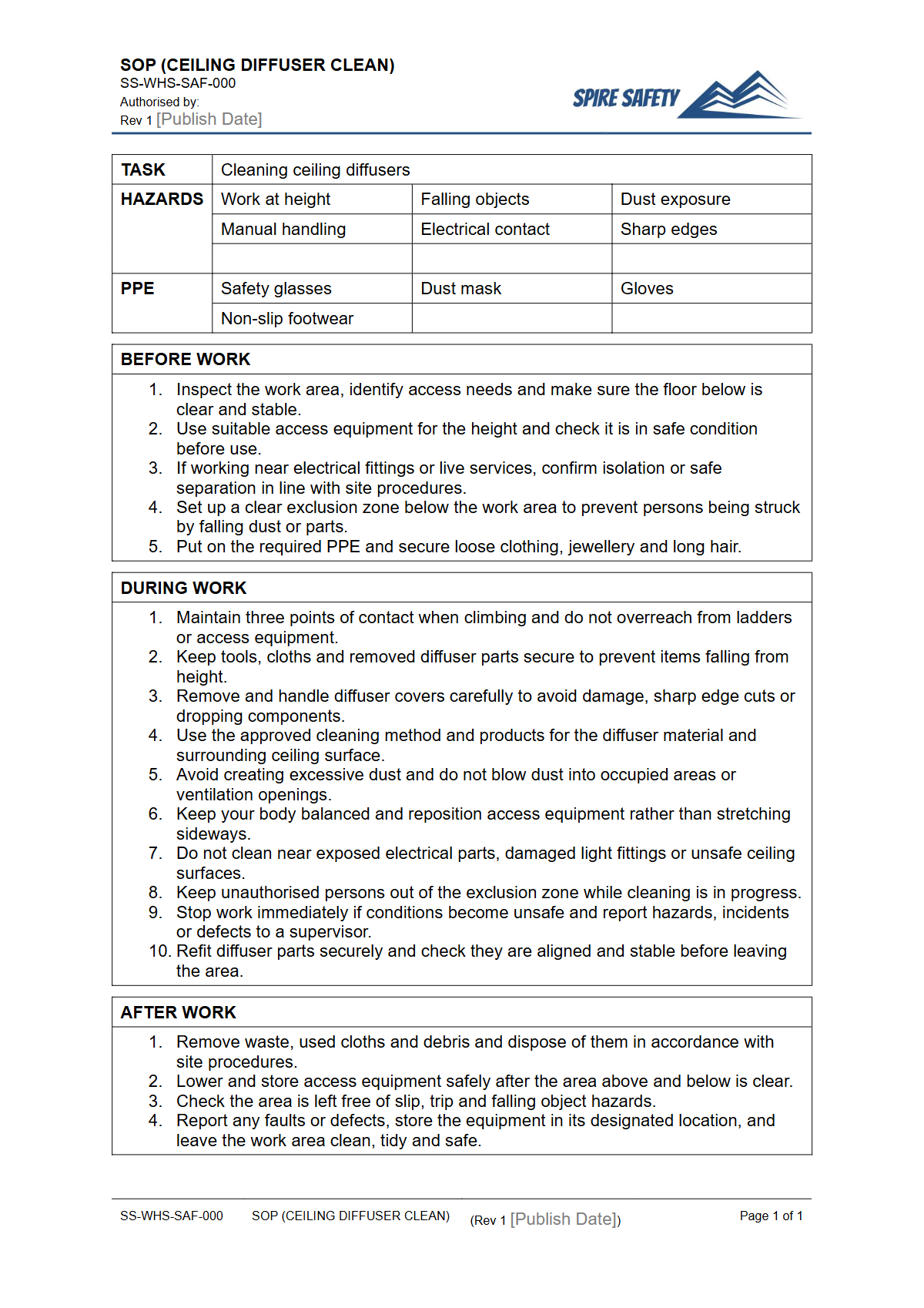
This Free Safe Operating Procedure (Ceiling Diffuser Clean) Template provides a structured framework for businesses to outline the risks and control measures associated with cleaning ceiling-mounted air conditioning and ventilation diffusers. Regular cleaning is essential for maintaining indoor air quality and HVAC system efficiency.
This task, while seemingly simple, involves hazards such as working at heights, manual handling, and exposure to dust or biological contaminants. Using a formal SOP helps ensure the task is performed consistently and safely by all workers, standardising the process and demonstrating a commitment to proactive safety management.
The template is designed as a foundational document, aligned with Australian WHS principles, to help you meet your duty of care. It guides you through documenting key information, including required personal protective equipment (PPE), step-by-step instructions, and emergency procedures.
Formalising this process is a critical component of effective WHS management systems, ensuring that routine maintenance tasks are not overlooked from a safety perspective.
Video walkthrough
How to use the Free Safe Operating Procedure (Ceiling Diffuser Clean) Template
This template is provided in both DOCX and PDF formats for your convenience. The DOCX file is fully editable, allowing you to tailor the content to the specific environment, equipment, and chemicals used in your workplace.
A generic procedure is not sufficient for compliance; you must conduct your own risk assessment and adapt the document accordingly.
Important: This document is a template only. We are not familiar with your worksite, equipment, or personnel.
It is your responsibility to customise this procedure to reflect the specific hazards and control measures relevant to your organisation. This includes adding site-specific details, specifying the exact type of ladders or access equipment used, listing the approved cleaning agents, and detailing your unique emergency response protocols.
For tasks involving heights, a specific step ladder SOP should be referenced or integrated to address fall risks comprehensively.
When to use it
A Safe Operating Procedure for cleaning ceiling diffusers should be used whenever this task is performed by employees or contractors. It should be developed before work begins and reviewed regularly, especially if there are changes in equipment, cleaning products, or the work environment.
It is particularly important for inducting new staff or for workers who perform this task infrequently, serving as a vital refresher on the correct and safe method. Integrating this SOP into your scheduled maintenance program ensures safety is considered alongside operational needs.
The SOP should also be a key document referenced during safety meetings, toolbox talks, and incident investigations related to maintenance tasks. If a near-miss or incident occurs during this activity, the SOP should be reviewed and updated as part of the corrective action process.
This continuous improvement cycle is fundamental to maintaining a safe workplace. For guidance on developing robust safety documentation, our WHS consulting services can provide expert assistance.
Who should use it
This SOP should be used by Persons Conducting a Business or Undertaking (PCBUs), managers, supervisors, and the workers assigned to clean ceiling diffusers. Managers and supervisors use it to ensure they are providing a safe system of work, for training purposes, and as a standard to measure performance against.
Workers use the SOP as a direct guide to perform their tasks safely and correctly. It empowers them to understand the risks involved and the control measures they must implement to protect themselves and others.
The development and review of this procedure should involve consultation with the workers who actually perform the cleaning. Their hands-on experience is invaluable for identifying practical hazards and effective controls.
This collaborative approach not only improves the quality of the SOP but also fosters a positive safety culture within the organisation. For a broader overview of safety documentation, browse our free WHS resources library for more templates and guides.
A well-prepared workplace also accounts for emergencies. Part of a holistic safety plan includes having procedures for first aid and immediate medical response.
Consider supplementing your operational documents with an accessible defibrillator operation procedure to enhance site preparedness. Regular WHS compliance audits can also help verify that these procedures are being followed correctly and are effective in practice.
Common mistakes
Common mistakes to avoid
- Using an unsuitable or damaged ladder, or over-reaching while on the ladder.
- Neglecting to wear appropriate PPE, such as safety glasses and P2-rated dust masks.
- Failing to isolate the HVAC system, causing dust and debris to be blown around the room upon startup.
- Using abrasive cloths or harsh chemicals that can damage the diffuser's finish or the surrounding ceiling tiles.
Legal references
Legal considerations
The following legal requirements may be relevant to this type of work.
- Work Health and Safety Act (Harmonised) — Provides the primary duties for protecting workers and other people from work health and safety risks.
- Work Health and Safety Regulations (Harmonised) — Sets out requirements supporting the management of workplace hazards and risks.
The following codes may be relevant to this type of work.
- Managing WHS Risks Code of Practice — Provides practical guidance on identifying hazards, assessing risks and applying effective controls.
- Work Health and Safety Consultation, Cooperation and Coordination Code of Practice — Provides practical guidance on consulting workers and coordinating with other duty holders.
- Managing the Work Environment and Facilities Code of Practice — Provides practical guidance on safe work environments, workplace facilities and related controls.
Did you know
Air Quality Impact
Dirty ceiling diffusers can disrupt airflow patterns, leading to poor air distribution and reduced HVAC efficiency. They can also become a breeding ground for mould and bacteria, negatively impacting indoor air quality.
A Speck of Dust
Workplace dust isn't just dirt; it can contain a mixture of particles including skin cells, fibres, bacteria, pollen, and potentially hazardous substances from industrial processes, making PPE crucial during cleaning.
FAQ
Frequently asked questions
01Why is a specific SOP needed for cleaning ceiling diffusers?
02What are the main hazards associated with cleaning ceiling diffusers?
03How often should ceiling diffusers be cleaned?
04Can any worker clean a ceiling diffuser with this SOP?
Share this resource
Free Safe Operating Procedure (Ceiling Diffuser Clean) Template
Browse Categories
How To Use It
- 1Download and open in Word or PDF.
- 2Replace the placeholders with your business details.
- 3Get it reviewed by a WHS specialist before rollout.
Need it customised?
Our WHS consultants can adapt this template to your site, run a gap analysis, or audit what you already have in place.
Book a Free Consultation WHS consulting servicesor call 1300 156 382
Related templates
- Free Safe Operating Procedure (Ceiling Grid Cleaning) Template
- Free Safe Operating Procedure (Ceiling Hoist Check) Template
- Free Safe Operating Procedure (Ceiling Tile Cleaning) Template
- Free Safe Operating Procedure (Ceiling Track Check) Template
- Free Safe Operating Procedure (Cellar Cleaning) Template
- Free Safe Operating Procedure (Cellar Stock Handling) Template