
Free Safe Operating Procedure (Ceiling Grid Cleaning) Template
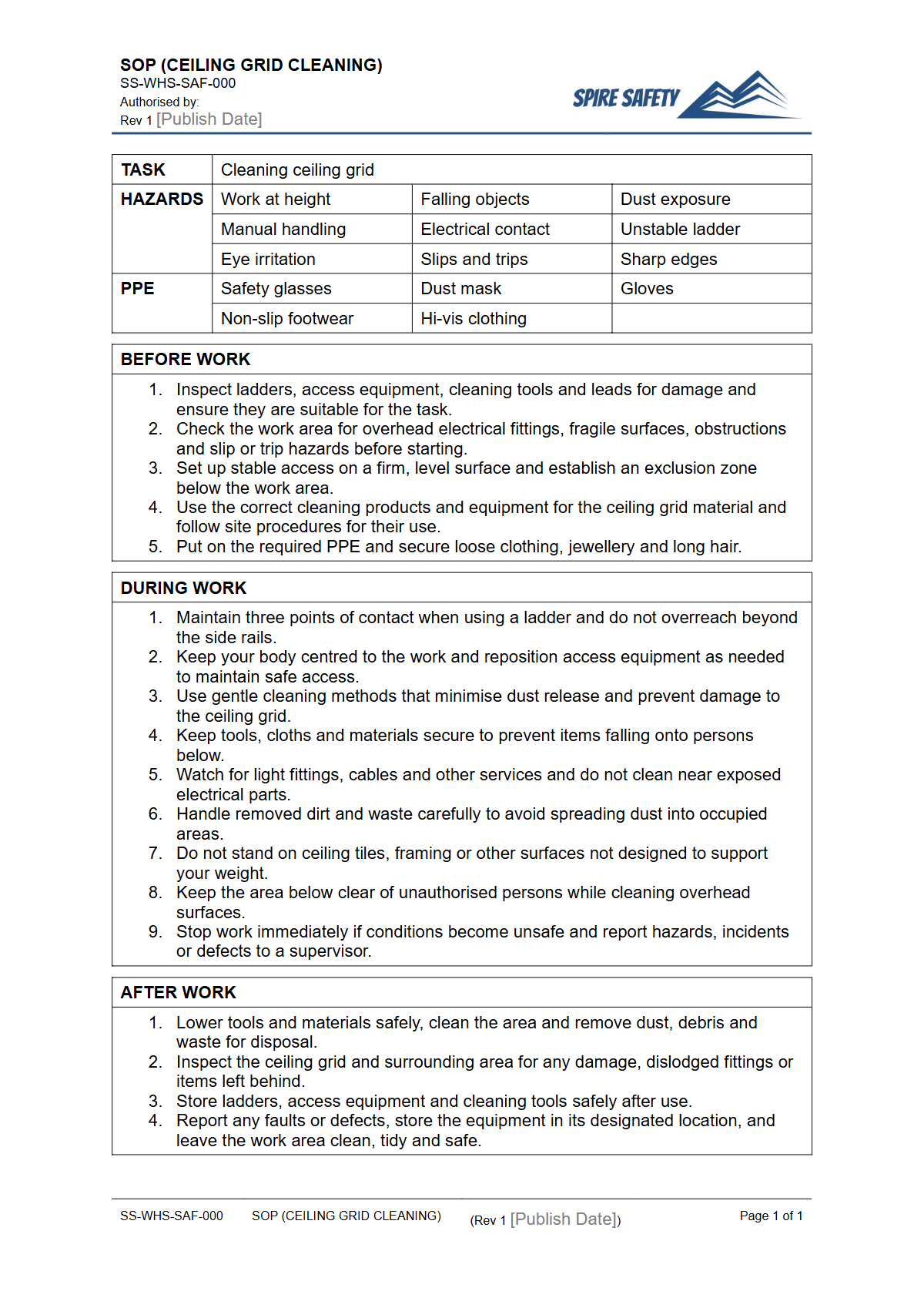
Download our free Safe Operating Procedure (Ceiling Grid Cleaning) template.
Free Safe Operating Procedure (Ceiling Grid Cleaning) Template
DOCX • 126 KB + PDF
Updated Oct 2026
No signup required
Purpose of the Free Safe Operating Procedure (Ceiling Grid Cleaning) Template
This Free Safe Operating Procedure (Ceiling Grid Cleaning) Template provides a structured framework for documenting the safest way to perform cleaning and maintenance tasks on suspended ceiling grids. Cleaning ceiling grids, diffusers, and surrounding tiles presents several significant workplace hazards, including falls from height, manual handling injuries, exposure to dust and airborne contaminants, and potential contact with concealed electrical wiring or services.
A documented SOP is a critical tool for managing these risks effectively.
By clearly outlining the required steps, personal protective equipment (PPE), and hazard controls, this SOP helps ensure that every worker follows a consistent, pre-approved, and safe method. It serves as a practical guide for workers and a key piece of evidence for management, demonstrating that proactive steps have been taken to ensure health and safety.
Integrating this procedure into your safety framework is a fundamental step towards building robust WHS management systems that protect your team and your business.
Video walkthrough
How to use the Free Safe Operating Procedure (Ceiling Grid Cleaning) Template
Our Free Safe Operating Procedure (Ceiling Grid Cleaning) Template is designed as a starting point, available in both DOCX for easy editing and PDF for straightforward distribution. The first step is to download the file and thoroughly adapt it to your specific operational context.
This involves consulting with the workers who actually perform the task to ensure the procedure is practical and reflects real-world conditions.
Key sections you must customise include:
- Personal Protective Equipment (PPE): Specify the exact type of gloves, safety glasses, respiratory protection (e.g., P2 masks), and footwear required.
- Pre-Operational Checks: Detail the checks for all equipment, such as inspecting ladders for stability and damage. This is especially important when working at heights; our free Step Ladder SOP provides more detailed guidance on this specific equipment.
- Step-by-Step Procedure: Break down the task into a logical sequence, from isolating the work area and setting up equipment to the specific cleaning techniques and handling of waste materials.
- Emergency Procedures: Outline the immediate actions to take in case of an incident, such as a fall, electric shock, or chemical splash. Knowing the correct response is vital, just as having a clear defibrillator operation SOP is for medical emergencies.
Please note: This is a template we have developed as a starting point. It is essential that you customise this document to reflect the specific hazards, equipment, chemicals, and environment of your workplace.
A generic SOP that isn't site-specific is not an effective control measure.
When to use a Safe Operating Procedure
A Safe Operating Procedure for ceiling grid cleaning should be a dynamic part of your daily safety practices, not just a document that sits on a shelf. It is essential for inducting new employees or contractors who will be performing the task.
It should also be used as the basis for pre-start meetings or toolbox talks before any cleaning work commences, allowing supervisors to refresh workers' knowledge of the risks and controls.
The SOP should be readily accessible in the work area for workers to reference as needed. Furthermore, it is a critical piece of documentation that will be reviewed during a formal WHS compliance auditing process.
Regular reviews and updates to the SOP—especially after an incident, near miss, or when new equipment or cleaning agents are introduced—are necessary to ensure it remains relevant and effective.
Who should use this document
This Safe Operating Procedure is intended for a range of personnel within an organisation. The primary users are the workers themselves—the commercial cleaners, maintenance teams, and facilities staff tasked with cleaning the ceiling grids.
It provides them with clear, unambiguous instructions to follow for their own safety and the safety of others in the vicinity.
Supervisors and managers must also use the SOP to train their staff, monitor work practices, and enforce safety standards. For WHS Managers and Safety Officers, this template is a foundational tool for developing and implementing a comprehensive set of safe work documents across the business.
If you require assistance in tailoring this or other documents to your specific needs, engaging specialist WHS consulting can provide valuable expertise. You can also explore our free WHS resources library for other useful templates and guides.
Common mistakes
Common mistakes to avoid
- Using a generic template without customising it for the specific work area, tools, and chemicals.
- Failing to train all relevant workers on the contents and application of the finalised SOP.
- Not making the SOP easily accessible to workers at the point of work.
- Neglecting to review and update the SOP after a near miss, incident, or change in work practice.
Legal references
Legal considerations
The following legal requirements may be relevant to this type of work.
- Work Health and Safety Act (Harmonised) — Provides the primary duties for protecting workers and other people from work health and safety risks.
- Work Health and Safety Regulations (Harmonised) — Sets out requirements supporting the management of workplace hazards and risks.
The following codes may be relevant to this type of work.
- Managing WHS Risks Code of Practice — Provides practical guidance on identifying hazards, assessing risks and applying effective controls.
- Work Health and Safety Consultation, Cooperation and Coordination Code of Practice — Provides practical guidance on consulting workers and coordinating with other duty holders.
- Managing the Work Environment and Facilities Code of Practice — Provides practical guidance on safe work environments, workplace facilities and related controls.
Did you know
Hidden Dangers
Dust accumulated in ceiling voids can contain hazardous materials like mould spores, bacteria, lead particles (from old paint), or even asbestos fibres in buildings constructed before 2004, making respiratory protection essential.
Falls from Height
According to Safe Work Australia, falls from height are a leading cause of fatalities and serious injuries in Australian workplaces. A significant number of these incidents involve falls from heights of less than three metres.
FAQ
Frequently asked questions
01What is a Safe Operating Procedure (SOP) for ceiling grid cleaning?
02Is this template ready to use immediately after download?
03What are the common hazards when cleaning ceiling grids?
04Who is responsible for developing and implementing an SOP?
Share this resource
Free Safe Operating Procedure (Ceiling Grid Cleaning) Template
Browse Categories
How To Use It
- 1Download and open in Word or PDF.
- 2Replace the placeholders with your business details.
- 3Get it reviewed by a WHS specialist before rollout.
Need it customised?
Our WHS consultants can adapt this template to your site, run a gap analysis, or audit what you already have in place.
Book a Free Consultation WHS consulting servicesor call 1300 156 382
Related templates
- Free Safe Operating Procedure (Ceiling Hoist Check) Template
- Free Safe Operating Procedure (Ceiling Tile Cleaning) Template
- Free Safe Operating Procedure (Ceiling Track Check) Template
- Free Safe Operating Procedure (Cellar Cleaning) Template
- Free Safe Operating Procedure (Cellar Stock Handling) Template
- Free Safe Operating Procedure (Cemetery Grounds Care) Template