
Free Safe Operating Procedure (Cellar Cleaning) Template
Download our free Safe Operating Procedure (Cellar Cleaning) Template. This DOCX & PDF resource helps you outline safe work methods for cellar hygiene tasks.
Free Safe Operating Procedure (Cellar Cleaning) Template
DOCX • 126 KB + PDF
Updated Oct 2026
No signup required
Purpose of the Free Safe Operating Procedure (Cellar Cleaning) Template
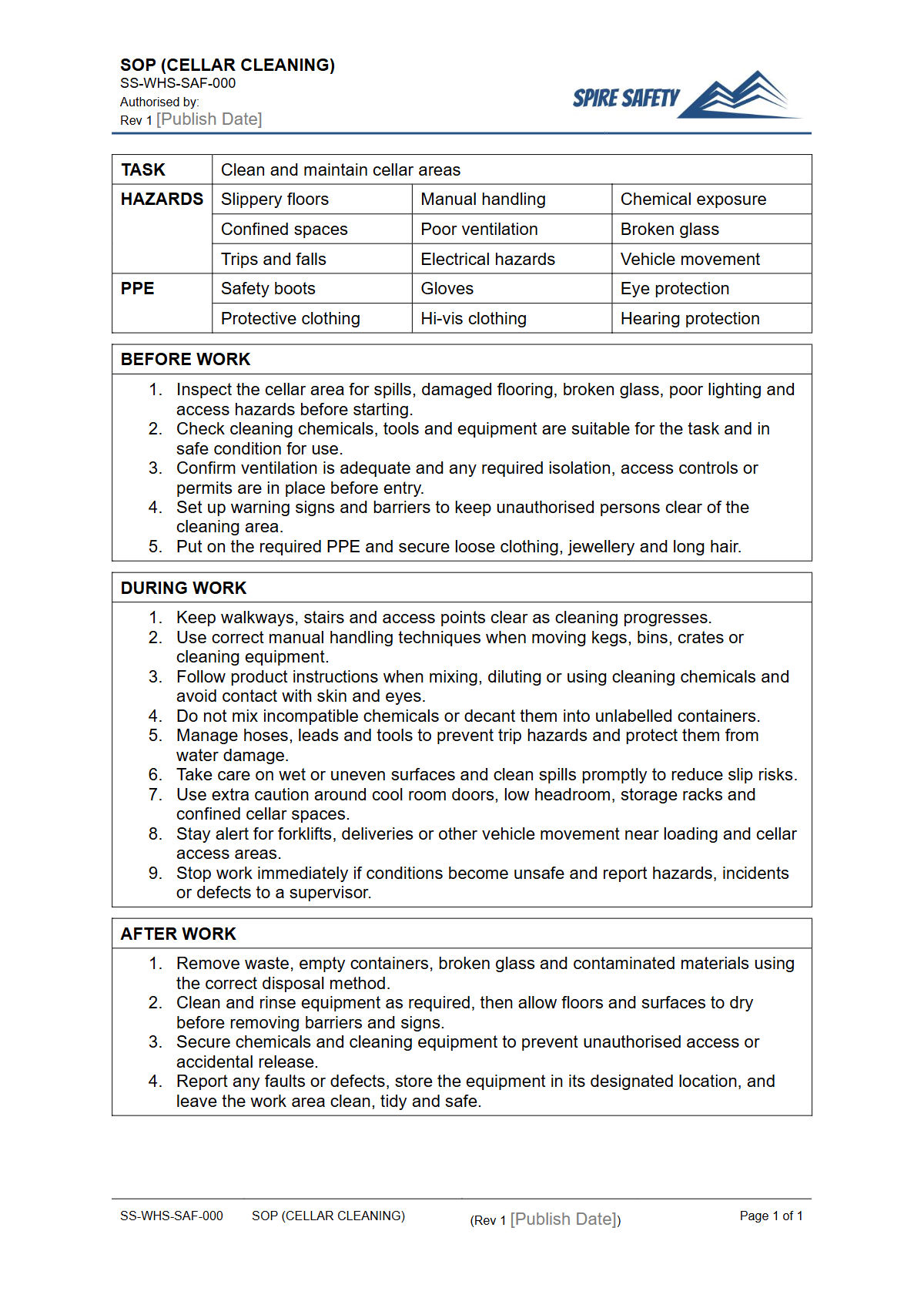
This free Safe Operating Procedure (Cellar Cleaning) template provides a structured framework for documenting the hazards and control measures associated with cellar cleaning tasks in hospitality venues. Cellar cleaning, while routine, involves significant risks including exposure to hazardous chemicals, slips on wet surfaces, manual handling injuries from moving kegs and equipment, and potential electrical hazards.
Using a formal SOP helps ensure these tasks are performed consistently and safely every time.
A well-defined Safe Operating Procedure (SOP) is a critical component for any person conducting a business or undertaking (PCBU) in the hospitality sector. It serves as a practical tool for managing risks, training staff, and demonstrating a commitment to workplace health and safety.
Implementing clear procedures is a fundamental part of building robust WHS management systems that protect your workers and your business.
Video walkthrough
How to use the Free Safe Operating Procedure (Cellar Cleaning) Template
Our cellar cleaning SOP is provided as a fully editable Microsoft Word (DOCX) document, allowing for easy customisation. A PDF version is also included for straightforward printing and distribution.
To use the template effectively, you should download the file and systematically work through each section, adapting the content to match your specific operational environment.
This involves:
- Listing the specific cleaning chemicals used in your cellar and referencing their Safety Data Sheets (SDS).
- Detailing the Personal Protective Equipment (PPE) required, such as gloves, eye protection, and non-slip footwear.
- Outlining the step-by-step process for cleaning beer lines, floors, cool rooms, and other cellar equipment.
- Specifying controls for manual handling and electrical safety.
Important: This document is a template and must be customised to your workplace. It is not a complete, ready-to-use safety solution.
We strongly recommend that a competent person, familiar with your venue’s specific equipment, chemicals, and layout, reviews and approves the final document before implementation. If you require assistance, our professional WHS consulting team can provide expert guidance.
When to use it
A Safe Operating Procedure for cellar cleaning should be a living document, integrated into your daily operations. It should be used as the primary reference guide for any worker assigned to clean the cellar. Specific use cases include:
- Induction and Training: Use the SOP as a core training tool for new employees to ensure they understand the required safety standards from day one.
- Refresher Training: Conduct regular refresher sessions for existing staff, using the SOP to reinforce correct procedures and introduce any updates.
- Pre-Task Reference: Encourage workers to review the SOP before starting cleaning tasks, especially if they are performed infrequently.
- Incident Investigation: Following a near-miss or injury, the SOP provides a baseline to assess whether procedures were followed and if they need to be revised.
Just as you'd document procedures for equipment like a step ladder SOP to access high shelves, it's vital to do the same for process-based tasks like cleaning.
Who should use it
This template is designed for a range of personnel within the hospitality industry, including pubs, clubs, breweries, and restaurants. The primary users will be the workers who perform the cellar cleaning tasks.
However, its development and implementation should involve multiple levels of your organisation.
Key personnel include:
- Venue Managers and Supervisors: Responsible for customising, implementing, and enforcing the SOP, as well as providing training.
- WHS Representatives/Officers: Responsible for reviewing the SOP to ensure it aligns with organisational safety policies and legislative requirements.
- Cellar Staff and Cleaners: The end-users who must follow the procedure to ensure their own safety and the safety of their colleagues. Their input during the drafting process is invaluable for creating a practical and effective document.
Ensuring clear, documented procedures for all workplace elements, from an air compressor used for line cleaning to first aid equipment, is a cornerstone of good safety management. This SOP helps formalise a critical, high-risk process within your venue.
Common mistakes
Common mistakes to avoid
- Using a generic template without customising it for specific site chemicals and equipment.
- Failing to provide adequate training on the finalised SOP to all relevant staff.
- Not providing or enforcing the use of the specified Personal Protective Equipment (PPE).
- Storing incompatible chemicals together, such as acids and chlorine-based cleaners, creating a risk of dangerous reactions.
Legal references
Legal considerations
The following legal requirements may be relevant to this type of work.
- Work Health and Safety Act (Harmonised) — Provides the primary duties for protecting workers and other people from work health and safety risks.
- Work Health and Safety Regulations (Harmonised) — Sets out requirements supporting the management of workplace hazards and risks.
The following codes may be relevant to this type of work.
- Managing WHS Risks Code of Practice — Provides practical guidance on identifying hazards, assessing risks and applying effective controls.
- Work Health and Safety Consultation, Cooperation and Coordination Code of Practice — Provides practical guidance on consulting workers and coordinating with other duty holders.
- Managing the Work Environment and Facilities Code of Practice — Provides practical guidance on safe work environments, workplace facilities and related controls.
Did you know
Chemical Hazards
Many common cellar cleaning chemicals are classified as hazardous substances, requiring specific handling, storage, and disposal procedures under WHS regulations.
Slip Risk
Slips, trips, and falls are a leading cause of injury in the hospitality industry, with wet and often sloped floors in cellars being a major contributing factor.
FAQ
Frequently asked questions
01What should a cellar cleaning SOP include?
02Is cellar cleaning considered a high-risk task?
03Who is responsible for creating a Safe Operating Procedure?
04How often should a cellar cleaning SOP be reviewed?
Share this resource
Free Safe Operating Procedure (Cellar Cleaning) Template
Browse Categories
How To Use It
- 1Download and open in Word or PDF.
- 2Replace the placeholders with your business details.
- 3Get it reviewed by a WHS specialist before rollout.
Need it customised?
Our WHS consultants can adapt this template to your site, run a gap analysis, or audit what you already have in place.
Book a Free Consultation WHS consulting servicesor call 1300 156 382
Related templates
- Free Safe Operating Procedure (Cellar Stock Handling) Template
- Free Safe Operating Procedure (Cemetery Grounds Care) Template
- Free Safe Operating Procedure (Centrifugal Pump) Template
- Free Safe Operating Procedure (Centrifuge) Template
- Free Safe Operating Procedure (Chafing Dish) Template
- Free Safe Operating Procedure (Chain Block) Template