
Free Safe Operating Procedure (Centrifugal Pump) Template
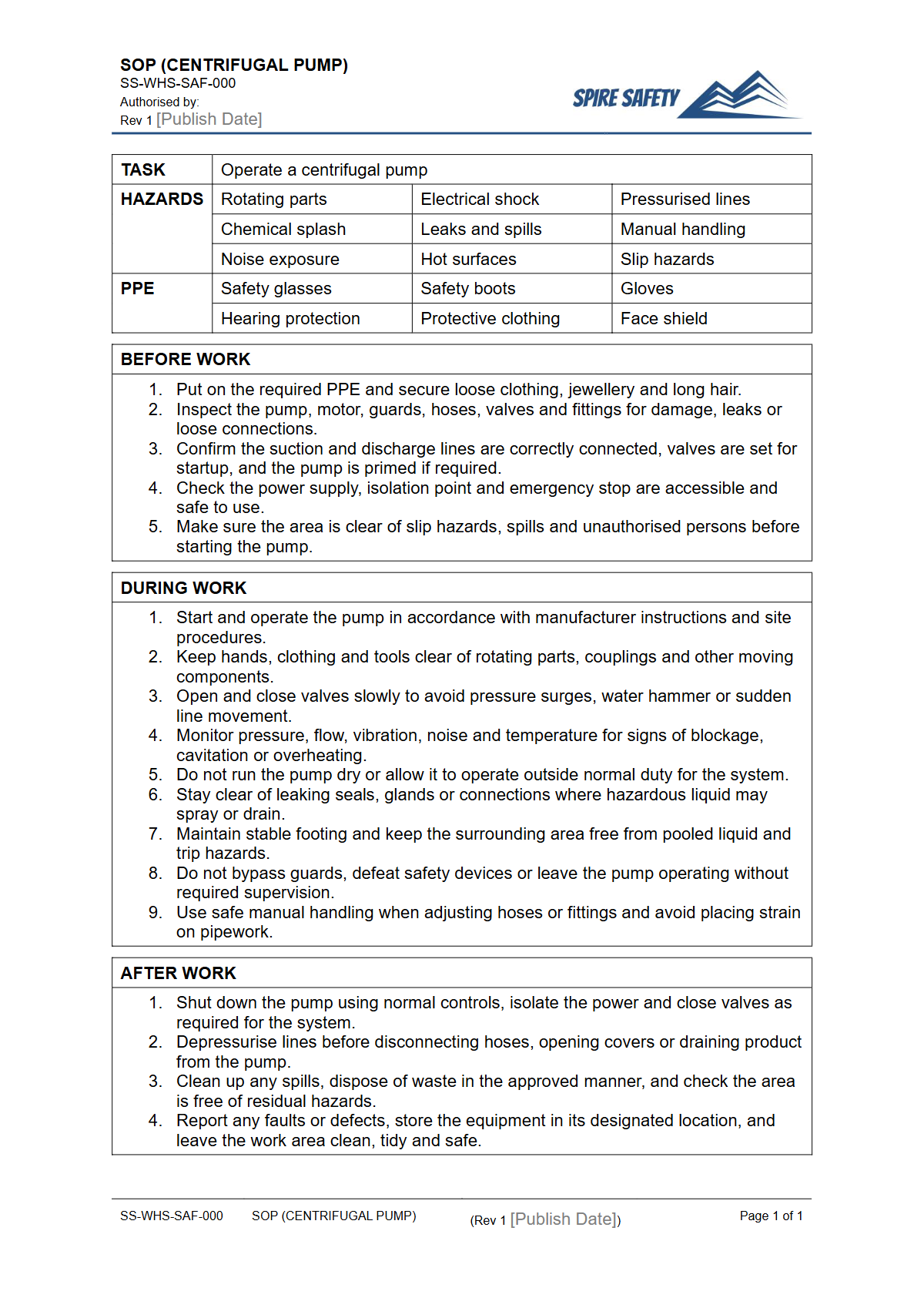
Manage the risks of operating centrifugal pumps with our structured procedure template.
Free Safe Operating Procedure (Centrifugal Pump) Template
DOCX • 126 KB + PDF
Updated Oct 2026
No signup required
Purpose of the Free Safe Operating Procedure (Centrifugal Pump) Template
Centrifugal pumps are common across many Australian industries, from manufacturing and mining to agriculture and water treatment. While essential, they introduce significant workplace hazards.
This free Safe Operating Procedure (Centrifugal Pump) template provides a structured framework for documenting the controls necessary to manage risks. Key hazards include mechanical entanglement with rotating shafts and couplings, high-pressure fluid injection from leaks, electrical shock from motors and control panels, exposure to hazardous substances being pumped, and excessive noise.
Developing and implementing a clear SOP is a critical step in fulfilling your duty of care under WHS legislation. A documented procedure standardises operator tasks, ensures safety controls are consistently applied, and forms a key part of your overall WHS management system. It provides a reliable method for controlling risks at the source, which is fundamental to preventing incidents and injuries.
Video walkthrough
How to use the Free Safe Operating Procedure (Centrifugal pump) Template
This document is a starting point designed to be adapted to your specific operational context. It is structured based on the model WHS framework and common industry practice.
To make it effective, you must review and modify it with information specific to your workplace. This includes adding the make and model of your pump, detailing your site's specific lockout-tagout (LOTO) procedure, listing the exact personal protective equipment (PPE) required, and incorporating your emergency response contacts and procedures.
To be effective, we must stress that you need to customise this template for your specific equipment, work environment, and legislative requirements. Involve the workers who actually operate and maintain the pumps in the customisation process to ensure the procedure is practical and reflects how the work is done.
For associated maintenance tasks that carry their own risks, you may need separate procedures, such as our free plasma cutter SOP template for fabrication or repair work.
When to use it
A Safe Operating Procedure for a centrifugal pump is a dynamic document used throughout the equipment's lifecycle. It is not a document to be filed and forgotten. It should be readily accessible and used:
- As a guide for pre-operational checks before starting the pump each day or shift.
- During the induction and training of new operators to ensure they understand the approved work method.
- As a basis for refresher training and verification of competency (VOC) assessments.
- By maintenance personnel to ensure correct isolation, de-energisation, and depressurisation before commencing work.
- As a key reference document during incident investigations to compare what happened against the established procedure.
Regularly reviewing your SOPs is also a core component of continuous improvement. This process can be formalised through scheduled internal reviews or as part of a formal WHS compliance audit to ensure procedures remain current and effective.
Who should use it
Several roles within an organisation have a responsibility to use and understand the SOP for centrifugal pumps. This ensures that safety is integrated at every level of operation.
- Operators: The primary users who must follow the step-by-step procedure for normal operation, shutdown, and minor troubleshooting.
- Maintenance Personnel: Fitters, electricians, and technicians must use the SOP to understand operational hazards and follow correct isolation procedures before performing maintenance or repairs.
- Supervisors and Team Leaders: Responsible for ensuring operators are trained on the SOP, follow it correctly, and have the required PPE. They use it as a tool for monitoring and instruction.
- WHS Advisors and Managers: Use the SOP as part of risk assessments, training program development, and workplace inspections.
Because pumps are often part of a larger system, it's beneficial to have consistent procedural formats. If your site also uses compressed air systems, our free air compressor SOP template provides a similar structure for another common piece of plant.
In applications involving mobile plant, such as concrete delivery, the principles of documenting safe procedures remain the same. For example, our free boom pump SOP template addresses the unique hazards associated with vehicle-mounted pumps.
By establishing clear procedures for all high-risk plant, your organisation creates a more predictable and safer working environment. You can explore more procedural documents in our free WHS resources library to build out your safety system.
Common mistakes
Common mistakes to avoid
- Using a generic template without customising it for the specific pump model and work area.
- Failing to include a detailed, energy-specific lockout-tagout (LOTO) procedure.
- Not involving experienced operators and maintenance staff in the drafting and review process.
- Neglecting to provide practical training on the SOP, assuming workers will just read and understand it.
Legal references
Legal considerations
The following legal requirements may be relevant to this type of work.
- Work Health and Safety Act (Harmonised) — Provides the primary duties for protecting workers and other people from work health and safety risks.
- Work Health and Safety Regulations (Harmonised) — Sets out requirements supporting the management of workplace hazards and risks.
The following codes may be relevant to this type of work.
- Managing WHS Risks Code of Practice — Provides practical guidance on identifying hazards, assessing risks and applying effective controls.
- Work Health and Safety Consultation, Cooperation and Coordination Code of Practice — Provides practical guidance on consulting workers and coordinating with other duty holders.
- Managing the Work Environment and Facilities Code of Practice — Provides practical guidance on safe work environments, workplace facilities and related controls.
Did you know
Pressure Hazard
A pinhole leak in a high-pressure fluid line can release a stream of liquid powerful enough to penetrate skin and cause severe, deep-tissue injuries that require immediate specialist medical attention.
FAQ
Frequently asked questions
01What are the main hazards of a centrifugal pump?
02Is a Safe Operating Procedure a legal requirement in Australia?
03Does this centrifugal pump SOP cover maintenance tasks?
04How often should a Safe Operating Procedure be reviewed?
Share this resource
Free Safe Operating Procedure (Centrifugal Pump) Template
Browse Categories
How To Use It
- 1Download and open in Word or PDF.
- 2Replace the placeholders with your business details.
- 3Get it reviewed by a WHS specialist before rollout.
Need it customised?
Our WHS consultants can adapt this template to your site, run a gap analysis, or audit what you already have in place.
Book a Free Consultation WHS consulting servicesor call 1300 156 382
Related templates
- Free Safe Operating Procedure (Centrifuge) Template
- Free Safe Operating Procedure (Chafing Dish) Template
- Free Safe Operating Procedure (Chain Block) Template
- Free Safe Operating Procedure (Chain of Custody Check) Template
- Free Safe Operating Procedure (Chain Sling Use) Template
- Free Safe Operating Procedure (Chainsaw - Standard Operation) Template