
Free Safe Operating Procedure (Centrifuge) Template
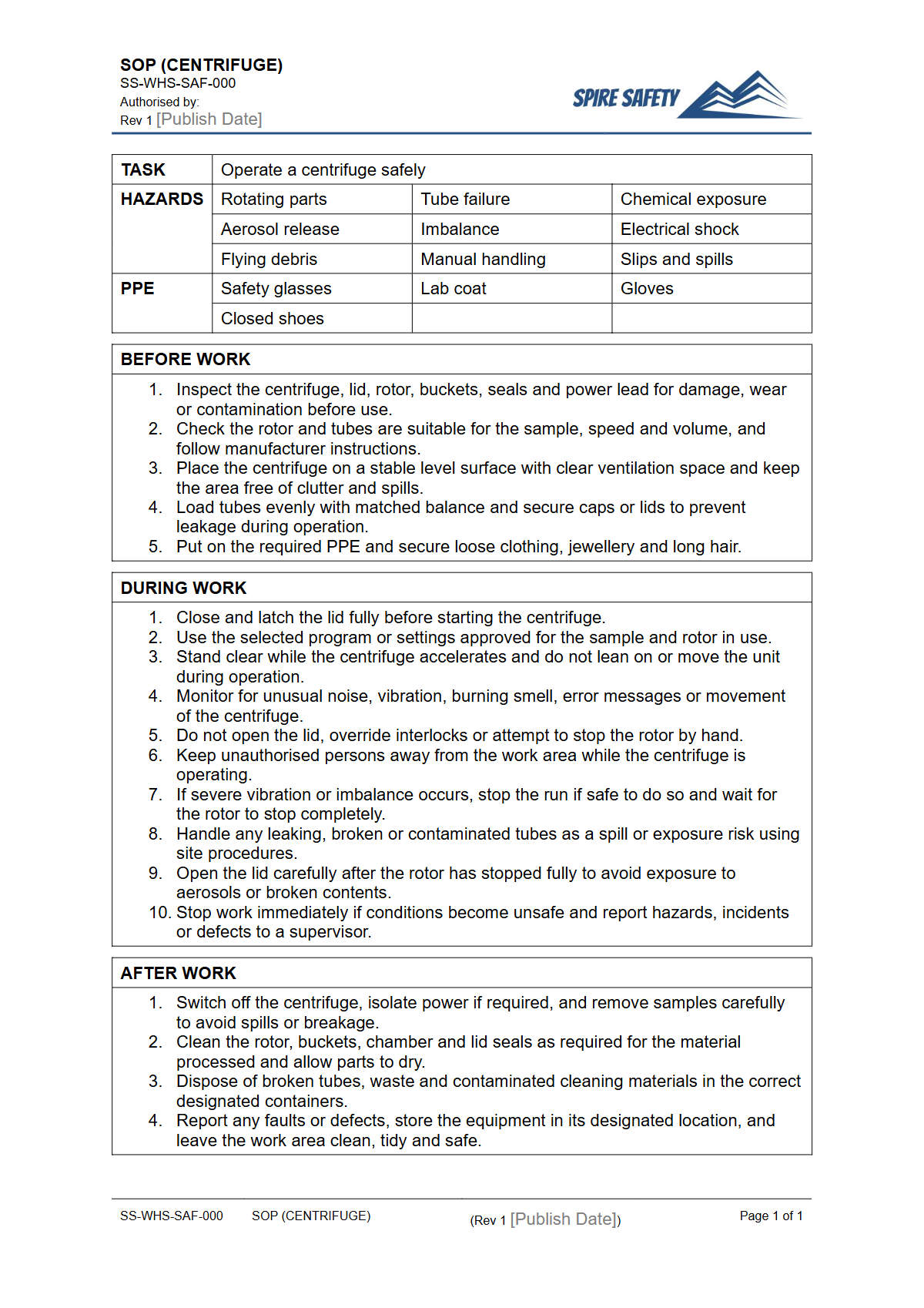
Download our free Safe Operating Procedure (Centrifuge) Template. This customisable DOCX & PDF helps you outline safe work steps for operating centrifuges.
Free Safe Operating Procedure (Centrifuge) Template
DOCX • 126 KB + PDF
Updated Oct 2026
No signup required
Purpose of the Free Safe Operating Procedure (Centrifuge) Template
A Safe Operating Procedure (SOP) is a crucial document that provides clear, step-by-step instructions for performing a task safely. This free Safe Operating Procedure (Centrifuge) template helps your organisation formalise the process for operating centrifuges, which pose significant risks due to high rotational speeds, potential for mechanical failure, and exposure to hazardous materials.
Using a structured SOP helps minimise the risk of injury from flying debris, aerosolised pathogens, or chemical spills. It provides a consistent training tool for workers and serves as a key component of your overall safety framework.
Implementing documented procedures like this SOP is a fundamental part of a robust safety system. A comprehensive approach integrates these individual procedures into a broader structure, often detailed within dedicated WHS management systems to ensure all workplace hazards are systematically controlled.
Video walkthrough
How to use the Free Safe Operating Procedure (Centrifuge) Template
This template is provided in both DOCX and PDF formats to serve as a strong starting point for your workplace. The DOCX file is fully editable, allowing you to add, remove, and modify sections to match your specific equipment and operational context.
You should detail the exact make and model of your centrifuges, the required Personal Protective Equipment (PPE), specific balancing protocols, and your site's emergency shutdown and decontamination procedures.
It is important to note: this document is a template only. We have developed it as a starting point, but you must customise it to reflect the specific centrifuge models, substances, and procedures in your workplace.
Once customised, the SOP should be used to train all relevant personnel and be made easily accessible near the equipment.
Regular reviews are essential to ensure the SOP remains current and effective. These reviews can be scheduled periodically or triggered by an incident, a change in process, or new equipment acquisition. The effectiveness of your documented procedures can be verified through practical observation and formal assessments like WHS compliance auditing.
Key Elements of a Centrifuge SOP
A thorough centrifuge SOP should cover every phase of the equipment's use. While centrifuges have unique risks like rotor imbalance and aerosol containment, the fundamental structure is similar to procedures for other plant. For instance, the pre-start checks are just as critical as those in our free air compressor SOP template.
Pre-Operational Checks
- Visual inspection of the centrifuge, including the bowl, seals, and lid latch.
- Checking the rotor for signs of corrosion, stress fractures, or damage.
- Ensuring the correct rotor is selected for the planned speed and tube type.
- Verifying that tubes are correctly balanced by mass and placed symmetrically in the rotor.
Operating Instructions
- Step-by-step guidance on loading the rotor into the centrifuge.
- Instructions for securing the lid and setting run parameters (speed, time, temperature).
- Clear directives not to leave the centrifuge until it reaches its target speed and to never open the lid while the rotor is in motion.
- Procedures for monitoring the machine during operation for unusual noises or vibrations.
Emergency and Post-Operation Procedures
- Steps to take in an emergency, such as a power failure or a suspected tube breakage.
- Protocols for safely opening the centrifuge after the run is complete.
- Instructions for cleaning and decontaminating the rotor and centrifuge interior.
- Procedures for logging usage and reporting any faults or issues.
- In the event of a medical emergency, having clear instructions for response is vital. This can include procedures detailed in resources like a defibrillator operation SOP.
When to Use This Procedure
The completed centrifuge SOP should be a core part of your safety system. It is used during the induction and training of new employees, technicians, or researchers who will operate the equipment.
It should also be used for periodic refresher training to ensure standards do not slip over time. Furthermore, the SOP is a vital reference document to be consulted before starting a non-routine task or after an incident to review and improve safety protocols.
Who Should Use This Procedure
This SOP is intended for a range of personnel within a laboratory, research, medical, or industrial setting. This includes:
- Laboratory Technicians and Assistants
- Research Scientists and Students
- Clinical Staff
- Supervisors and Lab Managers
- WHS Representatives and Officers
Essentially, anyone who operates, supervises the use of, or is responsible for the maintenance of centrifuges must be familiar with the contents of the relevant SOP. If you need help embedding this and other procedures into your organisation's safety culture, expert WHS consulting can provide tailored guidance and support.
Common mistakes
Common mistakes to avoid
- Improperly balancing tubes, leading to severe vibration and catastrophic rotor failure.
- Exceeding the maximum rated speed for a specific rotor or using damaged rotors.
- Attempting to open the centrifuge lid before the rotor has come to a complete stop.
- Failing to regularly inspect rotors and buckets for corrosion, pitting, or cracks.
Legal references
Legal considerations
The following legal requirements may be relevant to this type of work.
- Work Health and Safety Act (Harmonised) — Provides the primary duties for protecting workers and other people from work health and safety risks.
- Work Health and Safety Regulations (Harmonised) — Sets out requirements supporting the management of workplace hazards and risks.
The following codes may be relevant to this type of work.
- Managing WHS Risks Code of Practice — Provides practical guidance on identifying hazards, assessing risks and applying effective controls.
- Work Health and Safety Consultation, Cooperation and Coordination Code of Practice — Provides practical guidance on consulting workers and coordinating with other duty holders.
- Managing the Work Environment and Facilities Code of Practice — Provides practical guidance on safe work environments, workplace facilities and related controls.
Did you know
Extreme Force
An ultracentrifuge can spin at speeds over 100,000 rotations per minute (RPM), generating acceleration forces exceeding 800,000 times the force of gravity (g-force).
Rotor Energy
A rotor failing at high speed releases an enormous amount of kinetic energy, comparable to a handgun bullet. This is why modern centrifuges have robust steel containment bowls.
FAQ
Frequently asked questions
01What is the main purpose of a centrifuge SOP?
02How often should a centrifuge Safe Operating Procedure be reviewed?
03Is training required in addition to having an SOP for a centrifuge?
04Can this centrifuge SOP template be used for all types of centrifuges?
Share this resource
Free Safe Operating Procedure (Centrifuge) Template
Browse Categories
How To Use It
- 1Download and open in Word or PDF.
- 2Replace the placeholders with your business details.
- 3Get it reviewed by a WHS specialist before rollout.
Need it customised?
Our WHS consultants can adapt this template to your site, run a gap analysis, or audit what you already have in place.
Book a Free Consultation WHS consulting servicesor call 1300 156 382
Related templates
- Free Safe Operating Procedure (Chafing Dish) Template
- Free Safe Operating Procedure (Chain Block) Template
- Free Safe Operating Procedure (Chain of Custody Check) Template
- Free Safe Operating Procedure (Chain Sling Use) Template
- Free Safe Operating Procedure (Chainsaw - Standard Operation) Template
- Free Safe Operating Procedure (Change Room Inspection) Template