
Free Safe Operating Procedure (Chain Sling Use) Template
Download our Free Safe Operating Procedure (Chain Sling Use) Template.
Free Safe Operating Procedure (Chain Sling Use) Template
DOCX • 126 KB + PDF
Updated Oct 2026
No signup required
Purpose of the Free Safe Operating Procedure (Chain Sling Use) Template
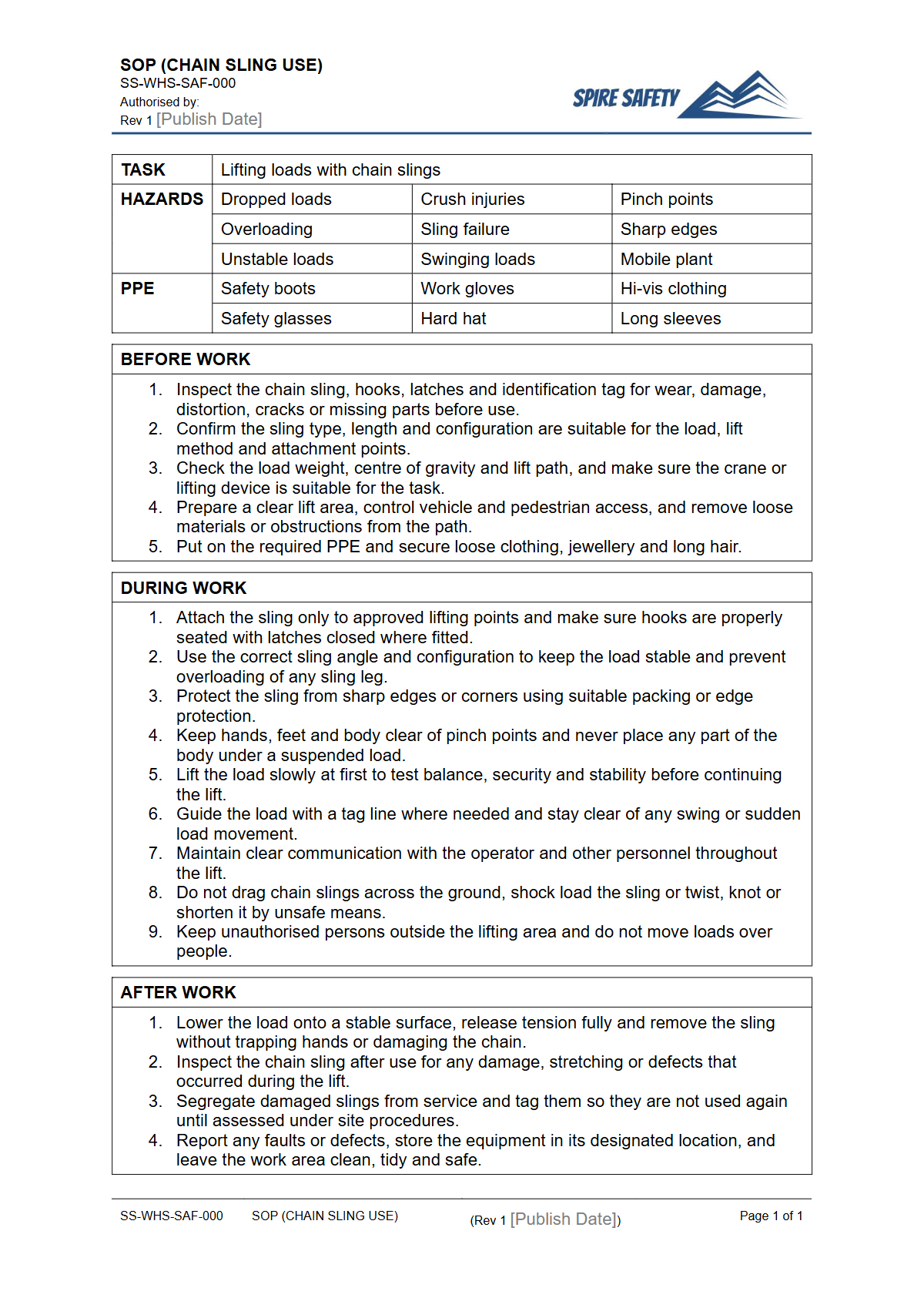
Using lifting equipment like chain slings without a documented process exposes workers to significant risks, including dropped loads, equipment failure, and serious injury. This Free Safe Operating Procedure (Chain Sling Use) Template provides a structured framework to help your organisation document the required steps for the safe handling and use of chain slings.
It formalises pre-operational checks, step-by-step operating instructions, and post-use procedures to minimise risk and guide worker behaviour.
A well-defined SOP is a fundamental component of risk management for high-risk work. It serves as a practical tool for training, supervision, and operational consistency, demonstrating a commitment to workplace safety.
Integrating such procedures is a critical step in developing a comprehensive WHS management system that actively protects your team and meets your duty of care obligations.
Video walkthrough
How to Use the Free Safe Operating Procedure (Chain Sling Use) Template
This resource is provided as a fully editable DOCX file, allowing for complete customisation, as well as a print-ready PDF. To use it effectively, download the template and adapt its contents to reflect the specific equipment, environment, and tasks at your workplace.
It is crucial that you tailor the document to your unique operational context.
Note: This template provides a starting point only. We have populated it with common headings and general guidance, but you must review and customise every section to ensure it is specific and relevant to your site.
This includes adding details about your specific chain sling types (e.g., Grade 80, Grade 100), working load limits (WLLs), unique site hazards, and emergency contact information. Just as our free Telehandler SOP template must be adapted for a specific machine, this document must be customised for your specific lifting gear.
Key sections to customise include:
- Hazards & Risks: Identify all potential hazards associated with chain sling use in your environment, such as crush zones, overhead powerlines, or uneven ground.
- Personal Protective Equipment (PPE): Specify the exact PPE required for the task, such as hard hats, steel-capped boots, high-visibility clothing, and gloves.
- Pre-Operational Inspection: Detail the specific checklist operators must follow, including checking for wear, elongation, cracks, distortion, and legible tags.
- Operating Steps: Document the sequence for safely attaching, lifting, moving, and detaching a load, including communication protocols between the operator and dogger/rigger.
When to Use This Safe Operating Procedure
A Safe Operating Procedure for chain sling use is not a document to be filed away. It should be a live resource used consistently throughout your operations.
Its primary uses include inducting new employees, training workers assigned to lifting tasks, and providing a refresher for experienced personnel. It should be readily accessible in the work area for quick reference.
The SOP also serves as a critical reference during pre-start meetings or toolbox talks before a lift commences. Furthermore, the procedures outlined within it form the benchmark against which performance is measured during site safety reviews and regular WHS compliance auditing.
Who Should Use This Safe Operating Procedure
This SOP should be used by any Person Conducting a Business or Undertaking (PCBU) where chain slings are used for lifting. It is an essential tool for managers, supervisors, and WHS personnel responsible for creating and implementing safe work systems.
They are responsible for ensuring the SOP is customised, implemented, and reviewed regularly.
Most importantly, the SOP is for the operators, riggers, and doggers who perform the lifting tasks. It provides them with clear, unambiguous instructions to follow, empowering them to work safely and consistently.
Ensuring every high-risk task is covered by a specific procedure, from lifting with slings to using access equipment like that covered in our Safe Operating Procedure for step ladder use, is key to building a strong safety culture. You can browse our free WHS resources library for more templates to support your safety management system.
Common mistakes
Common mistakes to avoid
- Exceeding the stated Working Load Limit (WLL).
- Using slings with missing, damaged, or illegible identification tags.
- Failing to account for sling angles, which reduces the effective lifting capacity.
- Using chains that are knotted, twisted, or show signs of stretching, nicks, or gouges.
- Shock loading the sling by jerking the load or allowing it to free-fall before tensioning.
Legal references
Legal considerations
The following legal requirements may be relevant to this type of work.
- Work Health and Safety Act (Harmonised) — Provides the primary duties for protecting workers and other people from work health and safety risks.
- Work Health and Safety Regulations (Harmonised) — Sets out requirements supporting the management of workplace hazards and risks.
The following codes may be relevant to this type of work.
- Managing WHS Risks Code of Practice — Provides practical guidance on identifying hazards, assessing risks and applying effective controls.
- Work Health and Safety Consultation, Cooperation and Coordination Code of Practice — Provides practical guidance on consulting workers and coordinating with other duty holders.
- Managing the Work Environment and Facilities Code of Practice — Provides practical guidance on safe work environments, workplace facilities and related controls.
Did you know
Sling Angles Matter
The lifting capacity (WLL) of a multi-leg chain sling decreases as the angle between the legs increases. At a 90-degree angle, the capacity is reduced to 70% of its vertical rating, and at 120 degrees, it drops to just 50%.
FAQ
Frequently asked questions
01What is a Safe Operating Procedure for chain slings?
02Is it a legal requirement to have an SOP for chain slings in Australia?
03How often should chain slings be inspected?
04What is a Working Load Limit (WLL)?
Share this resource
Free Safe Operating Procedure (Chain Sling Use) Template
Browse Categories
How To Use It
- 1Download and open in Word or PDF.
- 2Replace the placeholders with your business details.
- 3Get it reviewed by a WHS specialist before rollout.
Need it customised?
Our WHS consultants can adapt this template to your site, run a gap analysis, or audit what you already have in place.
Book a Free Consultation WHS consulting servicesor call 1300 156 382
Related templates
- Free Safe Operating Procedure (Chainsaw - Standard Operation) Template
- Free Safe Operating Procedure (Change Room Inspection) Template
- Free Safe Operating Procedure (Chargrill Operation) Template
- Free Safe Operating Procedure (Checkout Belt Cleaning) Template
- Free Safe Operating Procedure (Checkout Till Operation) Template
- Free Safe Operating Procedure (Checkweigher) Template