
Free Safe Operating Procedure (Checkweigher) Template
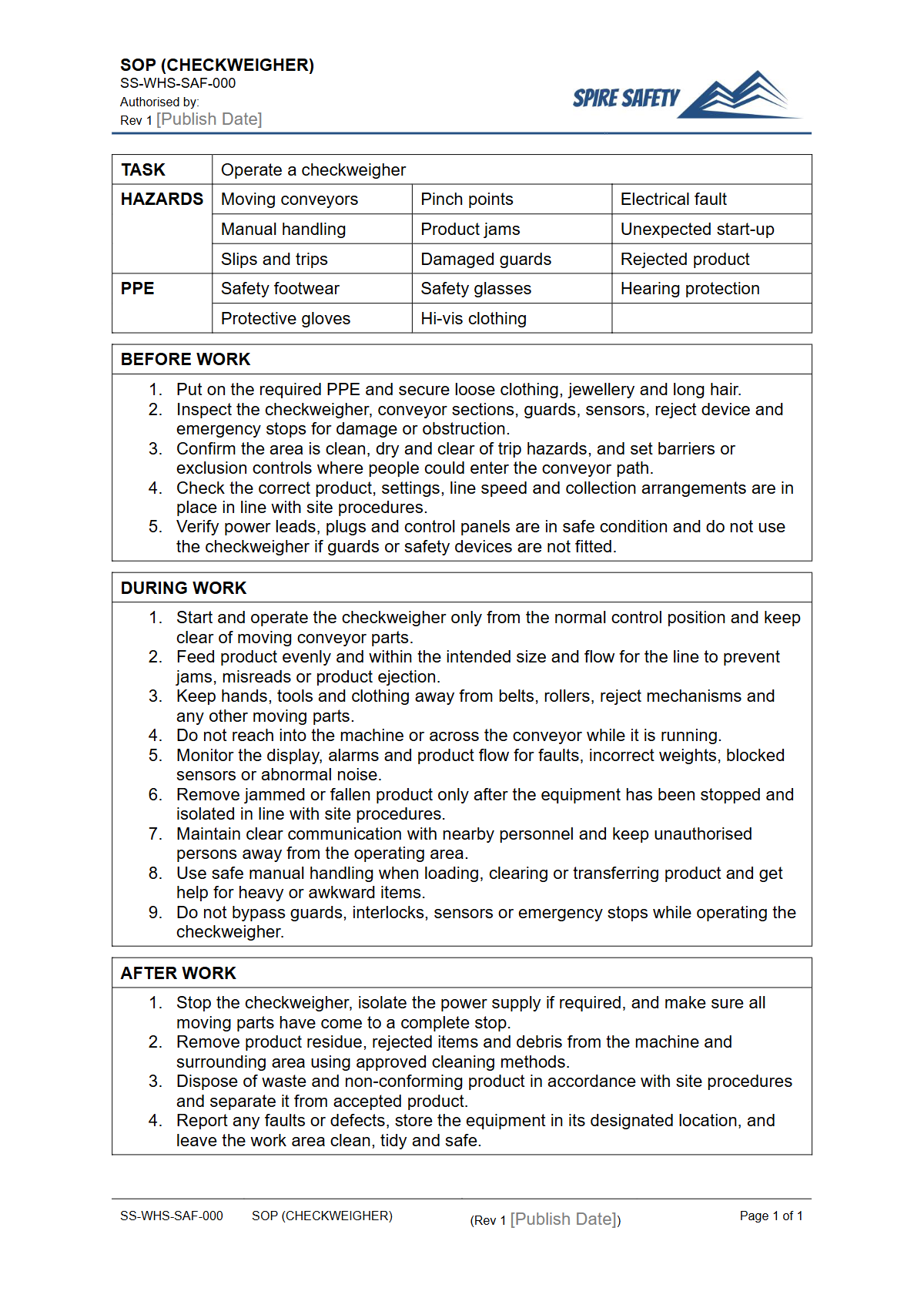
Download our free Safe Operating Procedure (Checkweigher) Template. This customisable DOCX and PDF helps you document safe work systems for your team.
Free Safe Operating Procedure (Checkweigher) Template
DOCX • 126 KB + PDF
Updated Oct 2026
No signup required
Purpose of the Free Safe Operating Procedure (Checkweigher) Template
A Safe Operating Procedure (SOP) is a critical document that provides step-by-step instructions on how to perform a task safely and efficiently. This free Safe Operating Procedure (Checkweigher) Template is designed to help your organisation establish and document a consistent method for operating industrial checkweighers.
Using this template helps reduce the risk of injury to operators, minimises equipment damage, and ensures operational consistency across all shifts. It provides a structured starting point aligned with Australian WHS best practices.
Documenting your processes is a fundamental component of a robust safety framework. An effective SOP serves as an essential training tool for new employees and a reference guide for experienced operators, reinforcing safe work habits and expectations.
Integrating clear procedures for specific plant and equipment is a cornerstone of effective WHS management systems, demonstrating a commitment to proactive risk management.
Video walkthrough
How to use the Free Safe Operating Procedure (Checkweigher) Template
This resource is provided in both DOCX and PDF formats for your convenience. The DOCX version is fully editable, allowing you to tailor it to the unique requirements of your workplace.
While this template provides a comprehensive foundation, it must be customised to be effective. Every workplace is different, and a generic procedure is not sufficient to control specific risks.
When customising, you should consult with the operators who use the equipment daily. You must include details specific to your site, such as the make and model of your checkweigher, identified hazards in the immediate work area, required Personal Protective Equipment (PPE), site-specific emergency shutdown sequences, and lock-out tag-out procedures.
We have provided this template as a guide; you must adapt it to the specific plant, tasks, and environment at your workplace. You can find other equipment-specific examples, like our free Air Compressor SOP, to see how procedures are adapted for different machinery.
When to use a Safe Operating Procedure
A Safe Operating Procedure for a checkweigher should be a living document, used and reviewed throughout the lifecycle of the equipment. It is essential during the induction and training of new operators to ensure they understand the correct and safe method of operation from day one.
It should also be readily available in the work area for quick reference by any team member.
The SOP should be formally reviewed on a regular basis, typically annually, or whenever there is a change in the process, equipment, or operating environment. Furthermore, it's crucial to review and potentially update the SOP after any incident or near-miss involving the checkweigher.
It also serves as a key piece of evidence during a formal WHS compliance audit, demonstrating that safe systems of work have been documented and implemented.
Who should use this Safe Operating Procedure
This template is designed for use by individuals responsible for workplace safety and operational management. This includes WHS Managers, Safety Officers, Production Supervisors, and business owners.
These roles are typically responsible for drafting, reviewing, and implementing safety documentation in consultation with the workforce. Involving the actual operators of the checkweigher in the drafting process is vital, as their hands-on experience provides invaluable insight into the practical risks and challenges of the task.
Ultimately, the finalised SOP is for the operators themselves. It is their guide to performing their duties without compromising their health and safety or that of their colleagues.
It is also useful for maintenance personnel who may need to understand the standard operating conditions before performing work, much like they would need to understand the safe use of tools outlined in a FREE Step Ladder SOP Template. Clear, accessible procedures empower all workers to take ownership of safety. For other vital workplace procedures, consider a free Safe Operating Procedure for defibrillator operation.
By establishing clear guidelines, you create a safer, more organised, and more productive work environment. For more templates and guides to assist your organisation, browse our complete free WHS resources library.
Common mistakes
Common mistakes to avoid
- Failing to calibrate the checkweigher regularly, leading to inaccurate readings and quality control issues.
- Neglecting to include specific cleaning and sanitation procedures, a critical risk in food or pharmaceutical environments.
- Writing a generic SOP that doesn't account for the specific machine model or surrounding workplace hazards.
- Not adequately training operators on the finalised procedure or verifying their understanding before they use the equipment.
Legal references
Legal considerations
The following legal requirements may be relevant to this type of work.
- Work Health and Safety Act (Harmonised) — Provides the primary duties for protecting workers and other people from work health and safety risks.
- Work Health and Safety Regulations (Harmonised) — Sets out requirements supporting the management of workplace hazards and risks.
The following codes may be relevant to this type of work.
- Managing WHS Risks Code of Practice — Provides practical guidance on identifying hazards, assessing risks and applying effective controls.
- Work Health and Safety Consultation, Cooperation and Coordination Code of Practice — Provides practical guidance on consulting workers and coordinating with other duty holders.
- Managing the Work Environment and Facilities Code of Practice — Provides practical guidance on safe work environments, workplace facilities and related controls.
Did you know
Precision at Speed
Modern industrial checkweighers can weigh products with incredible precision, often to within a fraction of a gram, while processing hundreds of items per minute. This accuracy is vital for quality control and regulatory compliance in many industries.
More Than Just Weight
Beyond checking for under or overweight products, checkweighers are also used to detect missing components in a package, such as a leaflet or accessory, ensuring the final product is complete before it reaches the customer.
FAQ
Frequently asked questions
01What should be included in a checkweigher Safe Operating Procedure?
02Is a Safe Operating Procedure a legal requirement in Australia?
03How often should an SOP for a checkweigher be reviewed?
04Who is responsible for writing a Safe Operating Procedure?
Share this resource
Free Safe Operating Procedure (Checkweigher) Template
Browse Categories
How To Use It
- 1Download and open in Word or PDF.
- 2Replace the placeholders with your business details.
- 3Get it reviewed by a WHS specialist before rollout.
Need it customised?
Our WHS consultants can adapt this template to your site, run a gap analysis, or audit what you already have in place.
Book a Free Consultation WHS consulting servicesor call 1300 156 382
Related templates
- Free Safe Operating Procedure (Cheese Grater) Template
- Free Safe Operating Procedure (Cheese Slicer) Template
- Free Safe Operating Procedure (Cheese Vat) Template
- Free Safe Operating Procedure (Chemical Decanting) Template
- Free Safe Operating Procedure (Chemical Dilution) Template
- Free Safe Operating Procedure (Chemical Dosing Pump) Template