
Free Safe Operating Procedure (Chemical Decanting) Template
Download our free Safe Operating Procedure (Chemical Decanting) template.
Free Safe Operating Procedure (Chemical Decanting) Template
DOCX • 126 KB + PDF
Updated Oct 2026
No signup required
Purpose of the Free Safe Operating Procedure (Chemical Decanting) Template
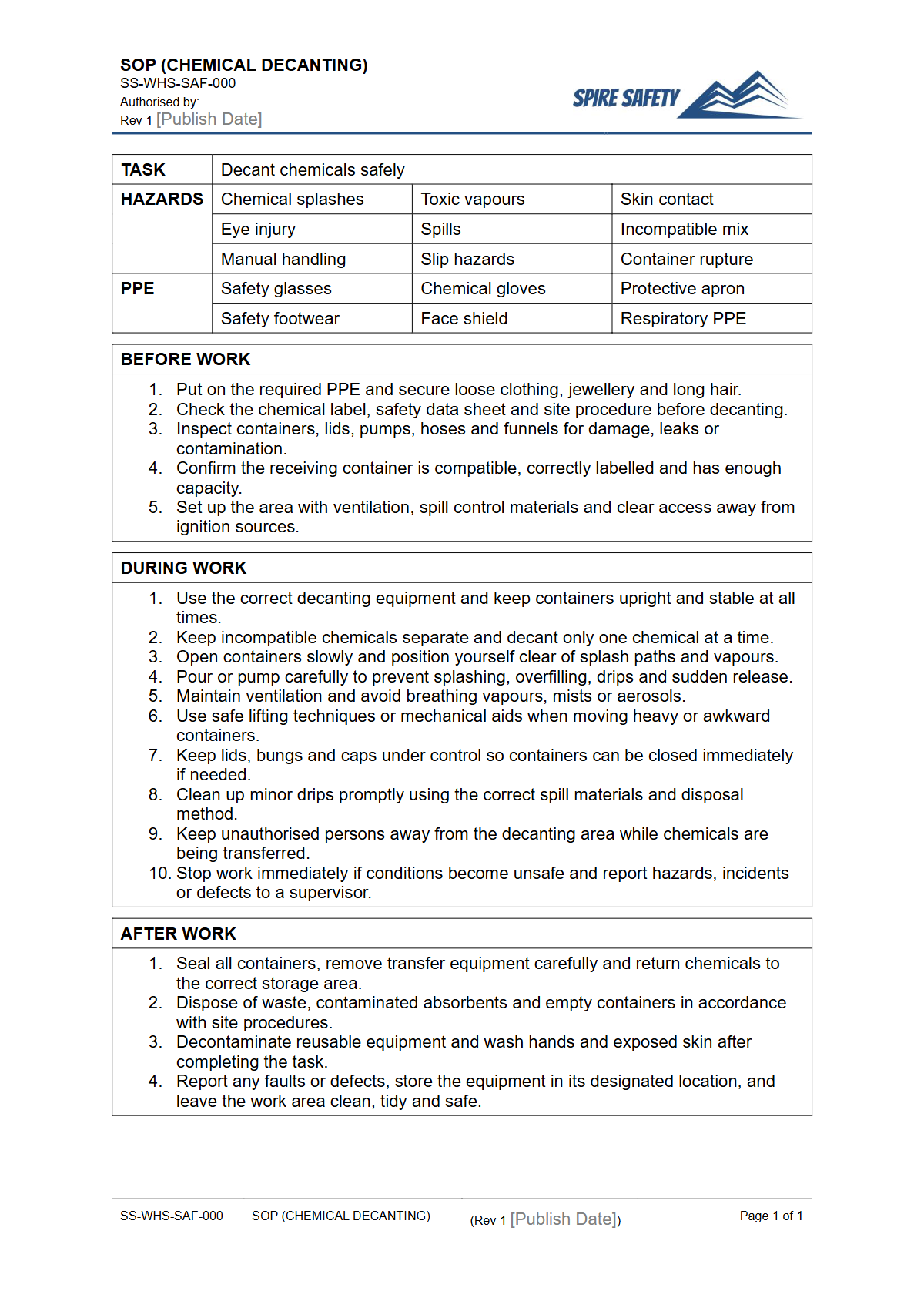
Effectively managing hazardous chemicals is a critical part of workplace safety. This free Safe Operating Procedure (Chemical Decanting) template provides a structured framework for documenting the step-by-step process of transferring chemicals from one container to another, typically from a larger bulk container to a smaller, more usable one.
The primary purpose of this SOP is to minimise risks associated with chemical handling, such as spills, splashes, inhalation of fumes, skin contact, and dangerous reactions from improper mixing. By clearly defining the required precautions, personal protective equipment (PPE), and emergency responses, this document serves as a vital tool for ensuring tasks are performed safely and consistently.
A well-defined SOP is a cornerstone of a safe system of work. It helps your organisation meet its duty of care obligations under Australian WHS legislation by providing clear, accessible instructions to workers.
Formalising the decanting process reduces the likelihood of incidents and demonstrates a proactive approach to risk management. This procedure is an essential administrative control that supports other risk mitigation strategies.
Integrating such procedures into broader comprehensive WHS management systems ensures a holistic and systematic approach to workplace safety.
Video walkthrough
How to use the Free Safe Operating Procedure (Chemical Decanting) Template
This template is provided in both DOCX and PDF formats for your convenience. The DOCX version is fully editable, allowing you to tailor it precisely to your operational needs.
To use this Safe Operating Procedure for Chemical Decanting effectively, you must conduct a thorough risk assessment specific to your workplace, the chemicals being handled, the equipment used, and the environment where the task occurs. You will need to add details such as specific chemical names, required PPE based on Safety Data Sheets (SDS), step-by-step instructions for your equipment, and site-specific emergency and spill response procedures.
Important: This is a template only and must be customised to reflect the specific hazards and control measures relevant to your workplace. We are not liable for any incidents that may arise from the use of this document.
It is the responsibility of the Person Conducting a Business or Undertaking (PCBU) to ensure the procedure is suitable and sufficient for its intended purpose. Regular review and updates are essential, particularly when processes or substances change. For specific scenarios, such as automated systems, you may need a more specialised document like our Safe Operating Procedure for pool chemical dosing systems.
When to use a Chemical Decanting SOP
A Safe Operating Procedure for decanting chemicals should be developed and implemented before any worker is permitted to perform the task. It is a critical document for several key situations.
It forms the basis of worker training and induction, ensuring everyone understands the approved, safe method for handling the substances. It also serves as an on-the-job reference guide for workers to consult before starting work, reinforcing correct procedures and safety checks.
Furthermore, the SOP is an essential tool during safety observations and periodic reviews of work practices. It provides a benchmark against which actual performance can be measured.
The document should also be reviewed as part of any incident investigation involving chemicals to determine if the procedure was followed and if it remains adequate. Regular WHS compliance audits will often involve reviewing SOPs to ensure they are current, accurate, and effectively implemented.
Who should use it
This SOP is designed for use by multiple roles within an organisation. WHS Managers, Safety Officers, and Compliance Managers will use it to establish and formalise safe work practices as part of the overall safety management system.
Supervisors and Team Leaders are responsible for implementing the SOP, training their teams, and ensuring adherence on a daily basis. They must verify that workers are competent in the procedure and have access to all required equipment and PPE.
Most importantly, the procedure is for the workers who physically perform the chemical decanting tasks. It provides them with clear, unambiguous instructions to protect their health and safety.
Involving these frontline workers in the development and review of the SOP is crucial, as they have practical, hands-on knowledge of the task and its associated risks. For further guidance on embedding safety procedures into your operations, you might consider engaging specialist WHS consulting services.
While this SOP covers the chemical transfer process, other tasks often accompany it. For example, if accessing chemicals stored at height, a separate procedure such as a step ladder SOP may be required to ensure safe access. Integrating various task-specific procedures creates a more robust safety framework, which you can explore further in our free WHS resources library.
Common mistakes
Common mistakes to avoid
- Using a generic template without adding site-specific details and risk controls.
- Failing to consult the Safety Data Sheet (SDS) for each specific chemical being decanted.
- Neglecting to train workers on the procedure and verify their understanding before they perform the task.
- Performing decanting in a poorly ventilated area without adequate fume extraction or respiratory protection.
Legal references
Legal considerations
The following legal requirements may be relevant to this type of work.
- Work Health and Safety Act (Harmonised) — Provides the primary duties for protecting workers and other people from work health and safety risks.
- Work Health and Safety Regulations (Harmonised) — Sets out requirements supporting the management of workplace hazards and risks.
The following codes may be relevant to this type of work.
- Managing WHS Risks Code of Practice — Provides practical guidance on identifying hazards, assessing risks and applying effective controls.
- Work Health and Safety Consultation, Cooperation and Coordination Code of Practice — Provides practical guidance on consulting workers and coordinating with other duty holders.
- Managing the Work Environment and Facilities Code of Practice — Provides practical guidance on safe work environments, workplace facilities and related controls.
Did you know
SDS is Key
The Safety Data Sheet (SDS) is the most critical source of information for any hazardous chemical. It legally must be available and will dictate the specific PPE, handling procedures, and first aid measures required for your SOP.
The Hierarchy of Control
Before relying on an SOP (an administrative control), a business must first consider higher-level controls. This includes trying to eliminate the hazardous chemical or substitute it with a safer alternative.
FAQ
Frequently asked questions
01What is chemical decanting?
02Is an SOP legally required for decanting chemicals in Australia?
03What PPE is needed for chemical decanting?
04How often should a Chemical Decanting SOP be reviewed?
Share this resource
Free Safe Operating Procedure (Chemical Decanting) Template
Browse Categories
How To Use It
- 1Download and open in Word or PDF.
- 2Replace the placeholders with your business details.
- 3Get it reviewed by a WHS specialist before rollout.
Need it customised?
Our WHS consultants can adapt this template to your site, run a gap analysis, or audit what you already have in place.
Book a Free Consultation WHS consulting servicesor call 1300 156 382
Related templates
- Free Safe Operating Procedure (Chemical Dilution) Template
- Free Safe Operating Procedure (Chemical Dosing Pump) Template
- Free Safe Operating Procedure (Chemical Dropoff Intake) Template
- Free Safe Operating Procedure (Chemical Shed Cleaning) Template
- Free Safe Operating Procedure (Chemical Spill Cleanup) Template
- Free Safe Operating Procedure (Chemical Transfer) Template