
Free Safe Operating Procedure (Chemical Dosing Pump) Template
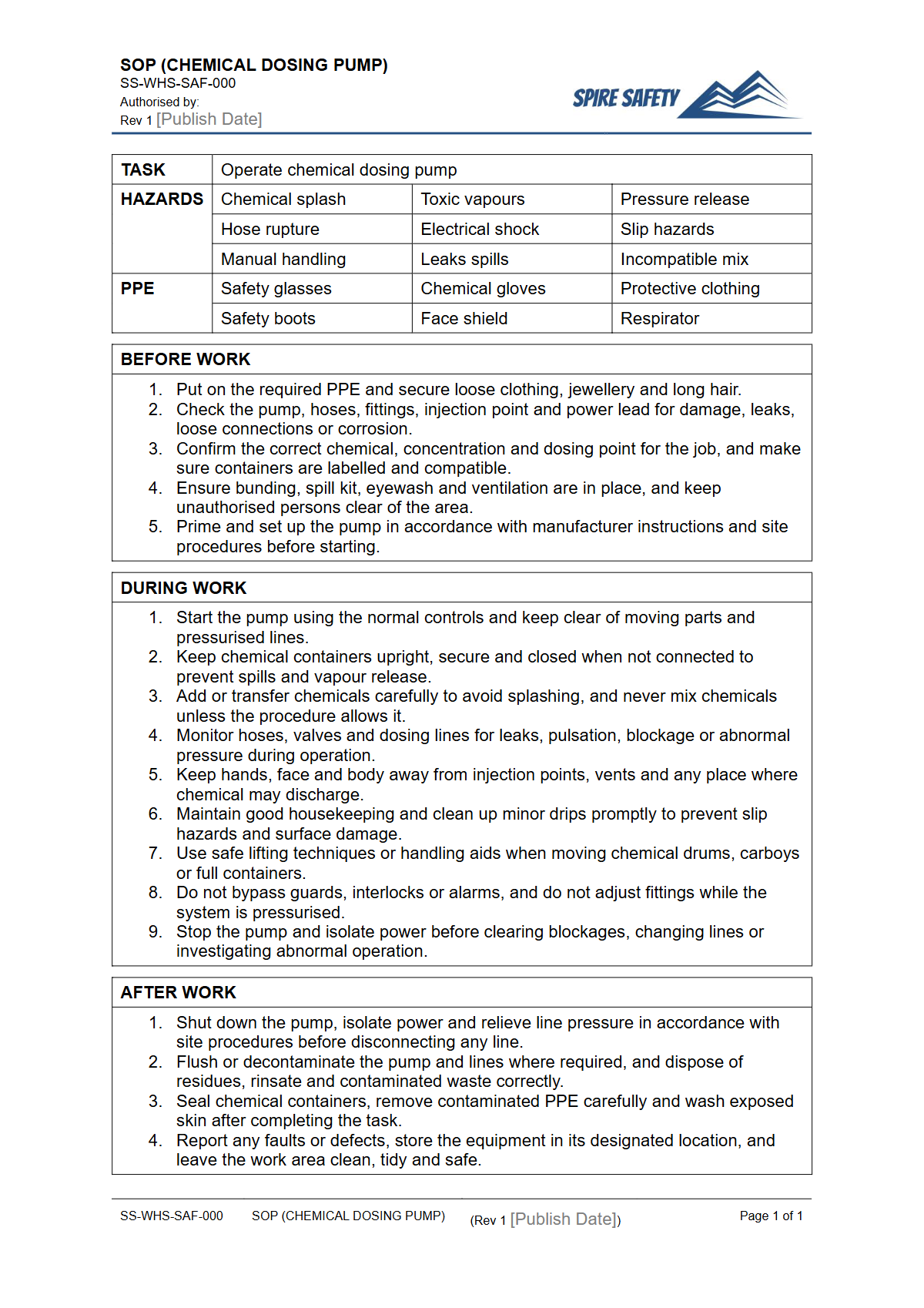
Download our free Safe Operating Procedure (SOP) template for chemical dosing pumps.
Free Safe Operating Procedure (Chemical Dosing Pump) Template
DOCX • 126 KB + PDF
Updated Oct 2026
No signup required
Purpose of the Free Safe Operating Procedure (Chemical Dosing Pump) Template
Operating chemical dosing pumps introduces significant workplace hazards, including chemical exposure, high-pressure injection injuries, and mechanical or electrical faults. This Free Safe Operating Procedure (Chemical Dosing Pump) Template provides a structured framework for documenting the steps required to operate this equipment safely.
A documented SOP is a critical tool for managing risks, standardising work methods, and ensuring all workers receive consistent training and instruction.
Implementing clear, accessible SOPs is a fundamental component of effective WHS management systems. This template helps your organisation meet its duty of care by outlining pre-operational checks, safe operational steps, and emergency procedures, forming a key part of your risk control strategy for hazardous chemicals and plant.
Video walkthrough
How to use the Free Safe Operating Procedure (Chemical Dosing Pump) Template
This resource is provided in both DOCX and PDF formats. Download the DOCX file to add, remove, and edit the content to align with your specific operational context.
It is designed as a starting point, aligned with Australian WHS principles, to be adapted for your business.
Important: You must customise this Safe Operating Procedure for your workplace. This involves incorporating site-specific information, such as the exact make and model of your dosing pumps, the names and properties of chemicals used, required Personal Protective Equipment (PPE) as detailed in the Safety Data Sheet (SDS), and unique environmental controls.
We cannot be held responsible for any incident that occurs from using this template without proper, site-specific customisation based on your own risk assessment.
For facilities like aquatic centres or water treatment plants, you may also find value in our specific Safe Operating Procedure for pool chemical dosing systems, which addresses hazards common to those environments.
When to use it
A Safe Operating Procedure for a chemical dosing pump should be used as a primary reference document in several key situations. It must be consulted by operators before starting the equipment for the first time or at the beginning of a shift.
The SOP is an essential training tool for new and inexperienced workers, providing a clear, step-by-step guide to safe operation.
It also serves as a critical checklist during maintenance, fault-finding, or cleaning activities, ensuring that isolation and depressurisation steps are not missed. Furthermore, the SOP should be reviewed during incident investigations and regular safety audits to ensure its continued relevance and effectiveness. Even tasks associated with accessing the equipment may require their own documented procedures, such as an SOP for step ladder use.
Who should use it
This SOP should be readily accessible to and used by all personnel who interact with chemical dosing pumps. This includes, but is not limited to:
- Plant Operators: The primary users who perform the day-to-day operation of the pumps.
- Maintenance Staff: Technicians and fitters who service, repair, or replace pumps and associated pipework.
- Supervisors and Team Leaders: Individuals responsible for overseeing work, providing training, and ensuring procedures are followed.
- WHS Personnel: Safety officers and managers who use the SOP to conduct risk assessments, deliver training, and perform workplace inspections.
In complex industrial settings, the safe operation of a dosing pump is often linked to other plant. It may be beneficial to develop procedures for associated equipment, for which an air compressor SOP can serve as a useful reference if pneumatic systems are involved.
If you require assistance in developing or reviewing SOPs to ensure they are robust and fit-for-purpose, our expert WHS consulting team can provide tailored support. You can also explore our complete free WHS resources library for more templates and guides.
Common mistakes
Common mistakes to avoid
- Failing to depressurise the system and lines before performing maintenance.
- Using the incorrect PPE or failing to consult the Safety Data Sheet (SDS).
- Not regularly verifying the pump's calibration, leading to incorrect dosing rates.
- Ignoring small leaks, which can be an early indicator of seal or diaphragm failure.
Legal references
Legal considerations
The following legal requirements may be relevant to this type of work.
- Work Health and Safety Act (Harmonised) — Provides the primary duties for protecting workers and other people from work health and safety risks.
- Work Health and Safety Regulations (Harmonised) — Sets out requirements supporting the management of workplace hazards and risks.
The following codes may be relevant to this type of work.
- Managing WHS Risks Code of Practice — Provides practical guidance on identifying hazards, assessing risks and applying effective controls.
- Work Health and Safety Consultation, Cooperation and Coordination Code of Practice — Provides practical guidance on consulting workers and coordinating with other duty holders.
- Managing the Work Environment and Facilities Code of Practice — Provides practical guidance on safe work environments, workplace facilities and related controls.
Did you know
The Right Material
Chemical compatibility is critical for dosing pumps. Using a pump with seals, diaphragms, or tubing not rated for the specific chemical can lead to rapid degradation, causing leaks and hazardous spills.
FAQ
Frequently asked questions
01What is a chemical dosing pump SOP?
02What are the main hazards of a chemical dosing pump?
03Is PPE required when operating a chemical dosing pump?
04How often should a chemical dosing pump SOP be reviewed?
Share this resource
Free Safe Operating Procedure (Chemical Dosing Pump) Template
Browse Categories
How To Use It
- 1Download and open in Word or PDF.
- 2Replace the placeholders with your business details.
- 3Get it reviewed by a WHS specialist before rollout.
Need it customised?
Our WHS consultants can adapt this template to your site, run a gap analysis, or audit what you already have in place.
Book a Free Consultation WHS consulting servicesor call 1300 156 382
Related templates
- Free Safe Operating Procedure (Chemical Dropoff Intake) Template
- Free Safe Operating Procedure (Chemical Shed Cleaning) Template
- Free Safe Operating Procedure (Chemical Spill Cleanup) Template
- Free Safe Operating Procedure (Chemical Transfer) Template
- Free Safe Operating Procedure (Chicken Coop Cleaning) Template
- Free Safe Operating Procedure (Child Play Area Cleaning) Template