
Free Safe Operating Procedure (Chemical Transfer) Template
Download our free Safe Operating Procedure (SOP) for chemical transfers. This DOCX and PDF template helps you document safe work methods and manage risks.
Free Safe Operating Procedure (Chemical Transfer) Template
DOCX • 126 KB + PDF
Updated Oct 2026
No signup required
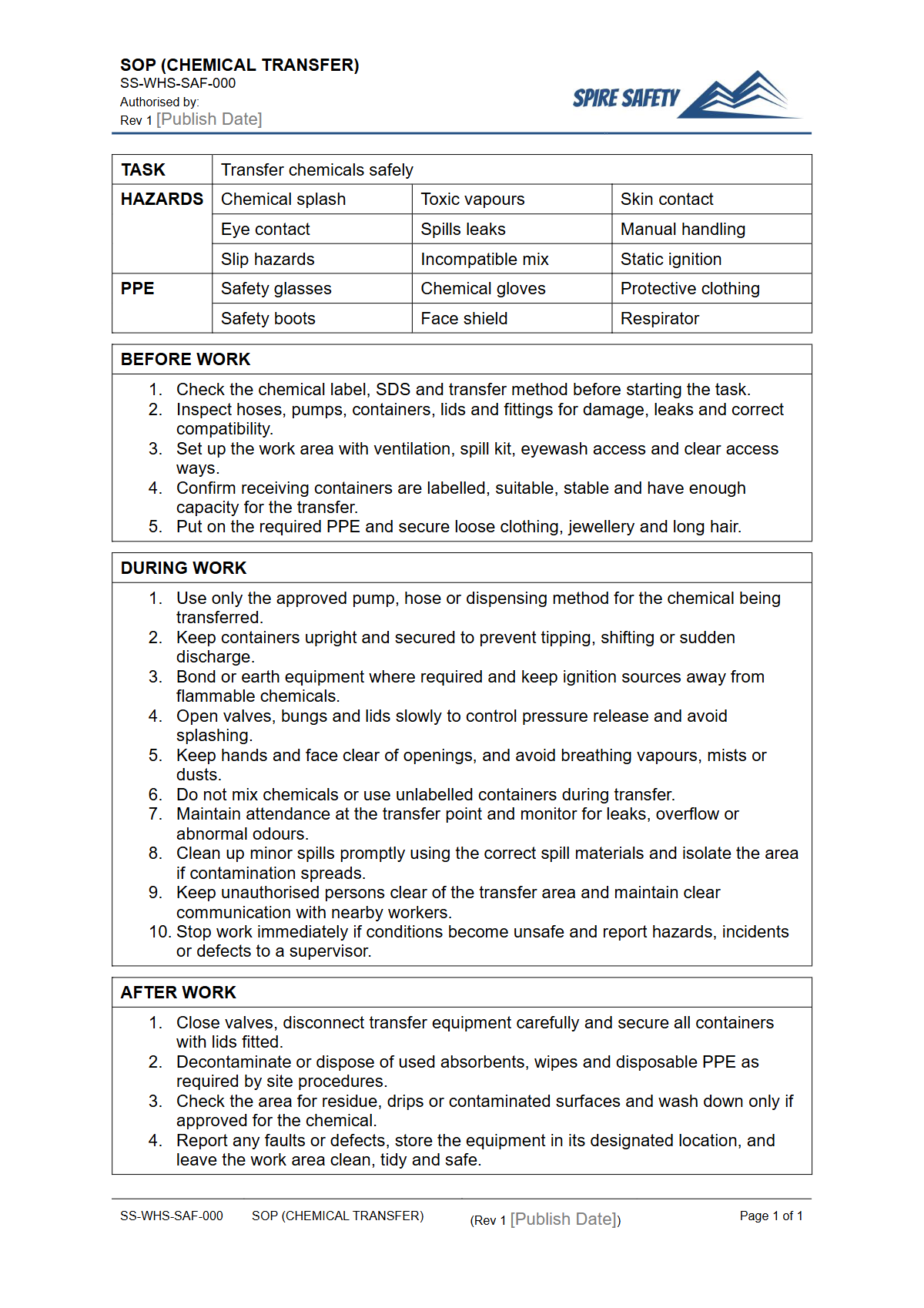
Purpose of the Free Safe Operating Procedure (Chemical Transfer) Template
Handling and transferring chemicals presents significant risks, including spills, splashes, fires, and exposure to toxic fumes. This Free Safe Operating Procedure (Chemical Transfer) Template provides a structured framework for documenting the specific steps required to perform this task safely.
Using a detailed SOP helps your organisation standardise its processes, minimise the risk of chemical-related incidents, and demonstrate a commitment to meeting its duties under Australian WHS legislation. It serves as a vital tool for worker training, hazard communication, and operational consistency.
This document is designed as a foundational template, aligned with the principles of the model WHS framework. It helps you outline critical safety elements such as required Personal Protective Equipment (PPE), pre-operational checks, step-by-step instructions, and emergency responses.
Implementing a robust SOP is a key component of effective risk management for any workplace that handles hazardous substances. Integrating such procedures into comprehensive WHS management systems ensures safety protocols are embedded throughout your operations.
Video walkthrough
How to use the Free Safe Operating Procedure (Chemical Transfer) Template
This template is provided in both DOCX and PDF formats for your convenience. The DOCX file is fully editable, allowing you to tailor the content to the unique requirements of your workplace.
Important: This is a template only. To be effective, you must customise this Safe Operating Procedure to reflect your specific equipment, chemicals, processes, and site-specific risks.
We cannot be held liable for any incidents that may occur. A generic procedure is not sufficient to ensure safety or compliance. Key areas for customisation include:
- Chemical Identification: Specify the exact names, classes, and volumes of chemicals being transferred.
- Equipment Details: List the specific pumps, hoses, containers, and ventilation systems used.
- PPE Requirements: Detail the mandatory PPE based on Safety Data Sheets (SDS), such as specific glove types, eye protection, and respiratory equipment.
- Site-Specific Procedures: Include details about your designated transfer areas, spill containment measures, and emergency shutdown points.
- Emergency Contacts: List internal and external emergency contact numbers.
After customisation, the SOP should be reviewed by a competent person, approved by management, and used to train all relevant workers before they undertake the task. For more complex chemical safety challenges, seeking specialist WHS consulting can provide tailored solutions and expert guidance.
When to use a Chemical Transfer SOP
A Safe Operating Procedure for chemical transfers should be developed, implemented, and referenced before any such task is performed. It is a critical document for several key activities:
- Worker Training: Use the SOP as the primary training document for new employees or workers newly assigned to the task.
- Pre-Task Planning: Workers should review the SOP before starting a transfer to refresh their understanding of the steps and safety controls.
- Incident Investigation: If an incident occurs, the SOP serves as a benchmark for reviewing whether the prescribed safe work method was followed.
- Audits and Reviews: The SOP should be regularly reviewed (at least annually) and audited to ensure it remains current and effective. For some hazardous tasks, you may even need a specific Safe Operating Procedure for Pool Chemical Dosing System Operation or other specialised equipment.
Who should use this Safe Operating Procedure
This SOP is intended for use by a range of personnel within an organisation:
- Workers and Operators: The primary users, who must follow the procedure step-by-step to perform their work safely.
- Supervisors and Managers: Responsible for ensuring workers are trained on the SOP and that the procedure is followed correctly. They also oversee its implementation and enforcement.
- WHS Professionals and Committees: Use the SOP as part of the broader risk management process, for conducting risk assessments, and to ensure control measures are documented and communicated. Regular workplace inspections often verify that procedures for tasks like accessing high areas are also formalised, sometimes requiring a dedicated step ladder SOP.
- Trainers: Use the finalised SOP as the basis for developing and delivering practical training and competency assessments. You can find more templates and guides in our free WHS resources library.
Common mistakes
Common mistakes to avoid
- Using incorrect or damaged PPE (e.g., gloves not rated for the specific chemical).
- Failing to inspect hoses, pumps, and containers for wear or damage before use.
- Working in a poorly ventilated area, leading to the buildup of hazardous vapours.
- Not having a spill kit readily accessible or workers not being trained on how to use it.
Legal references
Legal considerations
The following legal requirements may be relevant to this type of work.
- Work Health and Safety Act (Harmonised) — Provides the primary duties for protecting workers and other people from work health and safety risks.
- Work Health and Safety Regulations (Harmonised) — Sets out requirements supporting the management of workplace hazards and risks.
The following codes may be relevant to this type of work.
- Managing WHS Risks Code of Practice — Provides practical guidance on identifying hazards, assessing risks and applying effective controls.
- Work Health and Safety Consultation, Cooperation and Coordination Code of Practice — Provides practical guidance on consulting workers and coordinating with other duty holders.
- Managing the Work Environment and Facilities Code of Practice — Provides practical guidance on safe work environments, workplace facilities and related controls.
Did you know
Globally Harmonized System (GHS)
Australia has adopted the Globally Harmonized System of Classification and Labelling of Chemicals (GHS) to provide a consistent international approach to chemical hazard communication, including on labels and Safety Data Sheets.
Incompatible Chemicals
A common cause of serious incidents is the accidental mixing of incompatible chemicals during transfer or storage. For example, mixing chlorine bleach with ammonia-based cleaners can produce highly toxic chloramine gas.
FAQ
Frequently asked questions
01What chemicals does this Safe Operating Procedure cover?
02Is this template suitable for transferring chemicals from bulk containers?
03What should be included in the emergency procedures section of the SOP?
04Who needs to be trained on this chemical transfer SOP?
Share this resource
Free Safe Operating Procedure (Chemical Transfer) Template
Browse Categories
How To Use It
- 1Download and open in Word or PDF.
- 2Replace the placeholders with your business details.
- 3Get it reviewed by a WHS specialist before rollout.
Need it customised?
Our WHS consultants can adapt this template to your site, run a gap analysis, or audit what you already have in place.
Book a Free Consultation WHS consulting servicesor call 1300 156 382
Related templates
- Free Safe Operating Procedure (Chicken Coop Cleaning) Template
- Free Safe Operating Procedure (Child Play Area Cleaning) Template
- Free Safe Operating Procedure (Chiller Plant Operation) Template
- Free Safe Operating Procedure (Chip Spreader) Template
- Free Safe Operating Procedure (Chlorine Handling) Template
- Free Safe Operating Procedure (Chocolate Melter) Template