
Free Safe Operating Procedure (Chicken Coop Cleaning) Template
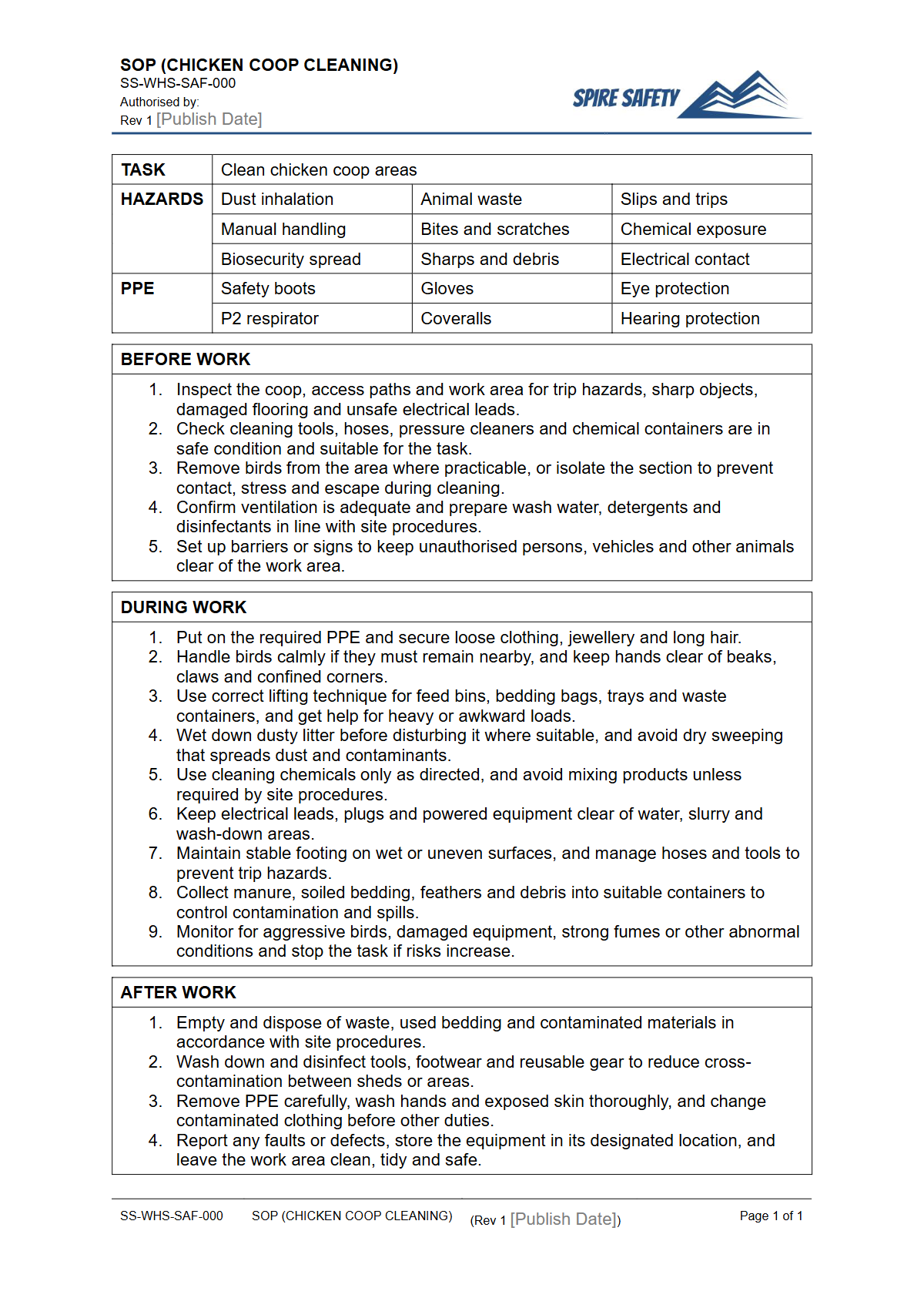
Download our free Safe Operating Procedure for chicken coop cleaning. This customisable DOCX & PDF template helps manage biological and manual handling risks.
Free Safe Operating Procedure (Chicken Coop Cleaning) Template
DOCX • 126 KB + PDF
Updated Oct 2026
No signup required
Purpose of the Free Safe Operating Procedure (Chicken Coop Cleaning) Template
Cleaning poultry enclosures, while routine, involves significant health and safety risks. This Free Safe Operating Procedure (Chicken Coop Cleaning) Template provides a structured starting point for documenting a safe system of work for this common agricultural task.
An effective SOP helps manage hazards such as exposure to biological agents, respiratory dust, hazardous chemicals, and ergonomic strains from manual tasks. Formalising your process helps meet your duties under WHS legislation and demonstrates a commitment to worker safety.
By implementing a clear, step-by-step procedure, you can standardise the cleaning process, ensure correct personal protective equipment (PPE) is used, and train workers effectively. This document is a foundational component of broader WHS management systems, helping your business proactively control risks rather than reacting to incidents.
It is designed to be adapted to any workplace where poultry is kept, from commercial farms to educational facilities.
Video walkthrough
How to use the Free Safe Operating Procedure (Chicken Coop Cleaning) Template
This SOP template is available for download in both DOCX and PDF formats. The DOCX file is fully editable, allowing you to tailor it to your specific operational needs.
A competent person must conduct a risk assessment and customise this document to reflect the unique conditions of your workplace, including the specific layout of the coop, the type of bedding used, the cleaning agents on site, and the equipment available.
Important: Before use, this template must be customised by a competent person to reflect the specific equipment, chemicals, environment, and processes at your workplace. We have provided a framework based on common industry practice, but you must complete the site-specific details and risk controls to ensure it is relevant and effective for your operation.
Consultation with the workers who will be performing the task is a critical part of this process.
If your organisation lacks the internal expertise to conduct a thorough risk assessment or customise safety documentation, engaging external WHS consulting services can provide the necessary support and ensure your procedures are robust and practical.
When to use it
A Safe Operating Procedure for chicken coop cleaning should be in place and actively used before any worker undertakes the task. It serves as a primary reference document for:
- Training and inducting new farmhands or employees responsible for animal husbandry.
- Conducting pre-start checks and ensuring all necessary equipment and PPE are available.
- Providing a clear, sequential guide for workers to follow during the cleaning process.
- Reviewing and improving safety protocols, especially after a near-miss, incident, or when new cleaning chemicals or equipment are introduced.
- Routine refresher training to prevent complacency and reinforce safe work habits.
The principles in this SOP can also inform procedures for other agricultural tasks. For example, similar controls around dust, manual handling, and equipment use are found in our FREE Grain Drill SOP Template.
Who should use it
This SOP is intended for use by Persons Conducting a Business or Undertaking (PCBUs) who have workers or others performing chicken coop cleaning tasks. This includes:
- Commercial poultry farm owners and managers.
- Supervisors responsible for overseeing daily operations and worker safety.
- WHS managers and officers developing and implementing safety systems.
- Workers who perform the cleaning, who must be trained in and understand the procedure.
- Educational institutions with agricultural programs or hobby farms.
For tasks that may require working at height, such as cleaning high surfaces or accessing loft areas, procedures should be integrated with other relevant SOPs, such as our FREE Step Ladder SOP Template, to ensure all fall risks are controlled.
Key Hazards in Coop Cleaning
Without proper controls, cleaning chicken coops can expose workers to serious health risks. The SOP helps to address:
- Biological Hazards: Dust from dried faeces and bedding can contain bacteria (e.g., Salmonella, Campylobacter), fungi (e.g., Histoplasma, Aspergillus), and viruses. These can cause serious respiratory and gastrointestinal illnesses. Zoonotic diseases are a primary concern.
- Respiratory Hazards: Fine dust particles and ammonia gas can irritate the respiratory system and lead to chronic conditions. Appropriate respiratory protective equipment (RPE) is essential.
- Ergonomic Hazards: The task often involves repetitive bending, shovelling, lifting heavy bags of waste or new bedding, and awkward postures, which can lead to musculoskeletal injuries.
- Chemical Hazards: Disinfectants and cleaning agents can cause skin or eye irritation, burns, or respiratory issues if not handled correctly. Always refer to the Safety Data Sheet (SDS) for the specific product being used.
A well-prepared workplace is also ready for emergencies. As part of your overall farm safety plan, ensure workers know the location of first aid kits and emergency equipment. Your emergency plan might include procedures detailed in resources like the Free Safe Operating Procedure (Defibrillator Operation) Template.
What's in the Template?
Our template provides a comprehensive structure for your SOP, covering essential safety elements. Sections include required PPE, pre-operational checks, a detailed step-by-step cleaning procedure, waste disposal, post-cleaning tasks, and emergency response actions. This thorough format ensures all stages of the job are considered from a safety perspective. You can explore our full free WHS resources library for more templates to support your safety management system.
Common mistakes
Common mistakes to avoid
- Performing a 'dry scrape' or 'dry sweep' which creates large clouds of hazardous dust.
- Using incorrect or poorly-fitting respiratory protection (e.g., a simple dust mask instead of a P2/N95 respirator).
- Neglecting to read the Safety Data Sheet (SDS) for cleaning chemicals and disinfectants.
- Poor manual handling techniques when lifting heavy bags of bedding or full wheelbarrows.
Legal references
Legal considerations
The following legal requirements may be relevant to this type of work.
- Work Health and Safety Act (Harmonised) — Provides the primary duties for protecting workers and other people from work health and safety risks.
- Work Health and Safety Regulations (Harmonised) — Sets out requirements supporting the management of workplace hazards and risks.
The following codes may be relevant to this type of work.
- Managing WHS Risks Code of Practice — Provides practical guidance on identifying hazards, assessing risks and applying effective controls.
- Work Health and Safety Consultation, Cooperation and Coordination Code of Practice — Provides practical guidance on consulting workers and coordinating with other duty holders.
- Managing the Work Environment and Facilities Code of Practice — Provides practical guidance on safe work environments, workplace facilities and related controls.
Did you know
Ammonia Levels
Ammonia gas, released from the breakdown of uric acid in chicken droppings, can reach harmful levels in poorly ventilated coops. Concentrations as low as 25 parts per million (ppm) can cause respiratory tract irritation.
Zoonotic Risk
Zoonotic diseases are illnesses that can be transmitted from animals to humans. According to Safe Work Australia, workers in agriculture are at a heightened risk of contracting zoonoses like salmonellosis and psittacosis directly from infected birds or their droppings.
FAQ
Frequently asked questions
01What kind of PPE is required for cleaning a chicken coop?
02How can I reduce dust when cleaning out a coop?
03Is a Safe Operating Procedure a legal requirement in Australia?
04What are the risks of histoplasmosis from chicken coops?
Share this resource
Free Safe Operating Procedure (Chicken Coop Cleaning) Template
Browse Categories
How To Use It
- 1Download and open in Word or PDF.
- 2Replace the placeholders with your business details.
- 3Get it reviewed by a WHS specialist before rollout.
Need it customised?
Our WHS consultants can adapt this template to your site, run a gap analysis, or audit what you already have in place.
Book a Free Consultation WHS consulting servicesor call 1300 156 382
Related templates
- Free Safe Operating Procedure (Child Play Area Cleaning) Template
- Free Safe Operating Procedure (Chiller Plant Operation) Template
- Free Safe Operating Procedure (Chip Spreader) Template
- Free Safe Operating Procedure (Chlorine Handling) Template
- Free Safe Operating Procedure (Chocolate Melter) Template
- Free Safe Operating Procedure (Chocolate Tempering) Template