
Free Safe Operating Procedure (Chlorine Handling) Template
Download our free Safe Operating Procedure (SOP) for Chlorine Handling. This template helps you manage chlorine-related hazards in your workplace.
Free Safe Operating Procedure (Chlorine Handling) Template
DOCX • 126 KB + PDF
Updated Oct 2026
No signup required
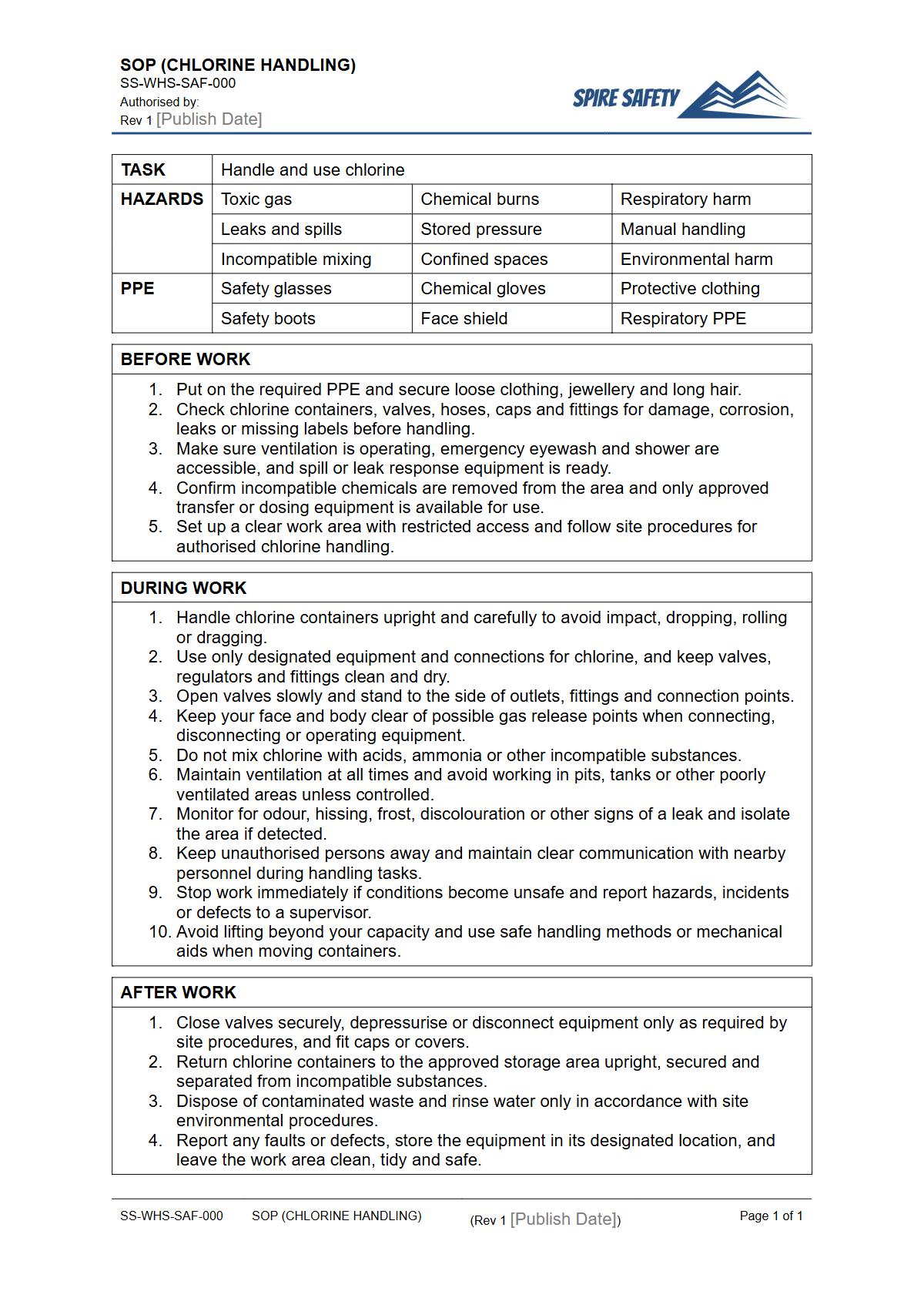
Purpose of the Free Safe Operating Procedure (Chlorine Handling) Template
Handling chlorine requires strict protocols to prevent serious health issues, chemical burns, and environmental incidents. This Free Safe Operating Procedure (Chlorine Handling) Template provides a structured starting point for organisations to formalise safe work methods.
It is designed to help you document the step-by-step processes for tasks involving chlorine, from delivery and storage to decanting, use, and disposal.
A well-drafted Safe Operating Procedure (SOP) is a fundamental tool for risk management. It helps your organisation meet its primary duty of care by identifying specific hazards associated with chlorine—such as inhalation of toxic vapour, skin and eye contact, and reactivity with other chemicals.
The procedure then outlines the critical control measures required to mitigate these risks, including engineering controls (e.g., ventilation), administrative controls, required Personal Protective Equipment (PPE), and emergency response actions. Integrating this SOP is a key activity in developing and maintaining robust WHS management systems.
Video walkthrough
How to use the Free Safe Operating Procedure (Chlorine Handling) Template
Upon downloading the template in your preferred DOCX or PDF format, you must adapt it to the unique context of your worksite. The document provides a comprehensive framework aligned with Australian WHS good practice, but it is not a complete, ready-to-use solution.
Site-specific details are essential for the procedure to be effective.
Important: You must customise this template to reflect your specific operational realities. We have provided a general structure, but it is your responsibility to ensure the final document accurately details your workplace's equipment, the form of chlorine used (gas, liquid, powder), storage conditions, and emergency facilities.
Consultation is key; involve your workers and any Health and Safety Representatives (HSRs) in the drafting and review process to ensure the SOP is practical and understood by those performing the tasks. If you are unsure about the specific chemical hazards or controls, consider engaging professional WHS consulting services.
What is a Safe Operating Procedure?
A Safe Operating Procedure, or SOP, is a written document that provides clear, step-by-step instructions on how to safely perform a specific task or operate machinery. It is an administrative control measure that forms a critical part of a safe system of work.
An effective SOP goes beyond just the 'how-to' steps; it also details potential hazards, necessary PPE, pre-operational checks, and emergency shutdown or response actions. They serve as a vital resource for training, competency assessment, and incident investigation.
When to use this Chlorine Handling SOP
This Safe Operating Procedure should be developed and implemented before any personnel are permitted to work with chlorine. It serves as a core training document for new employees and a basis for regular refresher training for existing staff to ensure competency is maintained.
The SOP should be readily accessible in the work area where chlorine is handled or stored.
Beyond training, the SOP is a critical reference tool for supervisors and managers during routine work observations. It also provides a benchmark against which workplace practices can be measured during internal safety reviews or formal WHS compliance auditing. In the unfortunate event of a near miss or incident, the SOP is an essential document for the investigation process to determine if procedures were followed and whether they need to be improved.
Who should use this Safe Operating Procedure
This SOP is intended for use by multiple roles within an organisation:
- Persons Conducting a Business or Undertaking (PCBUs): To help fulfil their legal obligation to provide and maintain a safe system of work.
- Managers and Supervisors: To train workers, enforce safe practices, and oversee all operations involving chlorine.
- Workers: To understand and follow the established safe methods for handling chlorine, using correct PPE, and responding to emergencies.
- WHS Managers and Officers: To integrate the procedure into the broader safety management system and use it for risk assessments, training programs, and compliance activities.
Proper emergency preparedness is a non-negotiable part of chemical safety. Your overall emergency plan should include procedures for first aid and immediate response to exposure, which may involve documents like our Safe Operating Procedure for Defibrillator Operation if a risk assessment indicates a need.
You can find more templates and guides in our free WHS resources library to support your safety framework.
Common mistakes
Common mistakes to avoid
- Failing to customise the template with site-specific details, equipment, and chlorine concentrations.
- Neglecting to provide practical, hands-on training on the SOP for all relevant workers.
- Not specifying the exact type of PPE required (e.g., specific respirator cartridge, glove material).
- Forgetting to review and update the SOP after a process change or a safety incident.
Legal references
Legal considerations
The following legal requirements may be relevant to this type of work.
- Work Health and Safety Act (Harmonised) — Provides the primary duties for protecting workers and other people from work health and safety risks.
- Work Health and Safety Regulations (Harmonised) — Sets out requirements supporting the management of workplace hazards and risks.
The following codes may be relevant to this type of work.
- Managing WHS Risks Code of Practice — Provides practical guidance on identifying hazards, assessing risks and applying effective controls.
- Work Health and Safety Consultation, Cooperation and Coordination Code of Practice — Provides practical guidance on consulting workers and coordinating with other duty holders.
- Managing the Work Environment and Facilities Code of Practice — Provides practical guidance on safe work environments, workplace facilities and related controls.
Did you know
Chemical Reactivity
Chlorine is highly reactive and can form dangerous compounds when mixed with common substances like ammonia (found in cleaners) or acids, producing toxic chloramine or chlorine gas.
Heavier Than Air
Chlorine gas is about 2.5 times heavier than air. In the event of a leak, it will sink and accumulate in low-lying areas like pits and basements, posing a significant confined space hazard.
FAQ
Frequently asked questions
01What is a Safe Operating Procedure for chlorine handling?
02Is having a chlorine handling SOP a legal requirement in Australia?
03What should be included in a chlorine handling SOP?
04How often should a chlorine handling SOP be reviewed?
Share this resource
Free Safe Operating Procedure (Chlorine Handling) Template
Browse Categories
How To Use It
- 1Download and open in Word or PDF.
- 2Replace the placeholders with your business details.
- 3Get it reviewed by a WHS specialist before rollout.
Need it customised?
Our WHS consultants can adapt this template to your site, run a gap analysis, or audit what you already have in place.
Book a Free Consultation WHS consulting servicesor call 1300 156 382
Related templates
- Free Safe Operating Procedure (Chocolate Melter) Template
- Free Safe Operating Procedure (Chocolate Tempering) Template
- Free Safe Operating Procedure (Chute Clearing) Template
- Free Safe Operating Procedure (Cinema Floor Cleaning) Template
- Free Safe Operating Procedure (Cinema Screen Cleaning) Template
- Free Safe Operating Procedure (Cinema Seat Cleaning) Template