
Free Safe Operating Procedure (Chute Clearing) Template
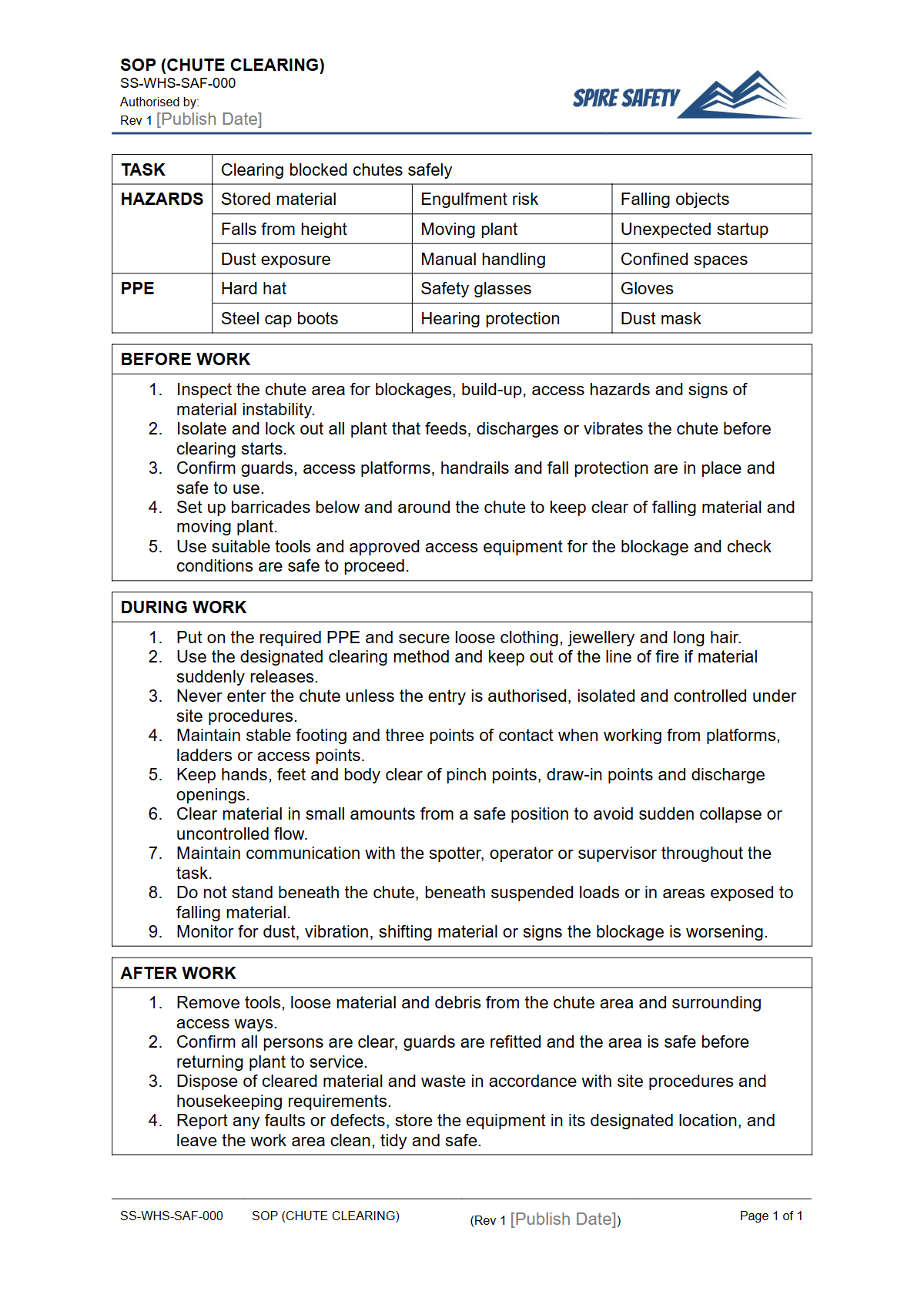
Download our free Safe Operating Procedure (Chute Clearing) Template.
Free Safe Operating Procedure (Chute Clearing) Template
DOCX • 126 KB + PDF
Updated Oct 2026
No signup required
Purpose of the Free Safe Operating Procedure (Chute Clearing) Template
Clearing blocked chutes is a high-risk activity that can expose workers to severe hazards, including crushing, entanglement, and engulfment. This Free Safe Operating Procedure (Chute Clearing) Template provides a structured framework to help you document a safe system of work for this task.
It guides you through outlining the necessary steps, identifying potential hazards, and implementing robust risk controls. Using a formalised SOP is a critical step in managing your work health and safety obligations and protecting your team from harm.
The template is designed as a starting point, aligned with the principles of the Australian model WHS framework. It prompts you to consider essential safety measures such as energy isolation, lockout-tagout (LOTO) procedures, personal protective equipment (PPE) requirements, communication protocols, and emergency response.
Formalising these steps ensures consistency and helps prevent incidents caused by ad-hoc or unsafe clearing methods. Implementing clear procedures is a fundamental part of building effective WHS management systems in any workplace that deals with bulk materials.
Video walkthrough
How to use the Free Safe Operating Procedure (Chute Clearing) Template
This document is a template, not a completed procedure. To use it effectively, you must adapt it to the unique conditions of your workplace.
Download the DOCX file and systematically work through each section, consulting with workers who perform the task. Your procedure must be specific to the type of chute, the material being handled, and the equipment available on site.
Generic procedures are often ineffective and can create a false sense of security.
Important Note: We have provided a foundational structure. It is essential that you customise this template to reflect the specific plant, materials, and environment at your worksite.
You must complete a site-specific risk assessment to ensure all identified hazards and controls are relevant and effective for your operations. For tasks involving different types of heavy machinery, you might also need specific procedures like our FREE Dozer SOP Template.
When to use a Safe Operating Procedure
A Safe Operating Procedure for chute clearing should be used whenever a blockage occurs or is anticipated. It is not a document to be filed away; it is an active tool for safe work execution.
The SOP should form the basis of worker training and competency assessments for this task. It should be readily available at the worksite for reference before and during the job.
Furthermore, the SOP should be a key document in pre-start meetings or toolbox talks when chute clearing is scheduled, ensuring everyone involved understands the risks and agreed controls. The procedure is also a vital reference during incident investigations or regular safety reviews.
Who should use this Safe Operating Procedure
This SOP is intended for use by multiple groups within an organisation. Workers and Operators must be trained in and follow the procedure meticulously to ensure their safety.
Supervisors and Team Leaders are responsible for ensuring the SOP is implemented correctly on the ground, that workers are competent to perform the task, and that all required permits and isolations are in place. Safety Managers and Persons Conducting a Business or Undertaking (PCBUs) should use the template to establish a standardised, safe process and ensure it is integrated into the broader safety management system.
If your organisation struggles to develop and implement these critical documents, engaging professional WHS consulting services can provide expert guidance and support.
Ultimately, a collaborative approach is best. Involving the workers who actually clear the chutes in the development and review of the SOP is crucial for creating a practical and effective procedure.
This consultation process ensures the document is workable and addresses the real-world challenges they face. If the task involves related equipment, you might reference other specific procedures, such as our FREE Scraper SOP (Safe Operating Procedure) Template, to ensure comprehensive safety coverage.
Regularly verifying that these procedures are being followed correctly is just as important as writing them. This can be achieved through workplace inspections and observations.
Conducting periodic WHS compliance auditing helps confirm that your documented procedures match your real-world practices, identifying any gaps before they lead to an incident. If you're looking for more templates to build out your safety system, you can browse our complete free WHS resources library for other useful documents.
Common mistakes
Common mistakes to avoid
- Failing to correctly isolate the plant and all energy sources before starting work.
- Using a generic, non-customised procedure that doesn't match the specific chute or task.
- Workers reaching into chutes or placing themselves in the path of potential material flow.
- Lack of clear communication between the worker clearing the chute and plant operators.
Legal references
Legal considerations
The following legal requirements may be relevant to this type of work.
- Work Health and Safety Act (Harmonised) — Provides the primary duties for protecting workers and other people from work health and safety risks.
- Work Health and Safety Regulations (Harmonised) — Sets out requirements supporting the management of workplace hazards and risks.
The following codes may be relevant to this type of work.
- Managing WHS Risks Code of Practice — Provides practical guidance on identifying hazards, assessing risks and applying effective controls.
- Work Health and Safety Consultation, Cooperation and Coordination Code of Practice — Provides practical guidance on consulting workers and coordinating with other duty holders.
- Managing the Work Environment and Facilities Code of Practice — Provides practical guidance on safe work environments, workplace facilities and related controls.
Did you know
Stored Energy
Many serious injuries during chute clearing occur not from the blockage itself, but from the sudden release of stored energy (gravitational, mechanical, or pressure) once the obstruction is moved.
Hierarchy of Controls
The most effective way to manage chute blockages is to prevent them through design and maintenance (elimination/engineering controls), rather than relying solely on procedures to clear them.
FAQ
Frequently asked questions
01What is a Safe Operating Procedure for chute clearing?
02Is using this template enough for WHS compliance?
03Who should be involved in developing the SOP?
04How often should a chute clearing SOP be reviewed?
Share this resource
Free Safe Operating Procedure (Chute Clearing) Template
Browse Categories
How To Use It
- 1Download and open in Word or PDF.
- 2Replace the placeholders with your business details.
- 3Get it reviewed by a WHS specialist before rollout.
Need it customised?
Our WHS consultants can adapt this template to your site, run a gap analysis, or audit what you already have in place.
Book a Free Consultation WHS consulting servicesor call 1300 156 382
Related templates
- Free Safe Operating Procedure (Cinema Floor Cleaning) Template
- Free Safe Operating Procedure (Cinema Screen Cleaning) Template
- Free Safe Operating Procedure (Cinema Seat Cleaning) Template
- Free Safe Operating Procedure (Cinema Spill Cleanup) Template
- Free Safe Operating Procedure (Circuit Breaker Test) Template
- Free Safe Operating Procedure (Clean Linen Trolley) Template