
Free Safe Operating Procedure (Cinema Spill Cleanup) Template
Download our Free Safe Operating Procedure (Cinema Spill Cleanup) Template. This customisable DOCX & PDF helps manage slip, trip, and fall hazards.
Free Safe Operating Procedure (Cinema Spill Cleanup) Template
DOCX • 126 KB + PDF
Updated Oct 2026
No signup required
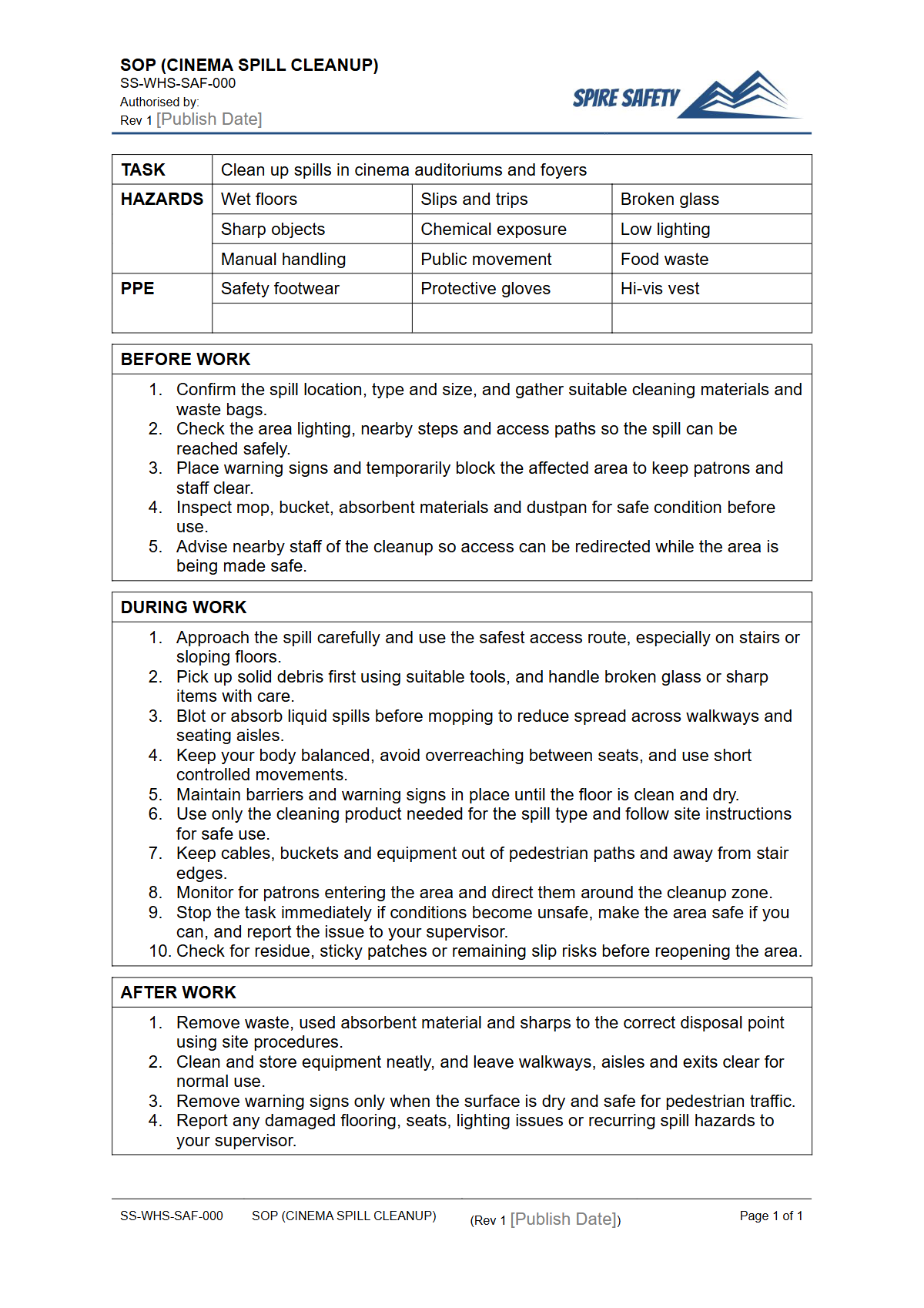
Purpose of the Free Safe Operating Procedure (Cinema Spill Cleanup) Template
Managing spills effectively in a high-traffic environment like a cinema is crucial for preventing injuries to patrons and staff. This Free Safe Operating Procedure (Cinema Spill Cleanup) Template provides a structured starting point for developing a clear, step-by-step process for this common task.
The primary purpose is to control slip, trip, and fall hazards, which are among the most frequent causes of injury in public venues. Using a formal SOP ensures that all spills, from soft drinks and ice cream to cleaning fluids, are handled consistently and safely.
This document is designed to guide your organisation in outlining key safety measures, including isolating the area, selecting appropriate cleaning materials, using correct techniques, and disposing of waste. Formalising this process helps meet your primary duty of care under Australian WHS laws by minimising foreseeable risks.
It also forms a critical part of worker training and induction. For other common but hazardous tasks, a documented process like a Safe Operating Procedure for step ladder use is equally important for maintaining a safe environment.
Video walkthrough
How to use the Free Safe Operating Procedure (Cinema Spill Cleanup) Template
This template is available for download in both DOCX and PDF formats. The DOCX version is fully editable, allowing you to tailor it to the specific conditions of your cinema or venue.
It is essential that you adapt the document to reflect your operational reality, including the specific types of flooring, cleaning chemicals available, and staff responsibilities.
Note: This document is a template and not a complete safety solution. We are not responsible for its application.
You must customise this Safe Operating Procedure by consulting with your workers and assessing the unique hazards at your site. This includes specifying the exact location of spill kits, types of Personal Protective Equipment (PPE) required, emergency contact numbers, and waste disposal protocols.
A generic procedure is not sufficient for compliance.
Integrating this SOP into your safety framework is a key step. Effective safety management relies on documented, repeatable processes that cover all operational risks.
This single SOP should be one component within your broader comprehensive WHS management systems to ensure a holistic approach to workplace safety.
When to use it
This Safe Operating Procedure should be activated immediately whenever a liquid, semi-solid, or greasy substance is spilt in any area accessible to patrons or staff. This includes the cinema foyer, candy bar, hallways, restrooms, and inside the theatres themselves.
Common scenarios include spilt soft drinks, melted butter from popcorn, dropped ice cream, or water tracked in on rainy days. It is also applicable for cleaning-related spills, such as an overturned bucket of mop water.
The procedure should be a default response for all cleaning and front-of-house staff. Having a clear, pre-defined process eliminates guesswork during a potentially disruptive situation, ensuring a fast and safe response.
This is particularly critical in low-light conditions, such as during or between film sessions, where a spill presents an elevated risk. For other emergency situations in a public venue, having a documented process like a Safe Operating Procedure for defibrillator operation can be life-saving.
Who should use it
This SOP is intended for all personnel who may be required to clean a spill. This typically includes ushers, cleaners, and other front-of-house staff.
Supervisors and managers are also key users, as they are responsible for overseeing the implementation of the procedure, ensuring resources like spill kits are stocked, and providing adequate training. No worker should be tasked with cleaning a spill without first being trained on this specific procedure and the safe use of any required cleaning chemicals.
Training records should be maintained to document which employees are competent to perform this task. Periodic refresher training reinforces correct procedures and is a vital part of due diligence.
The effectiveness of your procedures can be verified through regular WHS compliance audits, which help identify gaps in training or execution.
Beyond spill cleanup, many other maintenance and operational tasks within a facility also require documented procedures. For example, our Air Compressor SOP (Safe Operating Procedure) Template can be adapted for maintenance staff who work with such equipment.
You can find more templates like this across our free WHS resources library to build out your safety documentation.
Common mistakes
Common mistakes to avoid
- Failing to immediately cordon off the spill area with signs and barriers.
- Using the wrong cleaning method or chemical for the type of flooring, which can make the surface more slippery.
- Not leaving 'Wet Floor' signs in place until the area is completely dry to the touch.
- Forgetting to restock the spill kit after it has been used, leaving it unready for the next incident.
Legal references
Legal considerations
The following legal requirements may be relevant to this type of work.
- Work Health and Safety Act (Harmonised) — Provides the primary duties for protecting workers and other people from work health and safety risks.
- Work Health and Safety Regulations (Harmonised) — Sets out requirements supporting the management of workplace hazards and risks.
The following codes may be relevant to this type of work.
- Managing WHS Risks Code of Practice — Provides practical guidance on identifying hazards, assessing risks and applying effective controls.
- Work Health and Safety Consultation, Cooperation and Coordination Code of Practice — Provides practical guidance on consulting workers and coordinating with other duty holders.
- Managing the Work Environment and Facilities Code of Practice — Provides practical guidance on safe work environments, workplace facilities and related controls.
Did you know
Slips, Trips, and Falls
According to Safe Work Australia, slips, trips, and falls are the second leading cause of serious workers' compensation claims, with spills and wet surfaces being a primary contributor.
FAQ
Frequently asked questions
01Is this spill cleanup SOP suitable for chemical spills?
02What PPE is required for cleaning spills in a cinema?
03Do I need to train staff on this Safe Operating Procedure?
04How often should I review our Cinema Spill Cleanup SOP?
Share this resource
Free Safe Operating Procedure (Cinema Spill Cleanup) Template
Browse Categories
How To Use It
- 1Download and open in Word or PDF.
- 2Replace the placeholders with your business details.
- 3Get it reviewed by a WHS specialist before rollout.
Need it customised?
Our WHS consultants can adapt this template to your site, run a gap analysis, or audit what you already have in place.
Book a Free Consultation WHS consulting servicesor call 1300 156 382
Related templates
- Free Safe Operating Procedure (Circuit Breaker Test) Template
- Free Safe Operating Procedure (Clean Linen Trolley) Template
- Free Safe Operating Procedure (Clean Load Inspection) Template
- Free Safe Operating Procedure (Clean Utility Room) Template
- Free Safe Operating Procedure (Cleaners Room Cleaning) Template
- Free Safe Operating Procedure (Clegg Hammer) Template