
Free Safe Operating Procedure (Clean Utility Room) Template
Standardise safety in your facility's clean utility areas with our customisable template.
Free Safe Operating Procedure (Clean Utility Room) Template
DOCX • 126 KB + PDF
Updated Oct 2026
No signup required
Purpose of the Free Safe Operating Procedure (Clean Utility Room) Template
A clean utility room is a critical space in many workplaces, from healthcare facilities to laboratories and manufacturing sites. Maintaining its integrity is essential for operational efficiency and safety.
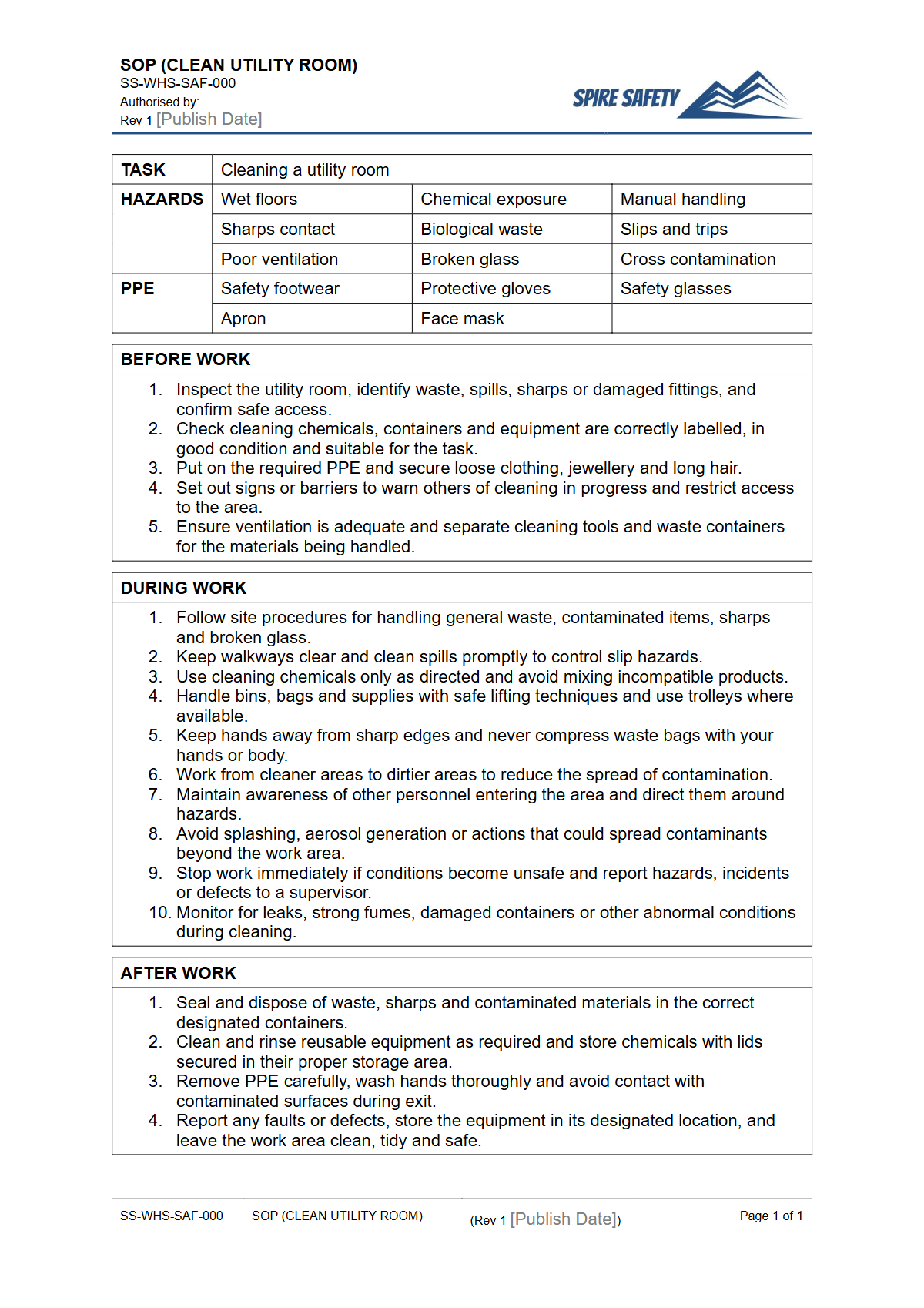
This Free Safe Operating Procedure (Clean Utility Room) Template provides a structured framework for documenting the safe methods required to perform tasks in this environment. It helps organisations standardise practices, minimise risks, and ensure all workers understand their responsibilities.
The core purpose of this Safe Operating Procedure is to identify potential hazards—such as chemical exposure, ergonomic strains, or slips and falls—and outline specific control measures. By formalising these steps, you create a reliable tool for training, supervision, and consistency, forming a key part of your overall safety management system.
Proper documentation demonstrates a commitment to fulfilling your duty of care under Australian WHS legislation.
Video walkthrough
How to use the Free Safe Operating Procedure (Clean Utility Room) Template
This template is provided as a fully editable DOCX file, making it easy to adapt to your specific operational needs. Simply download the document and open it in Microsoft Word or a compatible program.
You will find sections covering PPE, risk controls, step-by-step instructions, and emergency procedures, all aligned with Australian WHS practice.
Important: This document is a template, not a finished procedure. To be effective, you must customise it with the specific details of your workplace.
This includes listing the exact equipment used, the names of chemicals stored, your site-specific emergency contacts, and any unique environmental risks. We strongly recommend conducting a risk assessment on the tasks before finalising the document.
If you require assistance in tailoring safety documents, our general WHS consulting services can provide expert guidance.
Key Elements of a Clean Utility Room SOP
A comprehensive SOP for a clean utility room should cover several key areas to be effective. Our template prompts you to consider:
- Required Personal Protective Equipment (PPE): Specifies the gloves, safety glasses, or other gear needed to perform tasks safely.
- Hazard Identification and Risk Controls: Outlines potential dangers (e.g., chemical handling, manual tasks) and the measures in place to mitigate them.
- Step-by-Step Operating Sequence: Details the logical flow of work, from pre-start checks to task completion and clean-up, ensuring consistency. This includes tasks like restocking shelves, which may require a Safe Operating Procedure for step ladder use.
- Waste Management: Defines the correct procedures for disposing of general, chemical, or clinical waste.
- Emergency Procedures: Clearly states the actions to take in case of a chemical spill, injury, or fire. If the room contains a first aid station, you might also reference a separate Safe Operating Procedure for Defibrillator Operation.
When to use this Safe Operating Procedure
An SOP is a dynamic document used throughout the employment lifecycle. It is an essential tool for inducting new employees, providing them with a clear, authoritative source on how to work safely in the clean utility room from day one.
It also serves as a benchmark for ongoing competency, used in refresher training sessions to reinforce correct procedures and introduce any updates.
Beyond training, the SOP should be a readily accessible reference for workers during their daily tasks. It also becomes a critical piece of evidence during safety inspections and audits, demonstrating that your organisation has formalised its processes for managing risk.
Regular WHS compliance auditing can help verify that the procedures documented in the SOP are being followed correctly in practice.
Who should use this SOP
This Safe Operating Procedure is intended for a broad audience within an organisation. Primarily, it is for any worker, contractor, or visitor whose role requires them to enter or perform tasks within the clean utility room.
They must be trained on its contents and have access to it at all times.
Supervisors and managers are responsible for implementing the SOP, ensuring staff are trained, and monitoring compliance. Furthermore, WHS managers and advisors will use the template as a foundational document when building out and reviewing the organisation's broader WHS management systems. Effective implementation requires buy-in and participation from all levels of the organisation.
By establishing clear and safe work methods, this template helps you protect your people and streamline your operations. For more templates and safety guides, you can explore our complete free WHS resources library.
Common mistakes
Common mistakes to avoid
- Failing to customise the template with site-specific details, equipment, and chemicals.
- Neglecting to train all relevant staff on the final, approved procedure.
- Storing the SOP in an inaccessible location instead of near the point of work.
- Forgetting to include procedures for managing chemical spills or first aid response.
Legal references
Legal considerations
The following legal requirements may be relevant to this type of work.
- Work Health and Safety Act (Harmonised) — Provides the primary duties for protecting workers and other people from work health and safety risks.
- Work Health and Safety Regulations (Harmonised) — Sets out requirements supporting the management of workplace hazards and risks.
The following codes may be relevant to this type of work.
- Managing WHS Risks Code of Practice — Provides practical guidance on identifying hazards, assessing risks and applying effective controls.
- Work Health and Safety Consultation, Cooperation and Coordination Code of Practice — Provides practical guidance on consulting workers and coordinating with other duty holders.
- Managing the Work Environment and Facilities Code of Practice — Provides practical guidance on safe work environments, workplace facilities and related controls.
Did you know
Cross-Contamination Risk
In healthcare settings, separating clean and soiled utility functions is critical. A well-defined workflow, outlined in an SOP, is a key defence against healthcare-associated infections (HAIs).
Slips, Trips & Falls
Slips, trips, and falls are a leading cause of workplace injury in Australia. Clean utility rooms, with frequent floor cleaning and potential for minor spills, are common hotspots that require specific controls in your SOP.
FAQ
Frequently asked questions
01What are the main hazards in a clean utility room?
02How often should we review our clean utility room SOP?
03Is a written SOP mandatory for a clean utility room?
04What is the difference between a clean and soiled utility room?
Share this resource
Free Safe Operating Procedure (Clean Utility Room) Template
Browse Categories
How To Use It
- 1Download and open in Word or PDF.
- 2Replace the placeholders with your business details.
- 3Get it reviewed by a WHS specialist before rollout.
Need it customised?
Our WHS consultants can adapt this template to your site, run a gap analysis, or audit what you already have in place.
Book a Free Consultation WHS consulting servicesor call 1300 156 382
Related templates
- Free Safe Operating Procedure (Cleaners Room Cleaning) Template
- Free Safe Operating Procedure (Clegg Hammer) Template
- Free Safe Operating Procedure (Clinic Couch Cleaning) Template
- Free Safe Operating Procedure (Clinical Waste Handling) Template
- Free Safe Operating Procedure (Cloth Spreader) Template
- Free Safe Operating Procedure (Clothing Aid Cleaning) Template