
Free Safe Operating Procedure (Clinical Waste Handling) Template
Download our free Safe Operating Procedure for clinical waste handling.
Free Safe Operating Procedure (Clinical Waste Handling) Template
DOCX • 126 KB + PDF
Updated Oct 2026
No signup required
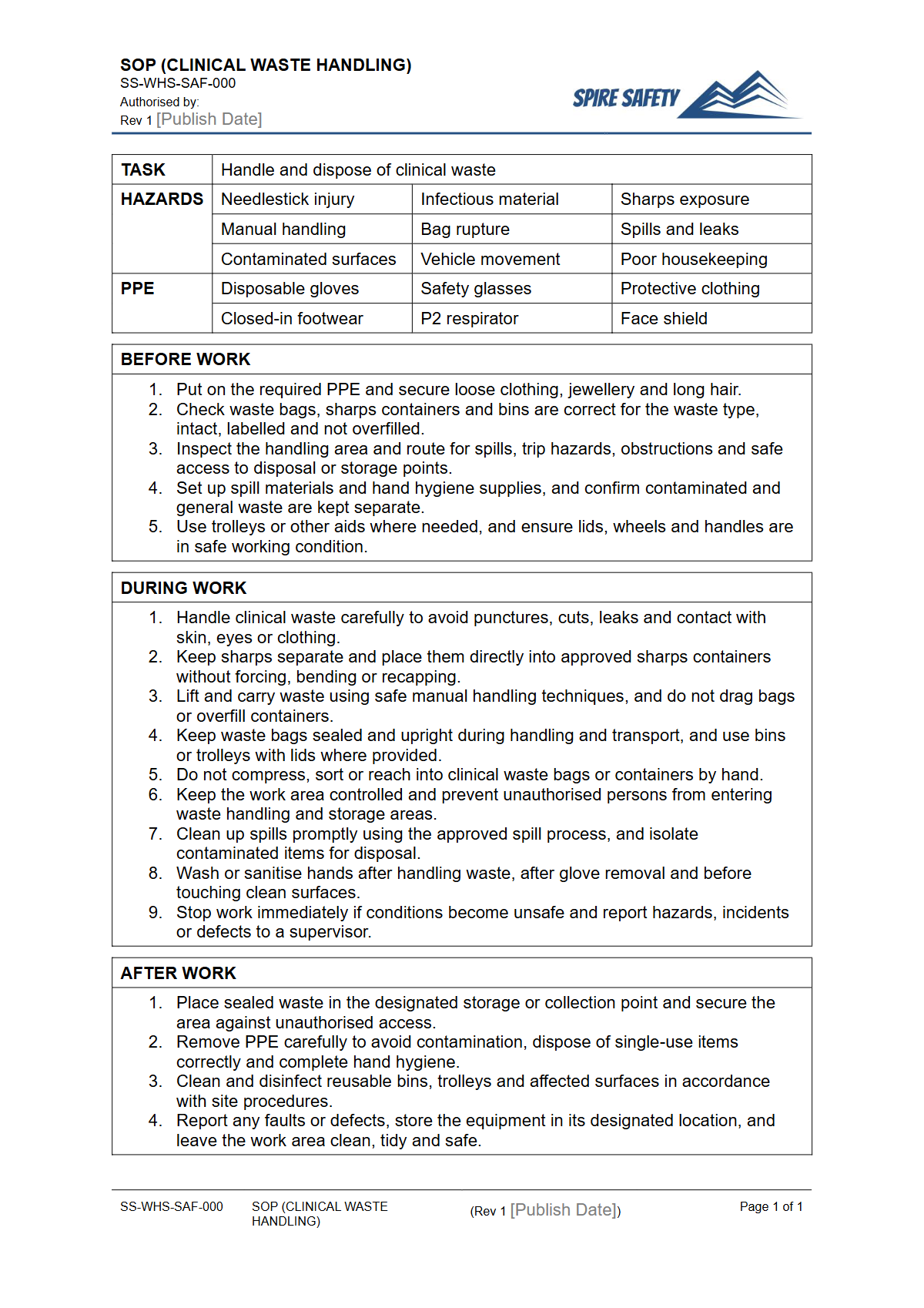
Purpose of the Free Safe Operating Procedure (Clinical Waste Handling) Template
Managing clinical and related waste is a critical task in many Australian workplaces, from medical clinics and hospitals to veterinary practices and laboratories. This Free Safe Operating Procedure (Clinical Waste Handling) Template provides a structured starting point for developing a documented process to control the significant health and safety risks involved.
Handling materials contaminated with blood, body fluids, or other potentially infectious substances exposes workers to hazards like sharps injuries, infection from blood-borne pathogens, and chemical exposure.
A documented SOP is a fundamental control measure that outlines the step-by-step process for performing a task safely. This template is designed to be adapted into a workplace-specific procedure covering waste segregation, containment, labelling, storage, and preparation for transport.
Integrating this procedure into your broader safety framework is essential for protecting your workers and ensuring risks are managed effectively. It forms a key component of comprehensive WHS management systems, demonstrating a proactive approach to hazard control.
Video walkthrough
How to use the Free Safe Operating Procedure (Clinical Waste Handling) Template
This document is a template, not a finished procedure. To use it effectively, download the DOCX file and systematically customise it to reflect the specific circumstances of your workplace.
Your procedure must account for the types of clinical waste you generate, the specific containers and equipment you use (e.g., sharps containers, wheelie bins, autoclaves), your facility layout, and your state or territory's unique environmental and health regulations.
Important: You must customise this template to suit your specific workplace. We are not responsible for your WHS compliance; this document is a starting point, and you are responsible for ensuring the final procedure is safe and relevant to your operations.
A thorough WHS compliance audit can help identify specific regulatory requirements and operational hazards that your customised SOP must address.
Key Components of this Safe Operating Procedure
When customising the template, pay close attention to the following critical sections to ensure your final document is robust and practical for your team.
- Waste Segregation: Detail the specific colour-coded bins and bags used in your facility (e.g., yellow for clinical waste, purple for cytotoxic waste, red for anatomical waste). Clearly define what goes into each stream to prevent cross-contamination.
- Personal Protective Equipment (PPE): List the mandatory PPE required for handling clinical waste. This typically includes heavy-duty gloves, safety glasses or face shields, fluid-resistant gowns or aprons, and enclosed footwear.
- Spill Management: Outline the step-by-step emergency procedure for managing a clinical waste spill. This should include securing the area, using a designated spill kit, decontamination procedures, and reporting requirements.
- Sharps Handling: Provide explicit instructions for the handling and disposal of all sharps. This includes never recapping needles, ensuring sharps containers are correctly assembled and labelled, and never filling them beyond the designated fill line.
When to use it
A Safe Operating Procedure for clinical waste handling should be used as a primary reference document for all personnel involved in the task. It is essential for:
- Induction and Training: Use the SOP to train new employees on the correct, safe methods for handling waste before they begin work.
- Refresher Training: Incorporate the SOP into regular refresher training sessions to reinforce safe behaviour and communicate any procedural updates.
- Daily Operations: Workers should have easy access to the SOP as a guide for performing their duties correctly every time.
- Incident Investigation: Following an incident or near-miss, the SOP should be reviewed to determine if the procedure was followed and if it needs to be updated to prevent a recurrence.
This procedure is a core health and safety document, much like a Safe Operating Procedure for defibrillator operation is for emergency first aid response.
Who should use it
This SOP is intended for all persons whose work involves generating or handling clinical and related wastes. This includes a wide range of roles:
- Doctors, nurses, dentists, and allied health professionals
- Veterinarians and veterinary nurses
- Laboratory and pathology staff
- Cleaners and environmental services staff
- Practice managers and facility administrators
- Waste management contractors
Furthermore, WHS managers, supervisors, and Persons Conducting a Business or Undertaking (PCBUs) should use this template to fulfil their duty of care by establishing and maintaining a safe system of work. If you require assistance tailoring safety documents to your specific operational needs, consider engaging professional WHS consulting services. You can also explore our free WHS resources library for other useful templates and guides.
Common mistakes
Common mistakes to avoid
- Improper segregation of waste at the point of generation, leading to costly disposal or contamination risks.
- Overfilling sharps containers or waste bags, creating a high risk of spills and puncture injuries.
- Using incorrect, damaged, or unlabelled containers for waste collection and storage.
- Failing to provide adequate training and PPE to all staff who may come into contact with clinical waste, including cleaners.
Legal references
Legal considerations
The following legal requirements may be relevant to this type of work.
- Work Health and Safety Act (Harmonised) — Provides the primary duties for protecting workers and other people from work health and safety risks.
- Work Health and Safety Regulations (Harmonised) — Sets out requirements supporting the management of workplace hazards and risks.
The following codes may be relevant to this type of work.
- Managing WHS Risks Code of Practice — Provides practical guidance on identifying hazards, assessing risks and applying effective controls.
- Work Health and Safety Consultation, Cooperation and Coordination Code of Practice — Provides practical guidance on consulting workers and coordinating with other duty holders.
- Managing the Work Environment and Facilities Code of Practice — Provides practical guidance on safe work environments, workplace facilities and related controls.
Did you know
A Significant Risk
Needlestick and other sharps injuries are a leading cause of occupational exposure to blood-borne viruses like Hepatitis B, Hepatitis C, and HIV among healthcare workers.
Regulation Varies
While national guidelines exist, each Australian state and territory has its own Environmental Protection Authority (EPA) with specific rules for the classification, storage, transport, and disposal of clinical waste.
FAQ
Frequently asked questions
01What is considered clinical waste in Australia?
02What PPE is required for handling clinical waste?
03How should sharps be disposed of?
04Can this SOP template be used in any Australian state or territory?
Share this resource
Free Safe Operating Procedure (Clinical Waste Handling) Template
Browse Categories
How To Use It
- 1Download and open in Word or PDF.
- 2Replace the placeholders with your business details.
- 3Get it reviewed by a WHS specialist before rollout.
Need it customised?
Our WHS consultants can adapt this template to your site, run a gap analysis, or audit what you already have in place.
Book a Free Consultation WHS consulting servicesor call 1300 156 382
Related templates
- Free Safe Operating Procedure (Cloth Spreader) Template
- Free Safe Operating Procedure (Clothing Aid Cleaning) Template
- Free Safe Operating Procedure (Clothing Rack Handling) Template
- Free Safe Operating Procedure (Club Change Room Clean) Template
- Free Safe Operating Procedure (Club Equipment Cleaning) Template
- Free Safe Operating Procedure (CNG Refuelling) Template